
Monday, January 12, 2009

Forgetting Myself


"In art the self becomes self-forgetful" - Flannery O'Connor

When I graduated from college as a philosophy major, I found myself, by a process too complex and frankly weird to explain right now, as a Teacher Corps intern in Hawaii. Teacher Corps was one of Lyndon Johnson's Great Society programs, and under its auspices I was working as an elementary school teacher while simultaneously getting my master's degree in education from the University of Hawaii. The best course that I wound up taking in that program, and in many ways the best course I have ever taken at any time, was an elementary arts methods course taught by Dr. Alex Pickens.

None of the people in my class were artists, and none of us were really yet educators. But the course was driven by the assumption that some of us might find ourselves asked to teach art in an elementary classroom, and so Dr. Pickens walked us through a series of units on printmaking, on clay, on making papier mache masks, on guache painting using pigments made from different colors of earth, and so on. His method, which I was only later to discover was the method at the heart of all good teaching, was to break each unit down into constituent parts that were essentially impossible to screw up too badly, even for a bunch of artistic zeroes like ourselves. For example our first clay assignment was to roll out the clay with a rolling pin, cut the rolled clay into a tile shape, and then create light and shadow on the surface of the tile by pressing on it with our fingers. Well, hey, even I could do that. From there he went to showing us how to pound out air bubbles so our pieces would not explode in the kiln, and how to use slip (a mixture of clay and water) to join pieces of clay together. One of our first "major" assignments was, using what we had learned to this point, to make a three dimensional piece which would not explode in the kiln. Well, it turned out I could do that too. Several classes later, when he came in, gave us each a hunk of clay,  and told us to make a human figure, I was by that time confident enough to figure that if he thought we were ready, we must be ready, so I set to work.

What happened next was something of a mystery to me. I lost all track of time. I lost all sense of where I was. I became totally absorbed in the figure I was making. When I finally finished the piece, every one was gone. The two-hour class had ended an hour ago. Dr. Pickens was in the back room cleaning up, and probably because he was too polite a man to tell me to put away my work and go home, already. But I'll tell you what, that human figure was the first piece of artwork I ever completed that was clearly beyond my capabilities and expectations. It was a sort of gift. It was given to me to make that piece. I have it on the shelf in my office to this day.

The reason I bring this up: for reasons that I am not quite sure I understand, I've found myself having the impulse to paint. We happened to have some acrylics and some brushes lying around from when my son was in high school, and I was reading The Gift which got me thinking about art again, and I'd been spending some time in the local galleries, and the next thing I knew I was down at the art store laying in supplies and slapping paint on canvas.

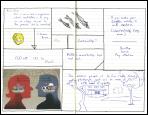
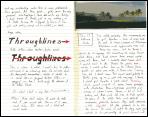
I don't have any pretensions. I don't really have any idea what I'm doing. I'm just fooling around, trying to figure out what I need to learn as I go along. I didn't start out to do a sequence of collages, but that, it turns out, is what I have done, perhaps because I don't have the drawing skill yet to simply start cranking out landscapes. But I have a friend who does really interesting collages, and so as I began to work on the surface of the canvas I guess I was primed to start thinking about what else might go on there besides the paint. The first one was the odd-looking thing in the previous post, and the next two are reproduced at the top and bottom of this one.

I'm noticing three things. First of all, it's a hell of a lot of fun. I find myself thinking about what I'm going to do next while I'm doing other things, like eating lunch or walking to meetings at work. Second, I find myself seeing everything differently. I was having a conversation with Susie Anderson at Gallery at Ward Center the other day and she was describing how not long after getting back into painting after a number of years in which she hadn't painted, she was driving in her car on a wet street and suddenly she could see the colors again. I don't think I can see them yet, but I am definitely seeing everything in sharper focus. I remember back when I was living in Massachusetts and working during the summers by helping a close friend who was a carpenter with various remodeling jobs. I remember that if we had been doing siding, suddenly every house I passed I was noticing the siding. It's been a little like that the last week or so. I'm noticing more about what's in front of my face. Third, I'm amazed at how time just melts away when I'm working on something that interests me. Tonight I started at 5:30 and it was close to eight when I finished up, and the only reason I even stopped was that I had promised myself to get out to the gym tonight.

So that's where I am tonight, at the intersection of art and writing and education, waiting to see what comes next.


Thursday, January 8, 2009

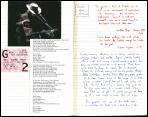
Biograph


Biograph

I. The Gathering

First color, in its groundedness, this one and that, tones
in tune, then text, howl gargle gargle howl, spun into what
might be sky. Then gauze to billow in counterpoint, fishnet
frieze. The choir, waiting for their cue. Stela, and a nickel
moon over lava flats. Such blood, such fire. Hot glue. Titanium
clumps drift like clouds, whitecaps: one, two, three, four, five.

II. The Gift

Somebody's life story, maybe mine. Elements in aggregate.
Sopranos seem innocent enough, but we know, they know,
it's only a matter of time. First encounters matter, because
now we have a story (I have a poem). They don't make
stencils like they used to, which raises more questions,
not that anyone cares. Thrice again to make up nine. Peace.

Sunday, January 4, 2009

On Education (Four): Process


I recently got back from visiting my son and his family in Bermuda. While I was there I was asked to meet the board of trustees and some of the parents of one of the Bermuda elementary schools, who wanted to know how I felt about competency testing in general and NCLB in particular. As I considered what I might want to say about that issue, I found myself working backward toward more the centrally held philosophical principles which have informed my ideas about education even from the start of my career and continue to do so today. One of those philosophical principles is the Taoist concept of wu-wei, which translates roughly as "non-action," or sometimes "emptiness." The student, or the sage, or the teacher, who wishes to be in harmony with the Tao must first learn that there are times when it is best to do nothing, so that the Tao can take its course. I think the same is true, to some degree, in the classroom. One of my early mentors, the writer and writing teacher Donald Murray, used to say  "I try to underteach so my students can overlearn." He saw it as his job to create an environment in his classroom which gave students room to explore on their own. His motto as a teacher might well have been, "Don't just do something. Stand there."

I've argued in previous posts for the value of creating classroom environments which are 1) process-oriented, 2) project-based, and 3) student-centered. My lament about standards-based education, as it is generally being implemented, is that it is none of these things. The stakes are too high. If I am a teacher and I know that I have 90 hours in a semester with a particular class, and that the students' success, and my own, is going to be evaluated primarily on the basis of a content-based test, that pushes everything else they, or I, might want to do right off the table. We can't take time to talk about and restructure our processes. We can't afford to "waste time" on projects that may or may not be relevant to what's going to be on the test. What individual students might choose to do or not to do to demonstrate what they are learning or have learned is not up for negotiation.

Don't get me wrong, I'm not opposed to assessment, and I'm not opposed to direct instruction when direct instruction is called for. The image I am carrying in my head for the "balance" that I spoke about in my last post is that of an accordian player. There's a dual dynamic in accordian playing: in and out; opening up and closing down. A well-designed instructional program should have, in my judgement, a similar dynamic: spaces for exploration (opening up), other spaces for direct instruction in skills or content related to that exploration (closing down). Then opening up again, and so on.

I've just finished reading Lewis Hyde's The Gift, (referenced in a previous post ) which is one of the most thoughtful and erudite - and beautifully written - books of our era. It's primary area of exporation has to do with the differences between gift-based cultures and commodity-based cultures. (Digression: one of his side points has to do with why it is that practioners in gift-oriented professions — like teaching — are not paid well within a commodity-oriented culture. He says, for example, "...there are labors that do not pay because they, or the ends to which they are directed, require built-in constraints on profiteering, exploitation, and — more subtly — the application of comparative value with which the market is by nature at ease." (138) But that's a discussion for another post, perhaps.)

Anyway, at one point in the book, during his analysis of the thinking and writing of Ezra Pound, he winds up talking about the role of willpower in the artistic endeavor:

There are at least two phases in the completion of a work of art, one in which the will is suspended and another in which it is active. The suspension is primary. It is when the will is slack that we feel moved or we are struck by an event, intuition, or image. The materia must begin to flow before it can be worked... (289)

That strikes me as being true to my own experience as a writer, and, more to the point, to my experience as a teacher. First we must find the materia. That is a process that is not fostered by, and is often actually inhibited by, the imposition of willpower. The materia must make its own appearance. Once it has appeared, or arisen, or arrived, then the will — and the critical facilities responsible for shaping and sequencing and re-presenting the materia — can take over.

Earlier in the book, talking about Whitman, Hyde says that the process of creation can be compared to the in and out movement of the breath itself:

These gestures — the inhalation and the exhalation, the reception and the bestowal — are the structuring elements of the poem, the passive and active phases of the gifted state... In sympathy, the poet receives (inhales, absorbs) the embodied presences of creation into the self; in pride, he asserts (exhales, emanates) his being out toward others. As with any respiration, this activity keeps him alive... (222-3)

As with any respiration, this activity keeps him alive. In like manner, a classroom which provides room for students to breathe, which allows them both to absorb and to emanate, provides a context not just for respiration but for inspiration.

What we are talking about here, of course, is process. I have not said a word about content here, about what subject we might be teaching or what is going to be on the final assessment. I'm trying to articulate the process dynamics that make sense to me as a teacher. And I'd like to spell out the implication of all this, which is that while it is all and good that I as a writer and you as a reader, presumably interested in education, if you've read this far, might be able to discuss our process intuitions and concerns deep into the night, it is not enough. It's not enough unless the students learn to think about process issues as well. It's easy enough for us as teachers to set up our classrooms in such a way that all the students need to do is jump through a given set of hoops. But if we set up our classrooms that way, how will the students ever learn how to manage — and to measure — their own thinking, their own learning, their own progress? Imagine a class - any subject, it doesn't matter - in which students are given the opportunity (and, yes, the time, the time, the time) to ask themselves "What have we done? Where are we now? What's are the options at this point? Where are we trying to get to? How might we get there? And, once we get there, how will we be able to document the process?

That's what I'm talkin' about.


Monday, December 15, 2008

On Education (Three): The Balance


Last week we had a visiting speaker on campus who did a series of presentations on creative thinking and entrepreneurship. One of the slides that she used with the teachers made reference to "building t-shaped people." It's a phrase that has apparently been around in the design industry for some years. Here's Tim Brown's explanation:


We look for people who are so inquisitive about the world that
they're willing to try to do what you do. We call them "T-shaped people." They have a principal skill that describes the vertical leg of the T -- they're mechanical engineers or industrial designers. But they are so empathetic that they can branch out into other skills, such as anthropology, and do them as well. They are able to explore insights from many different perspectives and recognize patterns of behavior that point to a universal human need. That's what you're after at this point — patterns that yield ideas.


I hadn't heard the phrase before, but it kept reverberating in my head as I went through the rest of the week. On Wednesday, I was asked to meet with the new teachers group at my school, and at the very start of the meeting one of the teachers asked what I think is probably one of the core essential questions that has to do with lesson planning and design, which was basically, "How do I find the balance providing time for my students room to explore and be innovative and engage in projects, and also providing time for them to study and master the core course content."

Well, it's exactly the right question to be asking. Students do need to learn core skills; they need to have some degree of "Depth of knowledge in a technical discipline." So there are times when as a teacher when you need to hone in on those skills: how to diagram a sentence, how to solve a quadratic equation, how to do html coding. On the other hand, if they are ever going to develop the broad spectrum of "21st century skills" that everyone keeps talking about, they are going to need time and space to try things out on their own, learn how to question and to collaborate and to brainstorm and to consider possible solutions and to devise plans and to put them into action and to evaluate the results. All of which takes time. And there's never enough time.

The good news is that it's not an either/or proposition. It's certainly possible to design a sequence of project-based, collaborative activities that have the beneficial side effect of helping students to learn content-area skills. That's the ongoing challenge: to come up with elegant, effectively-designed activity sequences that build both content skills and process skills. That also takes time, in the preparation, but it pays off in terms of efficiencies in class.

Sometimes you can't do it. Sometimes you have to say to your students, "You know what, the most efficient way for me to deliver this material to you is for me to talk and you to listen and ask questions. And there's going to be a test tomorrow that will help us both assess whether or not you've understood what I've been teaching you as well as you think you do."

But that's a mode of teaching, and a mode of learning, that I would prefer, if possible, to avoid. Students who are subjected to that particular teaching methodology most of the time will never develop the "breadth of knowledge about entrepreneurship and leadership," because there's nothing for them to do, in that environment, which is remotely entrepreneurial or innovative. The irony is that they're not going to wind up with a depth of knowledge either. I'm fond of B.F. Skinner's formulation that "Education is what's left over after you've forgotten what you've learned." And what my own experience of school has taught me is that you're going to forget pretty much everything that you haven't worked on yourself. I had a lot of well-meaning teachers who tried their best to stuff my head full of what they thought was useful information. But what I remember, what's left over, if you will, has little to do with what they taught me and a lot to do with who they were and what it felt like to be involved in a process that was thought-provoking and challenging and significant.

So that's why I think we have to keep the balance, keep weighing the alternatives: content skills vs process skills, individual work vs collaborative work, teacher-directed activities vs student-designed activities. One of my mentors when I was first teaching high school some 25 years ago had a resource book that he asked me to read called Freedom and Discipline in English. There's that balance once again. You need one; you need the other.

Sunday, November 30, 2008

On Education: Two (Education by Poetry)


I haven’t been in the classroom since June, so I was happy to take up Eliza’s offer to come into her Am Lit Nature classes and walk her students through a short introduction to Robert Frost.

Frost is one of our most misread and misunderstood poets. When I was in school I was given to understand that Frost was a nature poet, a pastoral poet, a genial and benevolent figure in the world of American letters. His most iconic poems, like “Stopping by Woods on a Snowy Evening” and “The Road Not Taken,” were interpreted by my classmates and teachers in ways that I later came to realize stripped them of their complexity, their equivocation, their essential darkness. Part of this was, of course, Frost’s fault. He cultivated the public persona of the grandfatherly presence, the crusty New England sage, the repository of genial wisdom, even as his battle with his many private demons were generating some of his greatest poems.

Another of my colleagues, when he found out that I was going to be talking with students about Frost, remarked, “I’ve never quite trusted Frost.” And that’s a good thing, I think. Frost is not a trustworthy character. He’s a shapeshifter, a ventriloquist, a writer who by his own admission is mostly interested in indirection, or what, in another context, might very well be called lies.

I remember reading Lawrence Thompson’s biography of Frost well after I had graduated from college and being stunned by the amount of pain that Frost had experienced, and generated in the lives of those around him. Grandfather, it turns out, was not a nice guy. As with most writers and artists, his poetry represents the best of him. It represents his iron-willed determination to master, to control, to get right on the page what he could could not master or control or get right in his life. I suspect that that is one reason why he chose to set so many of his poems in the world of nature. As an object of contemplation, a tree, a field, or a snowdrift is, first and foremost, exactly what it is, and there is a kind of purity, a clarity, in that. But for Frost, that essential simplicity rarely stays simple for long. He may be looking at a tree, or talking about a walk in the woods, but he’s always thinking hard about something else. This is, as he himself points out, his characteristic move as a poet, and, for that matter, a move he claims for all poetry:

Poetry provides the one permissible way of saying one thing and meaning another. People say, “Why don’t you say what you mean?” We never do that, do we, being all of us too much poets. We like to talk in parables and in hints and in indirections — whether from diffidence or some other instinct.


That remark is from an essay called “Education by Poetry.” It’s the edited transcript of a talk he gave at Amherst College in 1931, and in it he makes a number of arguments, the most interesting of which, following up on the line of thought he begins above, had to do with the essential value of metaphor as a tool — Frost argues that it is the tool — for thinking. His clearest and most dramatic statement of that point comes about midway through the essay, when he says:


We still ask boys in college to think…but we seldom tell them what thinking means; we seldom tell them it is just putting this and that together; it is just saying one thing in terms of another. To tell them is to set their feet on the first rung of a ladder the top of which sticks through the sky.


It’s a nice formulation, especially in the way that he uses an elegant and illustrative metaphor to clinch his point about the power of elegant and illustrative metaphors. Of course, he’s being reductive. He’s telling lies again. There are other modes of thought than the analogical. Frost knows that. But he expects us, as educated readers, to know it as well, and to take his metaphor as what it is, a means of making a point. As he says, in the same essay:

unless you are at home in the metaphor, unless you have had your proper poetical education in the metaphor, you are not safe anywhere . Because you are not at ease with figurative values: you don’t know the metaphor in its strength and its weakness. You don’t know how far you may expect to ride it and when it may break down with you. You are not safe with science; you are not safe in history…


To the degree that it is true that all thinking is metaphor, it behooves us to recognize both its power and its limitations. And, to Frost’s way of thinking, is the educative value of poetry: it teaches us how to navigate the landscape of metaphor, which is everywhere around us, and all too often invisible.

Thursday, November 20, 2008

On Education: One


I’ve been out of the classroom now for five months. I’m still involved in education, as a curriculum supervisor, administrator, and all-purpose utility player, but it’s still a little weird for me to wake up, after 39 years of being a classroom teacher, and begin my day knowing that I’m NOT going to be interacting with a group of students somewhere during the day. I’m driving forward, and the territory ahead looks broad and formidable and worthy of my complete attention, but I do tend to keep glancing back in the rear view mirror, watching my teaching career become smaller and more distant. So I thought that over the next couple of posts I’d try to string together some words that might capture some fraction of what I feel to be true to my experience as a teacher and my sense of what is at stake in the classroom. I’m going to try consciously to avoid going after this in a pre-planned or pre-programmed way. If I were to attempt to frame a Grand Theory of Everything Educational, I’d either be too daunted to start, or too likely to get bogged down in Chapter 74, if not in Chapter 2. Instead, I’m going to set my sights lower. I just want to write a paragraph or two each day about something that seems true to me. If I get lucky, maybe on some days I’ll hit on an idea that will sustain me in a more elaborated disquisition. I’m fully aware that some of what I am going to wind up writing will probably be predictable and ultimately un-enlightening. But hey, ya gotta start somewhere.

One.

Today a former student dropped by my office and we got to talking about his college applications and about his possible majors and about what he might expect to happen once he gets to college. I told him the story about what happened when my oldest son was accepted to college, and we got a letter from the school congratulating us on his acceptance, but cautioning us not to make the assumption, as proud parents, that our plans for him, or his plans for himself, would now be realized. The average student at that school, it was pointed out, changes his major at least four times. And, in point of fact, that turned out to be literally true in my son’s case. The field he eventually got a degree in, economics, was a field he hadn’t even considered when he was thinking about college. He had thought he wanted to be an engineer. He only wound up majoring in econ because there was a core course in macroeconomics that he was required to take, and it so happened that the course lit him up and his professor wound up taking an interest in him that opened some doors that at the start of school he had not even known were there.

So what’s the point? The point, to bend an old axiom, might be stated as “Education is what happens when you’re making other plans.” As a student, you need to be open to the possibility that where you thought you were going is not where you wind up, and that that is, in fact, a very good thing. (It’s a lot like writing, actually. For years I have told my students that if you start out knowing what you want to write and you write it and it comes out exactly the way you planned, you’ve probably got a mediocre piece of writing on your hands. The trick is to surprise yourself, to write your way into what you don’t know. The testimony of writers is surprisingly consistent on this. Robert Frost: “No surprise for the writer, no surprise for the reader.” Donald Barthelme: “The writer is one who, embarking upon a task, does not know what to do.” E.L Doctorow: “Writing is an exploration. You start from nothing and learn as you go. ... Writing is like driving at night in the fog. You can only see as far as your headlights, but you can make the whole trip that way.” Andre Dubus: “I don't know what characters are going to do. I have to work to discover the character, and I do that by becoming the character and experiencing that life. If I say that I know exactly what a character is going to do, then I've killed that character. The character has to surprise you, the way you should have a sincere conversation, not a rehearsed one. If you plan everything, it isn't a conversation.” And so on and so on and so on.)

This element of indeterminacy and unpredictability seems to me to be at the heart what makes for an interesting classroom. It’s at the heart of the problem I have always had with content-based courses and competency-based assessments that assume that everyone needs to do and learn the same things. It’s not that content isn’t important or that basic skills are not basic. It’s just that, ultimately, they're not that interesting; they're not what I value most as a learner or as a teacher. What I value, and what I hope I have found ways to help students to value and understand, is the search, the exploration, the element of surprise.

Monday, November 17, 2008

Gaudeamus Igitur


Throughlines
is two years old today. I'll mark the occasion with this passage from Orhan Pamuk, whose essay "How I Got Rid of Some of My Books" appears in Other Colors, one of the books in my current rotation:

A writer's progress will depend on a large degree on having read good books. But to read well is not to pass one's eyes and one's mind slowly and carefully over a text: it is to immerse oneself utterly in its soul. This is why we fall in love with only a few books in a lifetime. Even the most finely honed personal library is made up of a number of books that are all in competition with one another. The jealousies among these books endows the creative writer with a certain gloom. Flaubert was right to say that if a man were to read ten books with sufficient care, he would become a sage.


There are a lot of books jostling for position on my list, but if I were confronted by the candidates in an array, I suspect I would reach first for Cormac's McCarthy's All the Pretty Horses. And you?

Sunday, November 16, 2008

Inspired


There’s a fascinating article in this week's Sunday N.Y. Times magazine about poet and essayist Lewis Hyde, whom I had never heard of, despite the fact that he’s regarded as one of the most “illuminating, transformative, and completely original” writers of our age. The article was enough to get me out to the bookstore last night to find a copy of Hyde’s extended essay on Creativity and the Artist in the Modern World, entitled The Gift. It’s been a while since I have been as blown away by a book as I have been by this one. I’ve been reading with a highlighter and colored pens in my hand, and though I’ve only read 60 pages or so since last night, the book is already becoming well worn.

The other day I put together a post reflecting on elegance as a criterion for evaluating creativity. In his introduction to The Gift, Hyde suggests another, one suggested by the word inspiration, the etymology of which is from the Latin “spiro,” to breathe. Thus to breathe in, or, as Hyde puts it, quoting Lawrence, to have something breathed into oneself, “the wind that blows through me”:


As the artist works, some portion of his creation is bestowed upon him. An idea pops into his head, a tune begins to play, a phrase comes to mind, a color falls in place on the canvas. Usually, in fact, the artist does not find himself engaged or exhilarated by the work, not does it seem authentic, until this gratuitous element has appeared, so that along with any true creation comes the uncanny sense that "I," the artist, did not make the work. "Not I, not I, but the wind that blows through me," says D.H. Lawrence. Not all artists emphasize the "gift" phase of their creations to the degree that Lawrence does, but all artists feel it.

Saturday, November 15, 2008

Doing the Math


Jason Zengerle has an interesting profile of Malcom Gladwell in the New York Magazine Books Section. (Gladwell has a new book, Outliers, arriving in a bookstore near you on Monday.) In the course of the profile, Zengerle mentioned something from the book that has been rattling around in my head this morning:

Gladwell cites a body of research finding that the “magic number for true expertise” is 10,000 hours of practice. “Practice isn’t the thing you do once you’re good,” Gladwell writes. “It’s the thing you do that makes you good.”


Ten thousand hours. That’s a daunting statistic, but it’s also a hopeful one. I’ve been breaking it down in various ways in my head this morning. Some examples:

In the context of a nine-to-five job, it’s five years. (40 hours a week times 50 weeks = 2000 hours a year.) Intuitively, that makes some sense to me. I’ve spoken with any number of people who have told me, upon taking new jobs, that they figured it would take five years to get to the point where they were really good at it. And it’s been my own experience as a teacher that when I start teaching a new course, I need to teach it for about five years before I really have it in my head and my heart and my bones. I would also estimate that from the time I started practicing writing as a sort of apprentice (early in college) to the point where I started having a pretty clear sense of what I was trying to do and how I was going to go about it (about 15 years later), I must have logged somewhere in the neighborhood of 10,000 hours.

In the context of music or art lessons, and an hour of practice a day, it’s twenty-five years. (One hour lesson plus seven hours of practice each week, 52 weeks a year = 416 hours a year.) That also seems about right. There’s always the prodigy types that pick up a guitar at age 13 and are playing like Santana in six months, but really, how many of those have you known? For most of the rest of us mere humans, the only to cut the timeline down is to double or triple up on the practice time. If you want to practice 10 hours a day, you can rack up your ten thousand hours in less than three years. Chances are you’d have a couple of other problems by that time, though.

In the context of coursework in school, it’s either 55 years, counting just class time (an hour a day 180 days a year) or 28 years (if you factor in an hour’s work of homework between each class). It’s worth noting that even if you start in kindergarten, most people top out at 21 years. On the other hand, if you consider all the hours a college graduate in America has spent in class all told, one would have reason to expect that that student, according to the formula, would have arrived a certain level of academic expertise. (900 hours a year x 17 years = 15, 300 hours.) Which is, I suppose, what the college degree is attesting to.

It seems to me that this particular rule of thumb is something that it would be useful for students and aspiring writers and artists and musicians to know about and reflect upon. Zengerle closes his article with another quotation from Gladwell that sums up why:

We have a scarcity of achievement in this country, not because we have a scarcity of talent. We have a scarcity of achievement because we're squandering that talent. And that's not bad news, that's good news, because it says this scarcity is not something we have to live with. It's something we can do something about."


The numbers are in. Let's get cracking. The clock is running.


Friday, November 14, 2008

Where Does It Live?


Chris Lehmann had an interesting post on his blog Practical Theory this morning. I thought I'd share his post, and my comment.

Chris:

Where Does It Live?

Educators write pretty mission statements. But the problem with so many educational mission statements is that they sound good but bear little resemblance to the real world. This is part of the reason why good ideas get reduced to being called "edu-babble" because the words get invoked but never put into practice, so they lose their meaning.

But ideas have meaning if we let them.

So I have an idea -- whenever we hear or read schools or districts or teachers or administrators make a claim that their school / district / PD session / whatever is about "21st Century Learning" or "Life-Long Learning" or "Project-Based Learning" or whatever claim we may see or read, our first question should be -- "Where Does it Live?"

Educational ideas only have lasting power if they exist within the systems and structures of institutions that claim them. Everything -- every system, every policy, every structure -- in schools represent a pedagogical choice, and we don't take advantage of that. The classes we choose to schedule, the length of the classes, the times they meet -- every possible permutation privileges certain kinds of learning and makes other kinds of learning harder.

So, for example, at SLA, we say that the way we treat each other is based on the ethic of care -- the idea that caring relationships are at the heart of creating healthy learning environments. That idea has to live somewhere or eventually it will get squeezed out or only live within the people who came in already believing it. This is why we have Advisory -- a four year relationship between a group of twenty students and a teacher that ensures that every teacher has a group of kids for whom they are responsible and every students has an adult in the building who will always be their advocate. We had to plan for caring, we couldn't just assume it, and we certainly couldn't just say it.

All schools should be able to point to the places, the systems, the structures that prove that the words we say we believe truly live and are systemized in our schools. If we do this, those edu-bingo words will stop merely being buzzwords and, instead, will give us the rich language we need to teach and learn.

So what does your school claim to believe and where does it live?


Me:


Hi Chris,

That's a great question, one that I suspect most schools are wrestling with — or ought to be wrestling with — all the time. And I think you're right to place ideas in the context of structures, of environments. Right now my school is one year into a two-year self-study in preparation for the visit of the WASC accreditation team in March of 2010, and we're spending a lot of time trying to match up what it says in our mission with what we are doing.

The mission reads

We are committed to provide an environment where students can:

Develop moral and spiritual values consistent with the Christian principles on which the school was founded, affirming the worth and dignity of each individual

Develop intellectual, academic and physical potential to the fullest degree, preparing them for college and for challenges facing them now and in the future.

Develop and enhance creativity and appreciation for the arts.

Appreciate cultural diversity and develop social responsibility.

As we've been working on this, the word we seem to keep coming back to is in the first line: "environments." For most of my career I was an English teacher. And if you were to have asked me at any point, "Can you teach students how to write?" an honest answer would have been "no." I have no idea how to teach kids to write. But I have a lot of ideas which have proven to be pretty effective about how to create an environment in which kids can learn how to write.

Now there's a lot of talk all across the educational community about 21st Century skills. Tony Wagner's list, for one example, includes things like "agility and adaptability" and "initiative and entrepreneurialism." Can we teach agility? Can we teach initiative? I don't think so. Can we create environments in which students can be given the opportunity to be agile and to be entrepreneurial? Sure we can.

So I think that's how I'd answer your question. Where does it live? At my school, and perhaps in many other schools, it lives in the environments we create for students: the classrooms, the quad, the playing fields, the cafeteria, the auditorium, the chapel. It is — or ought to be — less about what we do and more about the kinds of choices we provide to our students, and the contexts in which those choices are made. And so, after much discussion, we have arrived at what I take to be our essential question for this self-study: "How do we create environments which promote flexibility, collaboration, and individual attentiveness." It's a question which cuts in two directions. It gets at what we want kids to do, and also at what we want teachers to do. And it pushes the responsibility for decisionmaking right down to the people in the room at the moment. That's what we're about, or what we're trying to be about. That's where it lives for us.

- Bruce


Thursday, November 13, 2008

Elegance


Okay, so Paul and I were talking at lunch today, following up on yesterday's meeting when he posed the question of what the analogue for Richard Paul's Universal Intellectual Standards would be if we were talking about creativity instead of critical thinking. How do you judge creativity? What makes one answer to a question, on solution to a problem, one essay, one piece of blown glass, more creative than another? Is there a creativity quotient to place alongside the intelligence quotient?

I don't know if there's a list that would parallel clarity, accuracy, precision, relevance, depth, breadth, and logic. (And I would certainly argue for the inclusion of specificity, significance, and plausibility in Paul's master list. He tends to keep playing around with the list.)

But as we were talking, one criterion popped into my mind which I would definitely want to include in the creativity list. That word is elegance.

Elegance is of course a slippery term. It has, like a fine wine, a lot of overtones and resonances. It connotes a multitude of virtues: simplicity, precision, surprise, aptness. Elegance is the difference between 200 lines of kludgy computer code and ten that do the same work. Elegance is the difference between mate in three and mate in twenty-seven. Elegance has to do how you carry off the task at hand, and how you carry yourself while you are doing it. Michael Jordan was elegant. Dave Cowens, for all his virtues, was not. The iPhone is elegant. In speech, eloquence is elegant. Barack Obama's acceptance speech was elegant, as was John McCain's concession speech, in its own way.

I suppose one might be creative without being elegant, but if I were asked to judge the creativity of two pieces of work produced for the same purpose, one of the things I would be responding to would be the which piece was the more elegant response. To come with a creative solution is to solve a problem that is instantly recognizable as elegant, but only after the fact, after all the inelegant solutions have been tried and discarded. There is an element of felicity in elegance, arising from a sense of joyful recognition, the "Aha" moment, the moment of creation.


So now I've got one word on my list. I'm looking for others. Nominations, anyone?

Sunday, November 2, 2008

What's the Story?


...even in the most austere scholarly report from the archives, the inventive faculty—selecting, pruning, editing, commenting, interpreting, delivering judgements—is in full play. This is not a naïvely relativist position that insists tht the lived past is nothing more than an artificially designed text...But it does accept the rather banal axiom that claims for historical knowledge must always be fatally circumscribed by the character and prejudices of the author.


- Simon Schama, Dead Certainties


I attended a wedding a few weekends ago. It was a beautiful wedding held far back in a Waiahole Valley on the windward side of Hawaii. There is much I might choose to say about the wedding, about the estate on which it was held, about the ceremony itself, about the excellent Hawaiian food that was served under a tent after the ceremony, and about the cast of characters, which included many of my colleagues at school and several former students. But in line with today’s theme, which will be dealt with more explicitly a little further down the line, I’m going to screen out most of that and focus on one small thing I noticed during the after-dinner speeches, which was that several of the members of the wedding party alluded to stories which could be told but which, given the celebratory nature of the occasion, would remain untold.

Perhaps the reason my ears pricked up when I heard that is that I had spent a number of hours over the previous week or so reading a book called Three Cups of Tea, which tells true story of Greg Mortenson, an American mountain climber who, having gotten lost on his descent after a failed attempt at the mountain known as K2, stumbles into a remote village in Pakistan, comes to love the people there, discovers that they have no school, and determines to build them one. Against incredible odds, he succeeds, and goes on to become director of an institute responsible for building schools in villages all over Pakistan and Afghanistan. He is able to succeed even though he is, to the reigning muslim authorities, an outsider and an infidel. It’s an inspirational story, very well stitched together by Mortenson’s co-author, David Oliver Relin, from conversations he had with Mortenson and from subsequent visits to the area and interviews he conducted with the many characters who figure in the story. I was about halfway through the book before it occurred to me that Relin’s depiction of Mortenson’s life and thoughts and mission was so completely and unambigously worshipful that it began to raise seeds of doubt in my mind. I couldn’t help wondering if this guy had any flaws at all, and if so, when they might ever appear. I began flipping toward the back of the book, and noticed that the last few pages include lots of information about how readers can support Mortenson’s efforts to “dedicate the next decade to achieve universal literacy and education for all children, especially for girls.” There is even a list of nine recommendations for what to do in the event that the book “inspires you to do more,” starting with visiting their web site and ending with the injunction to “Please direct media or Three Cups of Tea inquiries to info@threecupsofea.com or call 406-585-7841.”

Now I certainly think Mortensen’s work is admirable, and, if he is even half the man he is portrayed to be in the book, eminently deserving of knighthood, sainthood, legendhood, or whatever sort of hood one might imagine. It’s just that I can’t help having two suspicions: first, that we’re not getting the whole story, and second, that the story we are getting has been shaped with a particular purpose in mind, which is to generate support, moral and financial, for Mortenson’s mission. By midway through the book I began to feel, to some degree, manipulated, not to say milked. And at that point my enthusiasm for the book began to fade. The bookmark is still sitting there, right where I put the book down two weeks ago, on page 211, and I’m not sure when, if ever, I’m going to go back and read the last 120 heartwarming pages.

Surely it’s true enough that there is no pure story, not Mortenson’s story, not my story, and, and Simon Shama argues above, not history. The stories we tell each other, the stories we tell ourselves, the narratives we bequeath to our children, are I suppose inevitably riddled with significant omissions (some intentional, some inadvertent or perhaps conveniently forgotten) and with embellishments and elaborations that are not exactly lies but what Mark Twain liked to call “stretchers.” Even Hemingway, whose stated writing ethic was to “write one true sentence,” and then another, and then another, was known to indulge in creative mythologizing, shaping his own life story to his own ends. But I do feel more comfortable, I guess, if the story I'm being told has either the appearance of objectivity, or is acknowledged up front as being a work of fiction pure and simple.

Of course, as soon as I make either of these two assertions, I find myself standing at the edge of the kind of conundrum that David Foster Wallace was so adept at articulating. The first one would go something like, if all stories are in essence subjectively rendered versions of events, "circumscribed by the character and prejudices of the author," aren't the ones that present themselves under the aspect of objectivity even more deceptive and morally objectionable than the ones that make their biases explicit? The second one would go something like, "Is it even possible to create a work of fiction, "pure and simple"? Aren't all stories based to a greater or lesser degree (and often to an extreme degree) on lived experience?" In the telling of stories, what is legitimate and what is not? It's a question with very real pragmatic consequences, as James Frey, among many others, has discovered.

Then there's a different kind of perhaps more benevolent manipulation, which is to use story as a vehicle for the delivery of content in the classroom. Two years ago I heard Brian Greene give one of the keynote addresses at NAIS, in which he made the argument that the most effective way of delivering any content in the classroom was to link it to a narrative. In his lecture he illustrated his point by framing a discussion of string theory as the story of an attempt to mediate an argument between Newtonian physicists, whose theories seem to work well at the level of ordinary human experience on planet earth; and Einsteinian physicists, whose theories seem to do a better job of explaining what’s happening when we consider the universe as a whole. As a person who managed to graduate from college having taken only one science course and no math courses at all, I was perhaps Greene’s ideal listener, and the fact that two years later the gist of his argument remains clear in my mind, when so many other lectures and presentations have fallen out of my head, remains for me a convincing demonstration of the educative power of an artfully constructed story.

And of course, the presidential campaign has been in large part an attempt on both sides to create a credible story that resonates with voters, and to argue with or try to discredit the stories told by the opposition. How that story ends is about to be demonstrated, at long last, on Tuesday.

Sunday, October 12, 2008

After Basho


In the dark of night
our narrow path is lit up
by the rising moon.


Process Reflection: Went to a friend's wedding last night in Waiahole Valley. We were asked to park our cars in a field about a quarter mile from the actual grounds of the wedding. Walking back at the end of the night on a narrow road with no streetlights, our way was lit by the moon, which was bright enough for us to be able to watch the moonshadows of the people walking ahead of us. Which reminded me of this photo I took last weekend while I was walking around the campus of my school, more or less pointing and shooting. Just outside the cafeteria there's a macadam road with some fissures and paint spills. I was just moving my camera around and framing segments of the road and when this came into view I thought immediately of Basho's Narrow Road to the Interior, which is a sort of narrative essay about his travels on foot throughout Japan, "illlustrated" by the poems he wrote along the way, many of which make reference to the moon. As soon as I took the picture I thought I might try to write something to accompany it, as perhaps the first in a series.

Saturday, October 11, 2008

The Gap


Scenario One:
The other day I was having sort of working lunch wth a colleague on the lanai outside the teachers’ lunchroom. We had met partially because we enjoy talking with one another and partially because my colleague has a proposal for a learning fellowship in the works and was looking for feedback. The lanai overlooks middle field, one of the three athletic fields on our campus. It’s a pleasant place to eat and to watch the junior school students on recess chase each other around or play tag or touch football. While we were eating and talking, there were three junior high students fooling around underneath a plumeria tree about 50 or sixty yards away. I wasn’t paying much attention to them until I heard a crack and looked over to see the three students sprinting away from the tree and a large branch perhaps five or six feet long, lying on the ground. The three students ran across the softball field and behind the backstop, where they tried to hide behind a sign, laughing. There was one playground supervisor over near the basketball courts who had apparently been looking the other way and was not aware of the broken branch. That left my friend and me as the sole witnesses. I briefly considered getting up and walking downstairs to speak with the students, but I did not know them, and even as I was turning it over in my mind they were already heading over toward the classroom building. There was a good chance I wasn’t going to find them anyway, so I decided to let it go and continue with my lunch and conversation.

A few minutes later, another boy, perhaps a seventh grader, came over with a few of his friends, picked the branch up off the ground, and began chasing his friends around with it, swiping it dramatically through the air and smashing it on the ground behind them. Each time he did so, small branches and clusters of leaves were breaking off. He continued the chase for perhaps 30 or 40 seconds, and then dropped the branch and walked away with his friends, leaving the broken branches behind.

This incident weighed on my mind for the rest of the day, and is still occupying turf in my brain two days later. From one perspective, I suppose it’s no big deal. None of these kids were being actively malicious. They were just being kids, just fooling around. Within fifteen minutes one of the grounds crew had showed up, collected the broken branches, and put them in the dumpster, which I should mention was all of about 25 feet from the scene of the incident. So it might be argued that there was no harm done (except to the tree itself). It was the kind of incident that might have happened on any day, at any school, and given the range of possible incidents that might happen on any day, at any school, of comparatively minor concern.

So why does it bother me? Why does it bother me that the reaction of the orignal kids was to run away, and then to laugh about it? Why does it bother me that the second group of kids felt no compunction about creating a mess and then walking away from it? Why does it bother me that I did not put myself far enough out of my way to go down and address either group?

We have tried as hard as perhaps any school I am familiar with to create an environment which encourages responsibility and ethical awareness. We have a character education program that has been emulated nationwide. The last three words in our mission statement are “develop social responsibility.” We have a chapel program and a Center for Public Service and a variety of service-learning programs and a graduation requirement in Spiritual, Ethical, and Community Responsibility. Despite all of this, we have kids, as I imagine all schools do, who just don’t get it.

Scenario Two: At a meeting of academy supervisors the very next day one of the department heads made note of the fact that the word “rape” is now becoming a popular slang term in a variety of situations, as in “That test raped me” or “If you don’t give his book back Bobby’s gonna rape you.” In the time honored fashion following the similar entry of words like “suck” and “bitch” and “gay,” (not to mention the now omnipresent f-word) a word which has a broad range of denotative meanings is being pressed into service by kids precisely because of its shock value. It’s a way of being emphatic, dramatic, colorful. But isn’t the effect of the proliferation of the term is to deaden and devalue and commoditize both the language we are using and the very real denotation of the original word. What is humorous about rape? What is the effect of that word becoming common parlance on the sensibilities and sensitivities of the kids who literally think nothing of it?

So what are we to make of the gap between our aspirations and the behaviors of at least some of our students? What is to be done? Experience teaches that it doesn’t do much good to lecture kids about responsiblity or about vocabulary. If kids know who you are, and are willing to respect your personal preferences, they will usually listen if you tell them that the words they are using or the behaviors you are witnessing are offensive to you, and they will refrain from those behaviors for exactly as long as they know you are present. Over the course of my career I’ve tried to make use of the “teachable moments” when they have occurred in my classroom, but I have found it difficult to figure out what to do when I observe either at a distance or in passing bad behavior or bad language involving kids I don’t know. I know that on those occasions when I have chosen to talk with groups of kids who have, for example, strewn litter around and tried to walk away from it, that I have often been met with stony-faced resistance or complete disregard. At which point I have to make the choice to escalate the interaction into a full-blown confrontation or just give them a warning and walk away.

I’m not sure if there is an answer. The obvious answer is that you can change behaviors if the expectations are clear and everyone is willing to take on responsibility for enforcement. But I’m not sure that is ever the case anywhere, and it’s certainly not the case anywhere I’ve ever taught. So for now, I guess I’m going to continue living in the gap. But I’ll tell you what, the next time a branch goes down, I’m going after the kid.

Saturday, October 4, 2008

Ritual


I begin
in blankness
in desire
in the wish to body forth
words
with which first
to clarify
for myself the nature
of this moment, this gesture,
this need
and, second, to shape
a sequence of sounds, of syllables,
of sentences which might serve
to capture some slight essence
of what it means to be,
to be here, to be here writing,
to be here breathing and thinking
and trying to write:

The sun came up today. The birds
outside my bedroom window
once again rescued me,
as they do on every ordinary morning,
from my fitful dreams, back
into the half-light of another day,
in the face of which I lay
breathing
until I found the strength to swing
my legs to the floor, and stand,
and walk half awake into the living room
and begin my morning ritual:
Stretch. Breathe. Center. Wash. Eat. Chant.
Then off to work.


The sun came up today. For me, at least.
For me, again, the chance
to make something, to make something
happen, to be a presence, to be present,
to present myself,
to re-present something, this, something
else, something that will stand for
what I stand for
for as long as I am still standing,
and having begun,
am able
to continue.


Process Reflection: I haven’t been writing as much lately. It’s not that I haven’t been thinking about it or that I don’t have plenty of things to write about, I just haven’t been making the time. My attention has been elsewhere, but even as I have been consciously choosing to spend my time doing other things, there’s been this voice in the back of my head reminding me, “You need to write.” I do have a physical journal that I keep in addition to the several blogs I try to maintain and the writing I do for work. The most regular writing I do in that journal is on Saturday mornings, because on Saturdays have the time after I wake and before I move into the rest of the day to sit down and write. This morning I found myself thinking and writing about the routine that I have allowed myself to fall into so far this school year, and I decided that today at least I’d make an effort to change it.

The poem above is a product of that decision, facilitated by several stimuli. I’ve been working my way through Best American Poetry 2008, and this morning, after having breakfast and doing the Saturday crossword puzzle (one of my avoidance mechanisms for getting real work done), I picked it up and started reading. The second or third poem I came to was a poem by Susan Mitchell called “Ritual” which begins

as one who casts the word bread upon the word water, testing

as one who not believing something will rise up from
those waters, but not disbelieving either
casts out her voice

as one curious or hungry or filled with longing breaks
off just the crust of a word, throwing
the way she threw as a girl when everyone

told her that was not the way
to throw and expecting little or nothing
looks into the blackness...


I was taken by the poem, by the intentional tentativeness and the patterned repetitions of syntax which give it tonality which is not exactly conversational but explorational, and by its meditative-ness.

So when I sat down to write just now, I did not in fact know what I was going to write, only that I wanted to write, and I had the rhythms of that poem in my head, I knew I was working in territory Susan Mitchell had modeled for me. That led me, in a way I had not planned, to the middle section, which is actually a verbatim transcription of some lines I wrote in my pocket notebook last week in a meditative frame of mind after getting some sobering news about a close friend whose health has taken a turn for the worse.

I wouldn’t put up much of an argument for this poem in terms of its craft. It’s basically a zero draft, and it’s loose and it’s slack in ways that perhaps I will be able to improve over time. But it is at least preliminarily what it set out to be.

I’m very much aware of the speed with which time is passing. I am now, as best I can determine, just slightly older than my father was when he died of his third heart attack. I’m three months into a new job in which it may take five years or more before I am able to have much of an impact. I’m hoping to have that time, but I’m not counting on it. I’m trying to cultivate a frame of mind which is is realistic, optimistic, and grateful. And that’s where I am, today.

Sunday, September 21, 2008

Shades of Grey


One of the biggest challenges facing educators today is how to go about meeting the needs of individual learners. Educational discourse today centers, to a greater degree than at any time in the past, on such concepts as individualized learning and differentiated instruction. I’m don’t know for sure whether in the students we are teaching today are in fact a whole lot different, in terms of their relative abilities or disabilities, or their relative inclination or disinclination to buy into what we aspire to teach them, than they were, say, thirty years ago. My hunch is that in fact they are. Certainly I’ve seen a lot more students in recent years who state flat out that they dislike reading and, given the choice, would prefer not to have to do it at all. Where this comes from is, it appears, anybody’s guess. Less time with primary caregivers and more time in preschools? Lots more time watching television and less time sitting in someone’s lap reading a book? Too many distractions (video games, DVD’s, cell phones, laptops? Organized sports programs from first grade on up)? A cultural shift away from print and toward images? Everyone’s got an opinion. Nobody knows.

In what many teachers and parents would like to think of as the good old days, you could count on some basic assumptions. Even kids who struggled with reading or with math would at least concede that the struggle was necessary. I was talking to a grade seven teacher two years ago, who has since retired, and she told me that for the first time she had students showing up in her class who were simply declaring “Well, I’m not a reader. I’m not into that.” That feels like something new to me: the idea that a student would feel it was acceptable to simply opt out. I don’t do reading. So sue me.

Throughout my teaching career I’ve tried to be responsive to the individual needs and learning styles of all of my students. Most of the adaptions I have made have been guided by instinct rather than a solid grounding in educational research. I’ve always tried to frame my classes, and my assignments, in such a way that there are multiple ways for students to demonstrate what they know and what they care about. I’ve tried to provide them on the one hand with carefully sequenced activities that build reading and writing and thinking skills through a variety of modalities: reading, writing, speaking, listening, moving, looking. On the other hand, I’ve tried to create spaces for student choices about what to read and what to write about and what kinds of projects they want to do and how they want to be assessed. I’ve tried to balance individual activities for the kids who like those to collaborative group activities for those who like those.

And most of the time, for most of the students, it’s worked. By and large, I’m proud of the work my students have produced, and I think that even in the worst case scenarios I have managed to send the struggling students away untraumatized by their experience in my classes.

But now I’m out of the classroom, in a K-12 supervisory role, and I’m a little reluctant to continue to rely on gut instinct. When teachers, or parents, or kids, or visitors from other schools come to visit our school, I think we need to be able to come up with a better explanation of why we are doing what we are doing to meet the needs of individual learners than, “Whatever feels right.” Which is why I’ve embarked a reading program for myself on differentiated learning and the development of 21st century skills, and why I’ve been attending a number of workshops and presentations on these subjects. And so far, it’s been a little discouraging, because despite the enormous amount of time and energy and resources that have been devoted to these questions nationwide, and despite the knowledge that we have been accumulating about the physiology of the brain over the last twenty years, the answers to the basic questions remain murky. There isn’t a whole lot of black and white. Everything is shades of grey.

Take ADHD, for example. Just the other day I was at a workshop where a presenter (who was excellent, by the way) presented the diagnostic criteria for ADHD. After checking the audience of parents and educators to see if there was anyone present who was prepared to make the argument that ADHD is bunk, and getting no takers, she gave us a handout with the clinical rundown:

Diagnostic Criteria for ADHD:
Six (or more) of the following symptoms of inattention have persisted for at least six months to a degree that is maladaptive and inconsistent with developmental level:
  • often fails to give close attention to details or makes careless mistakes in schoolwork, work, or other activities
  • often has difficulty sustaining attention in tasks or play activities
  • often does not seem to listen when spoken to directly
  • often does not follow through on instructions and fails to finish schoolwork, chores, or duties in the workplace
  • often has difficulty organizing tasks and activities
  • often avoids, dislikes, or is reluctant to engage in tasks that require sustained mental effort
  • often loses things necessary for tasks or activities
  • is often easily distracted by extraneous stimuli
  • is often forgetful in daily activities.


Now, I’m sure this is a useful list and I’m sure it’s the product of many an hour of rigorous debate in whatever committees were responsible for its generation. But what strikes me as I look at it from my point of view as an educator are its many overlapping zones of indeterminacy, the grey areas. That word “often,” for example. How often is “often”? My wife can testify that I myself meet every criterion on the list often enough to get her attention. Pretty much everyone does some of the things on this list some of the time. So how much is enough? Why six of the symptoms? Would the efficacy of the diagnostic criteria be significantly compromised if the number were five? Or seven? And who makes the call about those matters of degree? What exactly do we mean by “maladaptive?” Given the many variations in developmental levels even at the same age within different parts of the brain, how far out does a symptom have to be to be adjudged “inconsistent with developmental level?”

From a purely practical level its important to have some kind of working definition so that students can be identified as in need of particular services or adaptions such as extended time for testing or remedial assistance. But I would suspect that the diagnoses that result from this particular instrument have an awful lot to do with the point of view of the person doing the assessment.

Or, for another example, take dyslexia. Throughout the forty years of my teaching career I had been under the impression that dyslexia was one particular kind of organic learning disorder. But Maryanne Wolf has this to say, in the book I recommended in a previous post:

As we embark on the study of dyslexia we find very quickly that it is an intrinsically messy enterprise. There are at least three sets of reasons: the complex requirements for a reading brain; the fact that so many disciplines have been involved in its study; and the perplexing juxtaposition of singular strengths and devastating weaknesses in individuals with dyslexia… What’s missing, ironically, is a single, universally accepted definition of dyslexia itself. Some researchers eschew the term “dyslexia” altogether and use more general descriptions such as “reading disabilities” or “learning disabilities.” And despite the fact that Plato and the ancient Greeks were aware of the phenomenon, there are some who still argue dyslexia doesn’t exist. (167-8)


Well, great. That’s certainly good to know, but not necessarily helpful. But that’s where I am at the start of this particular educational odyssey: in a grey room in a grey building. If and when I find myself encountering some primary colors, I’ll be passing them along.

Thursday, September 18, 2008

Happy Enchilada


Funny the way the brain works. Today I was writing in response to a couple of comments left on Throughlines, and I got thinking on the one hand about odd subliminal connections — the way the brain moves at the subconscious level — and on the other hand about the kinds of comments authors and performers make about their work. And that's when a memory popped up from wherever such things are secreted in the cerebral cortex.

When John Prine was in Honolulu in for a concert (in October of 2002, I discovered when I googled Prine-Honolulu-concert), he sang a song called “That’s the Way the World Goes Round.” And of all the things that I might remember about that concert, what has stuck in my mind, and popped out this morning, was what he said when he was introducing the song.

He said that at he had been playing at a club he had finished up and was going to do an encore and asked the audience what they wanted to hear, and one woman called out that she wanted to hear the “Happy Enchilada” song. Prine said something along the lines of, “Well, I’ve been writing songs for a long time, but I didn’t recall every having written a song about enchiladas, and I was damned sure I hadn’t written any about happy enchiladas. So I asked her to sing a little bit of it, and that’s when I figured out what song she meant. So I’m going to sing it now.”

Then he sang “That’s the Way the World Goes Round,” which goes like this

I know a guy that's got a lot to lose.
He's a pretty nice fellow but he's kind of confused.
He's got muscles in his head that ain't never been used.
Thinks he own half of this town.

Starts drinking heavy, gets a big red nose.
Beats his old lady with a rubber hose,
then he takes her out to dinner and buys her new clothes.
That's the way that the world goes 'round.

That's the way that the world goes 'round.
You're up one day and the next you're down;
Half an inch of water and you think you're gonna drown.
That's the way that the world goes 'round.

I was sitting in the bathtub counting my toes,
when the radiator broke, water all froze.
I got stuck in the ice without my clothes,
naked as the eyes of a clown.
I was crying ice cubes hoping I'd croak,
when the sun come through the window, the ice all broke.
I stood up and laughed thought it was a joke
That's the way that the world goes 'round.


He finished the song with the apocryphal version of the chorus:

That's the way that the world goes 'round.
You're up one day and the next you're down.
Happy enchilada, you think you're gonna drown.
That's the way that the world goes 'round.


Turns out that there’s a video on YouTube of Prine singing the song at somebody’s house, and, about midway through, telling the story.


Thursday, September 11, 2008

American Sentences


I ran across this exercise on the Poets Online blog, which is one of the many brainchildren of Ken Ronkowitz, on of my favorite edubloggers. Ken explains that the idea originated with Allen Ginsburg, who conceived of writing what he wanted to call "American Sentences," which would be the hang-loose, vernacular American version of haiku. The only formal restriction is that each sequence should be a stand-alone poem of 17 syllables. Seemed like a low-stress exercise that had the potential to be interesting. In a classroom it might serve to introduce students to the virtues of verbal economy. How much work can you get done in 17 syllables?

What I noticed in trying the exercise out is how the very nature of the exercise asks you to pay a different kind of attention to what you have written. There's a lot of counting and adjustment and recounting that goes on. Here are a few of my own:


Prairie highway: bleached abandoned houses, roofs caved in, shutters askew.

Outside the classroom door, students mill and swirl, bodies pressed in passing.

Rainy morning: orange flower petals strewn across the glistening bricks.

Wednesday, September 10, 2008

Proust and the Squid


I've spent the last four days reading one of the best books about education that I've ever gotten my hands around. It goes by the unlikely name of Proust and the Squid, and the subtitle is "The Story and Science of the Reading Brain." Maryanne Wolf, the author is a cognitive scientist, an educator, a parent, and a formidably talented reader and writer. In this book, she manages to convey in a comprehensive and comprehensible way the status of our current understanding of reading as a process from pretty much every relevant point of view: historical, psychological, physiological, sociological, and educational. She appears to have read pretty much everything ever written or published that relates to the history and science of reading, and she manages to organize this mountain of data into a series of clear and funny and eminently readable segments that are intellectually satisfying and aesthetically pleasing. The book is divided up into three main parts: "How the Brain Learned to Read" (the historical analysis); "How the Brain Learns to Read Over Time" (the physiological analysis); and "When the Brain Can't Learn to Read" (the pedagogical analysis). Each of these parts is in turn divided into three chapters, which can be read more or less independently as self-contained essays ("The Birth of an Alphabet and Socrates' Protests," for example). There are about 30 very helpful illustrations that help the reader visualize the brain processes being discussed. The book is also sprinkled liberally with quotations from all sorts of sources — literary, scientific, and personal — that speak to or illustrate the themes developed in each chapter.

I've done a lot of underlining and highlighting and dogearing in this book, and have already had occasion, several occasions actually, to go burrowing back into the book to revisit a passage that had set ideas rattling about in my head. A couple of examples:

Learning to read begins the first time an infant is held and read a story. How often this happens, or fails to happen, in the first five years of childhood turns out to be one of the best predictors of later reading. A little-discussed class system invisibly divides our society, with those families that provide their children environments rich in oral and written language oppportunities gradually set apart from those who do not, or cannot. A prominent study found that by kindergarten, a gap of 32 million words already separates some children in linguistically impoverished homes from their more stimulated peers. In other words, in some environments the average young middle-class child hears 32 million more spoken words than the young underprivileged child by age five. (20)


From a cognitive perspective, therefore, it is again not that the alphabet uniquely contributed to the production of novel thought, but rather that the increased efficiency brought about by alphabetic and syllabary systems made made novel thought more possible for more people, and at an earlier stage of the novice reader's development. This then, marks the revolution in our intlellectual history: the beginning democratization of the young reading brain. Within such a broadened context, there can be no surprise that one of the most profound and prolific periods of writing, art, philosophy, and science in all of previously recorded history accompanied the spread of the Greek alphabet. (66)


(A concluding paragraph from a section considering Socrates Objection to writing on the grounds that it would weaken the powers of memory of the Greek citizenry, which Wolf sees as an analogue to current debates about, for example, whether Google is Making Us Stupid ):


Questions from access to knowledge run throughout human history — from the fruit of the tree of knowledge to Google. Socrates’ concerns become greatly amplified by our present capacity for everyone with a computer to learn very, very quickly about virtually anything, anywhere, anytime at an “unguided” computer screen. Does this combination of immediacy, seemingly limitless information, and virtual reality pose the most powerful threat so far to the kind of knowledge and virtue valued by Socrates, Plato and Aristotle? Will modern curiosity be sated by the flood of pat, often superficial information on a screen, or will it lead to a desire for more in-depth knowledge? Can a deep examination of words, thoughts, reality, and virtue flourish in learning characterized by continuous partial attention and multitasking? Can the essence of a word, a thing, or a concept retain importance when so much learning occurs in thirty-second segments on a moving screen? Will children inured by ever more realistic images of the world around them have a less practiced imagination? Is the likelihood of assuming we understand the truth or reality of a thing even greater if we see it visually depicted in a photograph, film, or video or on “reality” TV? How would Socrates respond to a filmed version of a Socratic dialogue, to his entry in Wikipedia, or to a screen clip on YouTube? (77)

Recent reports from the National Reading Panel and the "nation's report cards" indicate that 30 to 40 percent of children in the fourth grade do not become fully fluent readers with adequate comprehension. This is a devastating figure, made even worse by the fact that teachers, textbook authors, and indeed the entire school system have different expectations from grade 4 on. This approach is encapsulated in the mantra that in the first three grades a child "learns to read," and in the next grades the child "reads to learn." After children leave the third grade, teachers expect them to have sufficiently automatic reading skills that enable them to learn more and more "on their own," from increasingly difficult text materials. Through no fault of their own, most fourth-grade teachers never take a course in teaching reading to children who have not acquired fluency. (135)

Jackie Stewart, the Scottish racing driver, won twenty-seven Grand Prix titles, was knighted by Prince Charles, and had one of the world's most successful racing careers before he retired. He is also dyslexic. Recently, he concluded a speech at an international scientific conference on dyslexia by saying, "You will never understand what it feels like to be dyslexic. No matter how long you have worked in this area, no matter if your own children are dyslexic, you will never understand what it feels like to be humiliated your entire childhood and taught every day to believe that you will never succeed at anything. (165-6)


That's a preliminary sampler. I will have more to say about spinoff issues in later posts. But this is a start.

One sometimes reads blurbs that say something to the effect that "This is a book which is a must read for every parent and educator." I've never had occasion to use that particular phrasing. Until now.

Monday, September 1, 2008

Intricacies, Frictions, Evasions


My school is now knee-deep in preparations for the visit of the WASC accreditation team which will be arriving in the spring of 2010 for its regular visit, which occurs every six years. Part of our responsibility to prepare for the visit is to conduct a self-study, and the part of the self study which has consumed a lot of our time so far is the creation of a compact "current reality" statement which we can share with various constituencies within the school community — students, teachers, faculty, admin, staff, and parents — in order to test our sense of who we are and get feedback as to what we need to re-think and what items should show up in the school improvement plan which will need to include in the report which will be presented to the visiting committee. During our work on drafting the current reality statement, we have found ourselves returning to a set of words which come about as close as any we can think of to defining the educational goals of the school within the context of the school's mission statement. The phrasing goes something like this: as a school our goal is to create environments which support flexibility, collaboration, and individual attentiveness.

I've already written one post, just as we were getting started with this process in June, which mentioned this particular formulation and went on to explore some thoughts I had with regard to collaboration. Today I have it in mind to try to work into the idea of attentiveness. It's kind of a subtle word. It means something more, for example, than "attention." Asking students, our ourselves, to pay attention seems to me to be a slightly different thing than asking them to be attentive or to practice the discipline of attentiveness. "Attention" is the direction of the mind's eye, "the concentration," according to the AHED, "of the mental powers upon an object." "Attentiveness," on the other hand, seems to imply the willed extension of attention to an object over time. "Attention" is an action of the mind; "attentiveness" is a habit of mind. There is an ethical dimension to attentiveness: to be attentive to manifest a certain attitude toward one's work, to accept a certain kind of responsibility, to be, well, "care-ful."

What might this kind of care, this kind of responsibility, look like in the classroom? Well, as an English teacher, I can offer the example of the discipline of reading poetry, which certainly demands of its readers a different sort of attentiveness that associated with most other kinds of reading. Denis Donoghue, reviewing in the current (September '08) issue of Harpers a book about the status of poetry in the modern world, comes up in his closing paragraph with this observation:

Reading a poem entails, to a special degree, the act of paying attention; we are required to concentrate our minds, not only to the extent we do habitually on words as they pass in ordinary life but as we are impelled to do on words in the intricacies, frictions, and evasions of lyric form. That so much in contemporary life encourages us to do otherwise—to accept things as they are, whether for the sake of ignorance or convenience—suggests, finally, why it is that poetry matters. (98)
I like that, especially the sequence about the "intricacies, frictions, and evasions" of poetry. Which is not to say that there aren't intricacies, frictions, and evasions everywhere we turn; the three words might serve as the title of a book about the current presidential campaign, or your school, or mine, or your family, or mine. But what Donogue is suggesting is that while in everyday life we mostly choose not to pay attention to the complexities, not to hold ourselves that responsible, if we wish to think of ourselves as good readers of poetry, we have to raise the bar, so to speak, we are "required to concentrate our minds" and to commit ourselves to a more elaborated and painstaking process of attentiveness. By way of illustration of what might be entailed is a handout that over the years I have been in the habit of giving to my English students. It is my own lightly edited and slightly elaborated version of a handout that was given to me in 1978 by Helen Vendler, who was my instructor that summer during an NEH fellowship program for teachers:

Some Ways to Scan a Poem
The quality of your reading of a poem has to do with the quality of the attention you pay to the poem. There are many things to consider when reading a poem, and it's probably not possible to do all of them simultaneously. That's one of the values of re-reading: it allows you to focus on one or two things each time. One term for such a reading is "scanning," which basically means reading with one particular question or purpose or element in mind. Eventually, with sustained, patient attention during the course of multiple scannings, you can arrive at a fully-rounded awareness of all of the elements of the poetic performance.
  1. Literally. What does the poem say or assert? What parts of it make sense on first reading? What parts of it create questions in your mind? What words don't you know? (Look them up.)
  2. Structurally. How many parts does the poem have? What is the logic of the sequence of the parts? Is there a "turn" in the poem at one or more points? A shift in structure or logic? How does the poem up? Is there an implied antecedent scenario? How does the poem end? What's the effect of the ending? Where are the surprises in the poem?
  3. Syntactically. What sort of sentences appear in the poem? (interrogatives, exclamations, apostrophes, etc.) What sort of phrases? voice? mood? tense? logical articulations?
  4. Imagistically. Where and what are the images in the poem? What sorts of imagery are there? What patterns? consistent? coherent? developmental? drawn from nature? from culture? from literature?
  5. Figuratively. Are there explicit figures of speech: similes or metaphors? Are there parts of the poem which can only be taken literally? which can be can be taken literally or figuratively? which can be only be taken figuratively? Are there perhaps several levels of significance which exist simultaneously? How do they reinforce or work against each other?
  6. Musically. What sounds does the poem consist of? What patterns of sound? (rhyme? half-rhyme? assonance? consonance? onomatopoeia? How does the music of the poem reinforce, or perhaps work against, other elements in the poem?
  7. Grammatically. What parts of speech get the most use? are they clustered in notable ways? does usage change over time (e.g. a passage from the definite to the indefinite article, or from concrete nouns to abstract nouns)?
  8. Lexically. What kinds of words are being used? What sort of diction (mythological, allegorical, naturalistic, speculative, scientific, discursive)? Is there a logic to the selection of words?
  9. Prosodically. What is the rhyme scheme? the stanza form? the total form? the metrical pattern?
  10. Imaginatively. What is the founding imaginative act of the poem? (imagining the conjunction of Leda and Zeus? imagining models of human life? imagining that there are mental seasons paralleling the natural seasons, etc. What is the attraction of this act of imagination?
  11. Tonally. What tone (or tones) is taken up by the poet toward his or her material? (the same content can be treated ironically, humorously, sublimely, parodically, etc.)
  12. Aesthetically. What particular type of beauty is being aimed at? a "terrible beauty"? or a "touching" or "pathetic" or "invigorating" or "sublime" or "humorous" or "fanciful" or "whimsical" beauty, etc. And how is that effect brought about? What parts of the poem strike you as being particularly effective or "poetic." Where is the poem most successful, closest to its ideal self?
  13. Generically. What subgenre does the poem belong to? In what way does it conform to the expectations of that subgenre? In what way does it deviate from them, reformulate them, overthrow them? (Some subgenres: ode, elegy, eulogy, panegyric, confession, definition, boast, farewell, etc.)
  14. Allusively. References to other literary works, predecessors, poetic tradition?
  15. Culturally. Is the poem orthodox or heterodox with respect to the received ideas of its culture (blasphemy, paradox, revolutionary ideas, etc.)?
  16. Authorially. (That is, adopting the perspective of a writer reading as a writer.) What has the author done? How has the author done it? What steps in the writing process might be inferred? What did this writer do that I would never have thought to do? What "moves" can be observed? What would I have to do to write something which would have the structural and stylistic features of this piece of writing? Could I come up with a "recipe"?
Well, there are more, but this is a start. When you have ''scanned" the poem in each of these ways, you are more in possession of it than when you have just read it through. When you see how these scanned levels interact in a formal dynamic to make the poem happen on the page, you are on the way to a reading of the poem. After that, you can begin to connect this one poem to others by the same poet, then to others by other poets, then to tradition as a whole.
English teachers will recognize in this list many of the moves associated with the time-honored concept of "close reading," which might itself be described as "reading with full attentiveness." Two things occur to me as I look through the list and consider the imperatives implied by the interrogatives. The first is that very few adults, not to mention students, are in the habit thinking quite so broadly (and deeply: the road to depth being through breadth) about anything, much less poetry. It's just a hell of a lot of work, for one thing. It implies a seriousness of purpose that in our surface-oriented culture might very well come across as geeky and obsessive. But the second has to do with the essential nobility of the enterprise: to make a commitment to read this carefully, to be this patient, to pay this kind of attention, is to honor both the author and ourselves.

My father used to say, "What's worth doing is worth doing well." Donoghue's argument is that the reading and writing of poetry is important at least in part because it encourages us to practice and allows us to rehearse habits of mind which are of potential value to us elsewhere. I think they're both right; that quality is a function of attentiveness, whether in the reading of poems, or the building of houses, or the maintenance of friendships. And that's why it's important that my school, our schools, consciously make it their business to create environments in which attentiveness can be experienced and practiced by our students.