
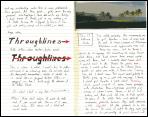
Friday, October 3, 2014

64 x 55 (The Path of Least Resistance)


The path of least resistance is simply to start writing and wait to see what will turn up on the page. No predetermined concept, no outline, no formal boundaries to work within or push against; just the words as they arrive, lining themselves up obediently and without apparent resentment, moving forward across the page toward whatever fate their Creator has in mind for them.

Process Reflection: It's a Friday night, the end of a busy day and a busy week. It's earlyish (6:55) and I mostly wanted to get something posted tonight so I could go back and sink into The Secret Place for the rest of the evening. I'm becoming a big fan of Tana French. One of the things that I like about her mysteries is that they tend to undercut the predominant generic characterization of the detective who is always one step ahead of the perps, not to mention ahead of the reader. The scenarios she describes inevitably turn out to be messier and more hazardous to the mental and emotional well-being of her protagonists than they have any reason to anticipate that they will be. The detectives often go in thinking that the case in front of them will be a piece of cake. But it never is. Complications abound. She's also good—better than good, actually, more like amazing—at setting up scenes where two smart and crafty people (detective and detective, detective and suspect, detective and witness, suspect and suspect, etc) are working on other, trying to dope each other out and/or fake each other out. In these encounters both sides have a lot at stake, both are concealing more than they are revealing, and there's the ever-present risk of screwing up badly. A large proportion of each of her books consists of crackling good dialogue in just such scenarios, often very funny. Her books also engage a lot of other quite serious issues (gender relations, class conflict, career politics, identity politics, family dynamics) in ways that are entertaining and instructive. So you get some quotient of redeeming social value to go along with getting drunk on words. So yeah, for my post tonight I took the path of least resistance. Heading back to The Secret Place.

Thursday, October 2, 2014

AntiQuotidian


Interesting post by Shane Parrish on Farnam Street last week about Alain de Botton's book How Proust Can Change Your Life. The full backstory is in the post, but the short version goes like this: in 1922 Proust saw and responded to a query in a French newspaper posing the following question:


An American scientist announces that the world will end, or at least that such a huge part of the continent will be destroyed, and in such a sudden way, that death will be the certain fate of hundreds of millions of people. If this prediction were confirmed, what do you think would be its effects on people between the time when they acquired the aforementioned certainty and the moment of cataclysm? Finally, as far as you’re concerned, what would you do in the last hours.

Proust's reply includes this perhaps surprising assessment:

I think that life would suddenly seem wonderful to us if we were threatened to die as you say. Just think of how many projects, travels, love affairs, studies, it—our life—hides from us, made invisible by our laziness which, certain of a future delays them occasionally...But let all this threaten to become impossible forever, how beautiful it would become again! Ah! If only the cataclysm doesn’t happen this time, we won’t miss visiting the new galleries of the Louvre, throwing ourselves at the feet of Miss X, making a trip to India.

Here's part of de Botton's gloss on Proust:

Feeling suddenly attached to life when we realize the imminence of death suggests that it was perhaps not life itself which we had lost the taste for – so long as there was no end in sight, but our quotidian version of it, that our dissatisfactions were more the result of a certain way of living than anything irrevocably morose about human experience. Having surrendered the customary belief in our own immortality, we would then be reminded of a host of untried possibilities lurking beneath the surface of an apparently undesirable, apparently eternal existence.


I'm bringing this up because it seems to be to be relevant to me and many of my friends and colleagues as we continue to come to grips with the loss of Dan Mindich. Keeping Dan in our minds and hearts is one way to combat the lamentable tendency to fall into the vale of quotidian dissatisfaction, and one way to continue to celebrate life as he chose to do.


Wednesday, October 1, 2014

64 x 54 (Nothing But…)


Last night I wrote about things falling apart; this evening I'm here to report on putting them back together. Re-glued the frame in the morning, inset the collage at noon, did some minor adjusting this evening (including one unobtrusive screw in the back corner where the glue for some reason did not hold). Photographed it this evening and posted it to Flickr. Et voila:

Nothing But...


Tuesday, September 30, 2014

64 x 53 (Days Like This)


Too many angles. Too much spin.
Too many forests to get lost in.
Too much noise and not enough rhyme.
Way too many questions and not enough time.

Where did the brush go? Where is the glue?
What's with all the acorns?  What can I do
To get back to the way that it was at the start
Before it unraveled and fell apart?

Process Reflection: This one wrote itself, and in a hurry. The first two sentences just came into my head. I had just come up from the workshop where I had glued up and varnished a frame I had attempted to make out of koa wood, and decided, unwisely, to go ahead and clamp in the wood collage that was to go into the frame and let the whole thing all dry at once. The pressure of the clamps broke the bonds on the frame, and the whole thing came apart into pieces, each piece coated with wet varnish and/or wet glue. A godawful mess. Managed to get the pieces separated, re-organized and reasonably set up to dry, and will have to try again tomorrow to finish it off. Lesson learned: I'll take it one step at a time. 

Once there, the first two sentences basically framed everything that followed: four beat lines, rhyming couplets, even the stanza form seemed given rather than chosen. So while the piece does have a kind of thematic mama-said-there'd-be-days-like-this orientation, it is also, in this case, pretty much literal, even the line about the acorns, which may seem a little random (which is one of the things I like about it: I sometimes see myself as an advocate of randomicity), but I've been noticing every time I walk around back to the workshop that I'm knee deep in acorns, and I've been wondering about that. The oaks seem to be overcompensating this year. Maybe they know something we don't? 


Monday, September 29, 2014

64 x 52 (Twice Upon a Time)


Yesterday's post, an attempt to get a story started, got me thinking, even while I was writing it and definitely afterward, about the beginning of The Pearl. I have not read that book since I used to teach it in to junior high school students in the '70s, but I read it at least half a dozen times then and it is one of those books that I feel like I can hold pretty well in my imagination even after all these years, and all of the other books I have read and forgotten. And there's a reason for that. It has to do with the way that it is written and the way that it engages the imagination. 

I thought I'd take a look at the very start of that story as a sort of self-teaching exercise, to see what the difference is between what Steinbeck—who actually knows what he is doing—chose to do at the start, as opposed to what I did. So here's mine, followed by Steinbeck's.


BS: Seamus was a small lad who lived with his Mum and Da and his little sister Sarah in a three-room cottage in a country village near the forest. Each morning he would be the first in his family to wake, and he would get up quietly as he could, slip on his clothes, tiptoe to the door, and step outside to greet the morning.


JS: Kino awakened in the near dark. The stars still shone and the day had drawn only a pale wash of light in the lower sky to the east. The roosters had been crowing for some time, and the early pigs were already beginning their ceaseless turning of twigs and bits of wood to see whether anything to eat had been overlooked. Outside the brush house in the tuna clump, a covey of little birds chittered and flurried with their wings. 
Now obviously there are some similarities, which is probably why Steinbeck came to mind as I was writing. Both start out with a focus on a character waking in a house and attending to what is going on out of doors. But Steinbeck does a number of things that now, upon reflection, I can see would have vastly improved my own beginning if I had done them myself. First of all, I began with a classic mistake, one that I should have been aware of and have in fact often counseled my students to watch out for. I began with a generalized description of what Seamus would do each morning; Steinbeck begins with a very specific description of that Kino was doing on this particular morning. You may say, well, Kino isn't doing anything, actually. But he is. He's awake, and his eyes are registering the stars and the breaking light, and he's listening. Steinbeck is deliberate about enumerating the things that Kino hears as he lies there: the roosters crowing, the pigs rooting about, the birds in onomatopoetic action, chittering and flurrying. My language was flat and utilitarian, communicating information and not much else; Steinbeck's language is rich and sense-based, communicating information but also evoking a mood, paying attention to the quality of this particular moment as Kino experiences it, and thus indirectly characterizing Kino himself. At the end of my paragraph, we don't know much about the way Seamus's mind works, but at the end of Steinbeck's we know something about the way Kino's does: he listens well, he's attentive, he's patient. All I've got about the setting is that it's a house in a village; Steinbeck, in about the same number of words, has an inhabited world to life.

So if I were to take another shot at it, based on what I have observed in Steinbeck and still keeping within the self-imposed 64 word limit, it might look something like this:


Seamus woke to the sound of the milk truck passing the house. He raised his head and looked across the room to where his sister Sarah lay sleeping, only the tip of her head showing from under the covers. Seamus swung his feet carefully over the edge of the bed and stood. Grabbing his jacket, he tiptoed toward the door and let himself out.
I think that's better, and I have a much clearer sense of where I would go from there than I did on my first draft.

I can't resist finishing off by returning to the beginning of The Pearl, because the paragraph below has always been one of my favorite individual paragraphs in literature. Kino, like Seamus, has stepped outside the house, and is watching as the sun rises:


The dawn came quickly now, a wash, a glow, a lightness, and then an explosion of fire as the sun arose out of the Gulf. Kino looked down to cover his eyes from the glare. He could hear the pat of the corncakes in the house and the rich smell of them on the cooking plate. The ants were busy on the ground, big black ones with shiny bodies, and little dusty quick ants. Kino watched with the detachment of God while a dusty ant frantically tried to escape the sand trap an ant lion had dug for him. A thin, timid dog came close and, at a soft word from Kino, curled up, arranged its tail neatly over its feet, and laid its chin delicately on the pile. It was a black dog with yellow-gold spots where its eyebrows should have been. It was a morning like other mornings and yet perfect among mornings.

There's just so much of a muchness here: the richness of the sensory details, the rhythms of the sentences (that first sentence in particular), the obliquely foreshadowing business of the sand trap and the ant lion, the appearance of the dog "with yellow-gold spots where its eyebrows should have been." That line just kills me. I mean, where would that be coming from? It feels right, it feels convincing, it feels authoritative, but it's not the kind of line that would occur to most of us to include, even if we knew the story we wanted to tell as well as Steinbeck knows his. But it helps to cement the scene in our minds and make this morning seem real. And then, at the very end, the jump to the generalizing summary statement, which in this case gets a ton of work done, especially when you are re-reading the book. "A morning like other mornings and yet perfect among mornings" is a description that rings all the more resonantly after you know how the events of the story have played out, and that there will never be a way back to that innocent perfection.