Thursday, January 18, 2007

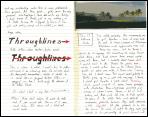
Thinkertools


Well, it's the start of a new semester, and I am once again working with students who have had a variety of different teachers during the first half of our Sophomore English course. There is a common course description, a fairly well-articulated statement of purpose, and a common rubric for evaluating essays. We teach a number of major texts in common. We meet regularly to compare notes and share ideas. And yet it should surprise no one that in a school with 450 students and up to nine teachers at each grade level, despite all these commonalities, the students entering my class at the beginning of the new semester arrive with widely varying sets of skills and understandings. Since the course designed to have a strong critical thinking course, it is up to me to try to pull together some threads that will help the students individually and also help to build some common understanding of what we are doing and why we are doing it.

I've evolved a number of, well, I need a term here, so I guess I'll call them thinkertools, that I wind up introducing to the students and then reinforcing through various activities through the course of the semester. My hope in this post is to come up with at least a preliminary listing of some of those tools, with a brief explanation of each.

Phrase Your Lack of Understanding as a Question: Many times students encounter something they don't get and respond by saying either "I don't understand," or "This doesn't make sense." (Or worse, "This is dumb.") None of these responses are useful, because none lead anywhere. When a student says, for example, "I don't understand Holden," my automatic response is "Can you phrase what you just said as a question?" Being able to ask the right question, in my experience, puts you well on the way toward an answer. And sometimes, the best questions don't have a single answer, or, for that matter, any answer, but the questions are still worth asking because of the thought processes they engender. (See the Chekhov quote in the sidebar for an elegant statement of this position.)

Question-Based Strategic Thinking: Having come up with a good question, consider as many answers as you can think of, even if they initially look like dead ends: A1, A2, A3, A4...A27. Once the list is out there, you can select, or, if necessary, invent a way of rank-ordering the answers based on whatever criteria are relevant: evidence, adequacy, simplicity (other things being equal, simple answers trump complicated answers). The Future Problem Solving Program has adapted and formalized this kind of process to their scenario competitions, and it's surprising how adept even very young students can become at using it.

Assess Your Current Situation: Three powerful questions that are relevant in any situation are: "Where am I now? Where am I trying to get to? How might I get there?" Whether you're writing an essay or reading a poem or considering where your relationship with your significant other is headed, these questions are worth visiting, and re-visiting.

The Sideways Move: Good thinkers have the ability to shift their point of view. The trigger for the move is some set of words like "Everything we've said so far is true, but there's another way of looking at it." Then consider—or invent—one.

Balance Generalizations with Specifics: The writer's cliché is "Show, Don't Tell." Much student thinking, like most of what passes for thinking in matters of public discourse, consists of what I have come to call BUGs—Big Unsupported Generalities. Like the sentence I just wrote. The next move, for balance, might begin with, "For example..." No one can be specific all the time. But it's useful for students to be aware of when they are generalizing and when they are being specific. As a writing teacher, I would say that I spend about half of my energy helping students figure out what to cut, and most of the other half encouraging them to push down a level or two on the ladder between BUG's ("Life is just a bowl of cherries") and minute specifics (A randomly selected sentence from The Lay of the Land: "The white-capped bay surface reveals, at a distance, only a single wet-suited jet-skier plowing and bucking along, clinging to his devil machine as it plunges, wave into steely wave.")

Write Your Way Through It: I've come to believe that writing is perhaps the single most powerful self-instructional tool we possess. Most students assume that in order to write you have to first know what you have to say. Sometimes you do. But writing can also be a way to generate thought. Five-minute or ten-minute freewrites allow half-formed thoughts and hunches begin to evolve a form. Writing makes thinking hold still. Writing out your first thoughts makes it possible to arrive at second thoughts.

Converse. With Yourself, If Necessary: Each semester I make a point of having students at various times interview one another in pairs, with one partner being responsible for keeping the other one talking by pumping him/her with questions. Then I ask them to go home and write a dialogue in which one person questions the other about whatever the topic was. The results of this exercise (samples here and here) are always vibrant and interesting and alive in ways that student writing too often is not. One powerful way to generate solid thinking is to interview yourself: ask the questions you have, and give the answers that you can come up with. You will in all likelihood surprise yourself.

There are, of course more. But this is the start of an inventory: what's in my toolbox.

(Photo by Alfredo Hisa).


Wednesday, January 17, 2007

The Lay of the Land (III)


A couple of weeks ago I wrote two posts (here and here) about Richard Ford's book The Lay of the Land, which I finally finished reading the other day. It was a long, slow, enjoyable read. The title phrase has a number of literal and metaphorical interpretations. It works at one level because Frank Bascombe is a realtor, whose job it is to match his prospective buyers with the house they want in the landscape they want. It works at another level because the novel is in some ways a painstaking recreation of the texture of the life in a particular (and uniquely American) time and place: several days around Thanksgiving in the year 2000 in suburban New Jersey. And it works in the more general metaphorical sense, where getting the lay of the land is an exercise in orientation, an attempt to correctly read one's surroundings.

Bascombe is of a certain age (55), has a certain physical condition (undergoing treatment for prostrate cancer), and has suffered some painful familial losses (one of his sons died young, his first wife divorced him, and his second wife has left him when her former husband, long presumed dead, suddenly shows up more or less on her doorstep.) He has weathered all of these experiences with a certain wry, soft-edged, self-deprecating humor. He is not easily distressed. Even when he is distressed, he tries not to let it get the better of him. But he sure thinks a lot. And one of the things he thinks a lot about—not surprisingly, under the circumstances, is what it means to grow old. That's a territory for which each of us must create his own map.

But there are, of course, models for us to examine for their possible relevance to our own situation. In Frank's life, one such model is Wade, whom he first met perhaps 15 years before when, for a time, he was dating Wade's daughter. The relationship didn't work out, but he remained friends with Wade. And now Wade has turned into a crotchety old fart, a character, and Frank watches him with a mixture of fascination and distaste:
Back in the Barnegat Pines days of '84—when Wade took life more as it tumbled, projected a seamless, amiable surface, kept his garage neat, his tools stowed, his oil changed, tires rotated, went to church most Sundays, watched the Giants not the Jets, prayed for both the Democrats and the Republicans, favored a humane, Vatican II approach to the world's woes, inasmuch as we live among surfaces, etc.—back then I just assumed that he, like the rest of us (prospective son-in-laws think such things), would wake up one morning at four, feel queasy, a little light-headed, achy from that leaf-raking he'd done the evening before and decide not to get up yet. Then he'd put his head back to the pillow for an extra snooze and somewhere around six and without a whimper, he'd soundlessly buy the farm. "He usually doesn't sleep that late, but I thought, well, he's been under a strain at work, so I just let him—" Gone. Cold as a pike.

Only old age plays by strange rules. Wade's now survived happiness to discover decrepitude. To be alive at eighty-four, he's had to become someone entirely other than the smooth-jawed ex-Nebraska engineer who was cheered to see the sun rise, cheered to see it set. He's had to adapt—to shrink around his bones like a Chinaman, grow stringy, volatile, as self-interested as a pawnbroker, unable to see his fellow men except as blunt instruments of his demon designs. Apart from merely liking him, and liking to match Wade—remembered to Wade—present tense, I'm also interested for personal reasons in observing if any demonstrable good's to be had from getting as old as Methuselah, other than that the organism keeps functioning like a refrigerator. We assume persistence to be a net gain, but it still needs to be proved. (312-3)

The passage captures quite well the sharply observant and wryly humorous turn of Frank Bascombe's mind. Much of The Lay of the Land is made up of passages like this, passages which are not narrative so much as ruminative. The lay of the land we are experiencing as we read this is the shape of the internal landscape of Frank's brain, the way his thoughts move in mediative, elaborative circles around certain recurring questions and themes. Frank is a world-class ruminator. What makes him such good company is that the questions and themes that he chews on are not-so-distantly relevant to anyone who has managed to find their way to the North End of middle age. It struck me more than once as I was reading that this is a book for adults, not age-of-majority adults, but adults who by age forty have, as the French proverb suggests, the face they deserve. Despite all the wisecracking by the narrator and the sheer linguistic exuberance of the author, this is a serious novel, in every sense of that word.

Tuesday, January 16, 2007

And What is Your Name?


Well, the second semester begins tomorrow. We had exams during the second half of last week, a holiday on Monday, and a teacher work day today. Tomorrow I get to meet a whole new group of students with whom I will be spending 56 hours during the next four and a half months. The first day is always a challenging day for me. It's a day I generally enjoy, trying to get a read on the new groups, learn their names, get a sense of what the chemistry in the room is going to be. It's a day I value, and look forward to. (I have a harder time with last days: I always find it difficult to find the right note to end on.)

I have a couple of standard items of business I always attend to. I hand out file cards and have the students answer some generic questions about where they're coming from and what's on their minds. The school suggests/requires that I hand out an "expectations sheet" which outlines the goals of the course and lets the students—and the parents—know how they can get in touch with me. And I usually do some kind of an exercise that allows me to learn their names before the first day is over. The one that has worked the best for me is first to tell them the story of my name: Richard Bruce Schauble.

"Richard" was the given name of my mother's brother Dick Porter, who worked as as an engineer with the Lummus Company in New York City, designing cracking furnaces for refining petroleum. One day Dick decided to bring a co-worker home for dinner with him, a man with the resoundingly Germanic name of Otto Charles Schauble. When Otto arrived at Dick's house for the meal, he met Dick's younger sister Miriam. They fell in love, got married, and some years later decided to name their sixth child, me, after the man who had introduced them.

My middle name, Bruce, was the name that my mother wanted me to be called. But she thought that Richard Bruce sounded better than Bruce Richard, so she put them in that order on the birth certificate. I was named Bruce after my mother's father, Oren Bruce Porter, who passed from this earth several hours before my arrival on it.

My family name, Schauble, is the name of an old German family from the Schwartzwald, or Black Forest area of Germany. I'm not in touch with any relatives there, although Wolfgang Schaüble, five years my senior, has had a long and in some cases unfortunately colorful career in German politics.

Having shared this much about my name and its history with the students, by way of providing a model, I ask them to work with a partner and have the partner share the story of his/her name. Each student is then asked to say his/her own name, to introduce the partner to the class, and then to tell the story of that person's name. While those presentations are going on, I'm mentally going around the room attempting to lock in each name with a face. Usually by the end of the exercise, about fifteen minutes, I've got them down, at least for that moment. If I have trouble the next day, and I usually do have trouble with a few of them, I try refresh my memory by taking attendance.

Depending on how much time is left over, I will either share a brief reading with the students, often a poem, and give them a short writing assignment based on what we have read, or give them another short writing assignment which I most often make up on the spot. If I were making one up right now, for example, I might ask them to think about what name—first, middle, and last—they would have chosen for themselves if they had been given the choice, write that name at the top of the page, and then write the story of THAT name.

I'll close this post with a poem by Mark Strand that a colleague brought to my attention this fall, one which I will probably find some way to work into the exercise I just described, either as a setup or a followup. It describes a moment of wonder and self-recognition and a kind of transcendence, the kind of moment we might hope to experience at least once or twice in a lifetime, or perhaps, if we're lucky, in a new semester of sophomore English:

My Name

Once when the lawn was a golden green
and the marbled moonlit trees rose like fresh memorials
in the scented air, and the whole countryside pulsed
with the chirr and murmur of insects, I lay in the grass,
feeling the great distances open above me, and wondered
what I would become and where I would find myself,
and though I barely existed, I felt for an instant
that the vast star-clustered sky was mine, and I heard
my name as if for the first time, heard it the way
one hears the wind or the rain, but faint and far off
as though it belonged not to me but to the silence
from which it had come and to which it would go.

Monday, January 15, 2007

Juxtaposition III


At the end of his justly famous and much anthologized 1873 essay about a class he took with Louis Agassiz at Harvard, Samuel Scudder quotes Agassiz as saying "Facts are stupid things, until brought into connection with some general law." The statement highlights the importance of context. Take the word "hands," for example. That word in isolation has a denotative meaning, but little other significance out of context. But put it on the page in the vicinity of another word, and significances proliferate. For example:

hands


birds


Now the placement of the words within the same field of vision encourages us to look at the words as being in some sort of unarticulated but inferable relationship with one another. We look at one word, then at the other, and then start thinking about what sort of relationship might exist between them. The space between the words becomes a field of energy in which the mind begins to play.

One of my colleagues at Punahou, Joe Tsujimoto, is the author of several books, among them Teaching Poetry to Adolescents, which was published by the NCTE in 1988. One of his favorite exercises early on when working with students is to ask them to write two-word poems of this kind. The assignment gives students the chance to explore the often surprising power that can be generated by the juxtaposition of just two words.


A lot of Japanese poetry in the tradition of haiku explores the energies between words in much the same way. I once was given a t-shirt with an enso sign (the calligraphic circle at the head to the left). Enso is a symbol of the harmonious interconnectedness of all things in the universe. On the t-shirt was brief poem, also in Japanese calligraphy. I don't recall what the Japanese words were, but the sense of it was something like this:

Flowers on the mountain

Birds on the wave


The placement of those two phrases next to one another encourages us to see them as related to one another, mirrors of one another, their syntactical and imagistic connectedness gesturing at the larger theme of interconnectedness implied by the enso itself.

Of course, all poetry—and all writing, and all thought—might be said to be, in essence, putting one word next to another, one sentence next to another, one idea next to another. And it might also be said the art of teaching is in large part the art of deciding what experience will best lead from the experience students have just had toward the experience they will be having next. Another colleague has a wide variety of context-shifting exercises he asks students to do. If the class has read a short story, for example, and come to the point where they are starting to run out of things to say, he might then ask them to look at a piece of art or listen to a piece of music and talk about how they go about making sense of that work of art. That completed, he might ask them to return to the short story, but to try to see it freshly through the interpretive lens they came up with for the work of art. What he is teaching the students to develop strategic thinking analogically: this worked over here; what would happen if we tried it over there?

Essentially what I've been trying to work my way through in these last few posts is some ideas about how purposeful choices about juxtaposition, both within genres and between them, can help to generate broader and deeper thinking. It's a commonsense notion, and one which has many other manifestations other than the ones I've discussed. The basic comparison-contrast essay is one familiar variation. And it's also given me the chance to share a few of the resources that I have found to be helpful in putting these ideas in front of students. If you're still with me, thanks for your patience.

Sunday, January 14, 2007

Juxtaposition II


I don't where it was that I first got the idea of asking students to read poems in clusters or two or three. It's easy enough to do, just put several poems on the same subject (or two poems by the same author on different subjects or in different forms) on a page and ask the students to read and discuss them, first individually, and then, as we did in yesterday's post, in terms of how one of them helps us to re-think the other. One of my favorites is a two poem cluster: "Song of the Wandering Aengus" and "Samurai Song" by Robert Pinsky:

The Song of Wandering Aengus

I went out to the hazel wood,
Because a fire was in my head,
And cut and peeled a hazel wand,
And hooked a berry to a thread;
And when white moths were on the wing,
And moth-like stars were flickering out,
I dropped the berry in a stream
And caught a little silver trout.

When I had laid it on the floor
I went to blow the fire a-flame,
But something rustled on the floor,
And someone called me by my name:
It had become a glimmering girl
With apple blossom in her hair
Who called me by my name and ran
And faded through the brightening air.

Though I am old with wandering
Through hollow lands and hilly lands,
I will find out where she has gone,
And kiss her lips and take her hands;
And walk among long dappled grass,
And pluck till time and times are done,
The silver apples of the moon,
The golden apples of the sun.

Samurai Song

When I had no roof I made
Audacity my roof. When I had
No supper my eyes dined.

When I had no eyes I listened.
When I had no ears I thought.
When I had no thought I waited.

When I had no father I made
Care my father. When I had no
Mother I embraced order.

When I had no friend I made
Quiet my friend. When I had no
Enemy I opposed my body.

When I had no temple I made
My voice my temple. I have
No priest, my tongue is my choir.

When I have no means fortune
Is my means. When I have
Nothing, death will be my fortune.

Need is my tactic, detachment
Is my strategy. When I had
No lover I courted my sleep.

What I like about this particular combination is that even though the poems are formally dissimilar and written nearly 100 years apart, one by an Irishman writing the voice of an Irish mythological figure, and one by an American writing in the voice of a medieval Japanese warrior, they actually seem to exist in a sort of dialogue with one another, the sort of dialogue that has led some of us to talk about literature as a "Great Conversation." I have mentioned before that I often ask students to consider Christopher Clausen's assertion that "All great literature addresses directly or indirectly two questions: 'What kind of word is this?' and 'How should we live in it?'" Each of these poems offers an implied answer to both of those questions, and the interesting thing is that the answers are, at least at first thought, polar opposites. Yeats seems to suggest that there is a certain kind of magic in the world, and that once one has tasted it, that taste will sustain a lifelong odyssey or quest. It does not seem to bother Aengus that he has not yet found his glimmering girl; he is sustained even in his old age by the (gorgeously articulated) vision of what it will be like when he does. Aengus seems to believe that the way we should live in this world is, having found a dream, to pursue it. It's an ethic of acquistiveness. And even if we fail to acquire that which we seek, the quest itself has given purpose and value to his life.

The samurai, on the other hand, has opted for an ethic of renunciation. His answer to the question "What kind of world is this?" seems to be something like "a world in which nothing can be taken for granted, a world in which everything will in all likelihood be taken from you, sooner or later." His strategy, as he says explicitly, is detachment. He has become an expert in substitution, in the strategy doing without by simply working with what is left after what you have is lost: "When I had no eyes, I listened. When I had no ears, I thought. When I had no thought, I waited."

And yet even though these speakers answer both questions differently, there is one important point of similarity: they each do in fact have a code, a philosophy, a consistent way of answering those two big questions. They may disagree with one another on matters of principle, but they are both principled people. Similarly, even though the language—the diction and the syntax and the figures of speech—that they use is quite different (we would talk about how if this were a class), in each case that particular kind language is consistent with their personal and philosophical orientations. Which raises another interesting question for us as readers: if we think of these two as models of a sort, in that they have each come up with a language that is unique and true to their own belief and experience, how do we as individuals do the same? The fact that these are invented voices adds another dimension to the question: not only might we wish to find our own true voice, but we might aspire to be able to speak as truly in the voices of others. Sidney Pollack, at a graduation speech I cited in an earlier post, argued that that effort—the effort to imagine and speak in the voice of others—helps to shape the kind of person you become: "It's a way of understanding the world that functions beyond intellect and it teaches and touches through feeling and experience even when the experience is purely that of the imagination (My italics). Fiction, and by that I mean the aesthetic creation of all artificial worlds, must persuade you to interpret the world through compassion." It seems to me that that is what both Yeats and Pinsky are up to here, and the juxtaposition of their two narrators not only allows me to feel some sense of understanding for both of them, but to see each through the other's eyes.

Saturday, January 13, 2007

Juxtaposition I

One of the courses I teach is a sophomore English class with a critical thinking emphasis. There's a complicated history leading into the creation of the course which I'm not going to get into now (there's a somewhat outdated by more or less accurate summary here). But one of the throughlines in the course has to do with providing the students with strategies for testing and expanding the range of their thinking skills—making observations, drawing inferences, asking questions, formulating hypotheses, and so on—in a more or less self-conscious, metacognitive way. There are a couple of basic moves that we identify and practice together. One of them is to periodically ask yourself strategic questions: "Where am I now? Where am I trying to get to? How might I get there?" One of them is to make a conscious effort to shift your point of view. And one of them, which I've been thinking a lot about the last few days, is a variation on the shift-your-point-of-view exercise. For lack of a better term, I'll refer to it here as juxtaposition.

Here, for example is a (somewhat inadequate digital reproduction of a) famous painting by Inness called "The Lackawanna Valley"


Even a very cursory look at the painting will register its major elements: The fields in the foreground, the valley itself, with smokestacks, the mountains (and the haze that separates us from them), the sky, the large on the left, and in the center, steaming out of the valley and up the hill more or in less in our direction, the railroad train. A closer look would might bring to our attention the figure of a man sitting on the ground next to the path that leads from the left foreground toward the center of the picture. It may be difficult to see in a reproduction this size, but the man is wearing a red sweater-vest and a straw hat, and he is looking down into the valley in the direction of the train, perhaps watching it. It also might be noted that he is looking over a pasture (there are barely discernable cows in the distance, just to the right of the big tree) which once was a forest; the stumps of the trees are still visible all over the hillside. There's more to be seen, but even the elements we have enumerated so far raise some fairly obvious questions: who is the man? why is he sitting out in the pasture? what's he thinking? What's the significance of the train? What's the subject matter of the picture? What does it make you think about? And so on.

The thing about this kind of "reading" is that it is pretty predictable. It deals with what has been put in front of us in a fairly straightforward way. If this were a class discussion, at the end of the class most of the students would be in position to write an analysis of the picture which would in all likelihood deal with the themes which this painting: the passing of time, the changing landscape of America, the effects, positive and negative, of industrialization. Such an analysis would be accurate, but not necessarily sufficient. There are a lot of other ways to think about this painting, and my point is that neither you nor I, not the students, would be likely to think outside of this particular box unless this painting were placed in the context of another work of art that would represent an alternative. If we were to look at another painting, to juxtapose one against the other, what we notice about one might lead us back to the other with a different set of eyes. So here goes:


This is a familiar image, and one that it might be difficult see freshly if we hadn't just been looking at the Inness painting. But to begin again with the obvious things: this is a picture of a valley as well. It also has sky at the top, buildings in the middle, and a large tree in the left foreground. But the real locus of attention is the sky itself, which is a sky unlike any literal sky. The stars and the moon are rendered in an inventive and somewhat peculiar way. This isn't how stars look, but it seems to be trying to represent something true about the stars through its presumably intentionial mis-representation. The points of light are surrounded by expanding circles of color, they appear on the canvas larger than they actually would be; it's almost as if they are pulsating. Likewise, the swirling movement in the center of the sky seems to suggest another kind of energy or life, perhaps the presence of wind or the movement of light itself. What comes to the foreground here is, in fact, less the subject matter than the technique. Van Gogh, wielding a palette knife in lieu of a brush, has carved himself a painting that seems to have an entirely different agenda than the Inness painting. The challenge for Inness was to render literally what was before him; the challenge for Van Gogh was to render symbolically that which could not be rendered literally: the life of the night sky.

If we now go back to the Inness painting and look at what we said before, several things call themselves to our attention. First of all, we said nothing of painterly technique in the first case. That was taken for granted, a given (although, interestingly, it might not have been if we had looked at the Van Gogh first). It is clear, in retrospect, that Inness is a master of a certain kind of realistic brushwork that Van Gogh, for lots of reasons—biographical, geographical, historical, and cultural—has chosen in this instance to forgo. Having noted this, we might begin to ask different questions about Inness himself: who did he study with? What made him paint this way? What assumptions did his viewers make about what was to be valued in art?

One might hypothesize that Inness was a painter from an earlier era, and that Van Gogh came later, as a kind of transition piece between the realism of the past and the abstract expressionism of the future. That hypotheis would turn out to be at least partially mistaken: Inness was born in 1825 and lived until 1894; Van Gogh was born in 1853 and died, at 37, in 1890. "The Lackwanna Valley" was painted in 1867, "Starry Night" in 1889, only twenty years apart.

My point is this: having looked at one painting in juxtapostition with the other, we are now engaged in an entirely different set of questions than we were when we began by looking at only one. This may seem like the most elementary kind of common sense, but from a pedagogical point of view I think it is worth paying attention to. Tomorrow I'd like to look at a couple of other examples of the ways in which juxtapositions can broaden and deepen student thinking.

Friday, January 12, 2007

Wabi Sabi


In a recent post, I responded to a comment posted by a Punahou student asking me if I had heard of wabi sabi. The Wikipedia has a nice capsule summary of the meaning of the two terms:
Wabi now connotes rustic simplicity, freshness or quietness, and can be applied to both natural and human-made objects, or understated elegance. It can also refer to quirks and anomalies arising from the process of construction, which add uniqueness and elegance to the object. Sabi is beauty or serenity that comes with age, when the life of the object and its impermanence are evidenced in its patina and wear, or in any visible repairs.
Then yesterday I found myself quoting a passage from Charles Baxter, in the last line of which he offered a slightly more colorful definition of sabi as "noble shabbiness." Now, at the close of the first semester, with the new semester beginning next week, and as I close in on my 60th birthday, I've been thinking about that term, and, somewhat wistfully, perhaps about the "beauty and serenity that comes with age."

In the summer of 2005, I spent two weeks in Japan with a group of teachers from Punahou on a trip sponsored by the Wo International Center. Before we left, we all took a field trip to the Japanese teahouse University of Hawaii campus, where a UH professor spoke with us about the tea ceremony in particular and Japanese aesthetics in general. He cited one source I had not previously heard of, a collection of essays by Kenko, called The Tsurezuregusa (Essays in Idleness). I went online to try to find a copy, but was unable to do so. After I got back from Japan, I was browsing in Borders one day and came across a copy a Columbia University Press translation by Donald Keene. It occurs to me, re-reading it now, that if Kenko were reincarnated today he might well be a blogger. The book consists of 243 short essays or reflective pieces on a wide variety of topics. The essays are opinionated, sometimes funny, often self-contradictory, and occasionally profound. This excerpt from essay number 137 was one passage cited by the professor as being essential for any full understanding of wabi sabi. I offer these few paragraphs for your enjoyment and reflection without further comment, mostly because whatever I might have to say in their wake would look, well, shabby, by comparison:

Are we to look at cherry blossoms only in full bloom, the moon only when it is cloudless? To long for the moon while looking on the rain, to lower the blinds and be unaware of the passing of spring—these are even more deeply moving. Branches about to blossom or gardens strewn with faded flowers are worthier of our admiration...People commonly regret that the cherry blossoms scatter or that the moon sinks in the sky, and this is natural: but it is only an exceptionally insensitive man who would say, "This branch and that branch have lost their blossoms. There is nothing worth seeing now."

In all things, it is the beginnings and the ends that are interesting. Does love between men and women refer only to the moments when they are in each other's arms? The man who grieves over a love affair broken off before it was fulfilled, who bewails empty vows, who spends long autumn nights alone, who lets his thoughts wander to distant skies, who yearns for the past in a dilapidated house—such a man truly knows what love means.

The moon that appears close to dawn after we have long waited for it moves us more profoundly than the full moon shining cloudless over a thousand leagues. And how incomparably lovely is the moon, almost greenish in its light, when seen through the tops of cedars deep in the mountains, or when it hides for a moment behind clustering clouds during a sudden shower. The sparkly on hickory or white-oak leaves seemingly wet with moonlight strikes one to the heart. One suddenly misses the capital, longing for a friend who could share the moment.

And who are we to look at the moon and the cherry blossoms with our eyes alone? How much more evocative and pleasing is it to think about the spring without stirring from the house, to dream of the moonlit night though we remain in the room!

Thursday, January 11, 2007

On Slowness


As an illustration for my post on Tuesday , I took a photo of the the New Yorker magazine, open to the first page of the Pamuk article, which had some passages highlighted which I wanted to place in the post. Next to the magazine was my commonplace book, in which I had begun writing out one of those passages by hand. Once I knew I wanted to use them in the post, I stopped writing them by hand and began typing them out. Along about the middle of the third one, as I was typing, the thought occurred to me that I might be able to save myself some time if the article was still available on the New Yorker site, and when I check, sure enough, there it was. Since I already knew and had highlighted the passages I wanted to use, I simply cut and pasted the rest of them into the post.

Today, as I picked up my commonplace book and began another entry, I began thinking about the qualitative and experiential differences between each method of processing that article. In the old days—I'm resisting the temptation to call them the good old days—if I wanted to copy something into my notebook, I pretty much had to do it by hand. (I was 12 years old when the first commercial xerox machines became available, and in my twenties before I personally got anywhere near one.) Now, thanks to technology, I've got options. And I'm thinking about the tradeoffs, the plusses and minuses of the analog and digital experience within this one very tiny realm of endeavor.

When I sit and copy something down on paper by hand, it's a certain kind of whole-body physiological experience. My eye moves to the text I am copying, I say the words out loud to myself to fix them in my memory, and then I follow the tip of my pen with my eyes as I use my fingers and my arm to flow the words onto the page. I find I breathe slowly and somewhat more irregularly as I write. It's a unidirectional process, the line of words I'm creating with my pen moves slowly but steadily forward, across and down the page. There's a kind of satisfaction that comes when I reach the bottom of the page and turn the leaf over to begin a new page.

Typing is different. When I type, my focus is not down but out. I still work from the text I am typing out, and say the words to myself in phrases short enough to hold in my mind while I type. I watch the letters appear on the screen in quick little bunches. I still, after all these years, make a lot of physical errors when I type, and my forward progress frequently stops and reverses as the third finger on my right hand darts up and over to tap at the delete key to erase little bunches of letters, one, two, or three at at time. Sometimes I’ll get through almost an entire line without missing a letter, but the overall sense of movement is not as deliberate and forward-moving as in handwriting. But I'm still immersed in a kind of brain-body experience which is more than simply visual. Whether I'm writing or typing, I'm processing the words in multiple modalities, and I think it's having some sort of an impact on my brain.

I remember my second grade teacher, Sister Mary Francis, who taught us that the best way to learn our spelling words was to write them out repeatedly, saying the letters out loud as we did so. She told us that doing so involved not just our eyes, but our mouth and ears and hand an arm as well, and that in this way we were "sending messages to our brain" that would help the brain remember. When I attended the Learning and the Brain Conference in Boston a couple of years ago and heard scientists reporting on the exciting new discoveries in the areas of neural networking and neural plasiticity. It occurred to me at that time that Sister Mary Vincent was about fifty years ahead of her time.

Then there's cutting and pasting. If I know there's a version of a text online, I can simply go to the site, search for the text, highlight, copy, and paste it in. It's fast, it's efficient, it's functional. But what I am missing out on is the more in-depth engagement with the text, the chance to have it become more deeply imprinted in my brain as the result of repeated multimodal encounters with it.

So I guess the question I am leading up to is, in this digital age, might it not be a good idea to occasionally ask students to revisit the old analog ways of learning? I'm all in favor of the ease-of-use factor, and I expect that most of us will copy and paste when the opportunity presents itself, as I myself often do. But I also value the old, slow ways, and would like to offer this modest endorsement of their usefulness and value. I sometimes do ask students to write out a passage by hand, slowly, in their best handwriting, paying attention to the shapes of individual words, the sequences of syllables, the way that the onflowingness of the sentence is controlled by the punctuation, the placement of the images, the texture of the sounds. Experiencing a sentence in this way is not unlike walking through a neighborhood you've only driven through in a car. You notice different things: the little bird motif on the mailbox in front of the blue house on the corner, the lilac curtains in the windows, the bend in the signpost where it was struck by a car. To process a sentence in this way is to get inside of it, to inhabit it for at least a while.

Helen Vendler once told the students in a class I was taking that one of the best ways she knew to study a poem (it works with prose as well) was to take a file card and cover up all but the first line, and then write that line out by hand on a separate piece of paper. Then stop and think about what you would write as the next line. What has been established so far? What might come next? Go ahead and write something you think would fit. Then slide the file card down and see what the writer actually did write, and think about how it compares to what you wrote, and what you notice now that's different, and what the next line will probably be. Working through an entire poem in this manner is a slow process, but a very instructive one. By the time you get done, you've experienced the inner workings of the poem in a completely different way.

Charles Baxter has a wonderful essay, the introduction to the 1999 edition of Ploughshares, in which he says:
I have noticed lately that students in my workshops have gotten into the habit of complaining about certain kinds of stories as “slow.” How is this story? What is it like? It’s real slow. How was the movie? Well, it was kind of slow. This adjective, once descriptive, has now become part of an inventory of complaint. Out of a certain perversity, or perhaps a feeling that very serious matters of aesthetic judgment are on the line, I find myself these days complaining at some length about the opposite problem. Most of the movies I go to at the cineplex are much too fast; events have happened before you have a context for figuring them out, and you feel as if you have been given the narrative equivalent of a shell game. The pacing is often, and too literally, breakneck. You feel as if you’re being sold something that basically won’t stand up to any intensive or serious scrutiny, that doesn’t, in fact, make any sense and that doesn’t care to do so, sense not having been part of the project at any point in its conception or execution.

Years ago, James Agee, in a fit-to-be-tied defense of Carl Dreyer’s somberly beautiful and by now classic film Day of Wrath, defended its pacing against an attack from a rival critic, Bosley Crowther, who had complained of its slowness, by saying that such a charge against a serious work of art is absurd. It would be, Agee wrote, like complaining that Beethoven’s adagio in the slow movement of the “Archduke” Trio was too slow. Slow music isn’t bad because it’s slow. If it’s bad, it’s bad for some other reason. The problem is never one of pacing but of focus and concentration. He had a point, and I wish he were still around to make it again, only with more vehemence. Too much recent fiction, I think, has been written as if for the movies, and the resulting rhythms are often too staccato or too breezy. Such fiction gives off a nervous and impatient air, a feeling of stage fright, as if the story had to get its business done in a hurry and had no right to exist if it didn’t.

This is, just possibly, an aesthetic spillover effect from the age of data processing, whose primary adaptive virtues include efficiency and speed. But perhaps it should go without saying that writing fiction, including short stories, is not data processing and never has been. This art does not need to be done quickly or consumed quickly; it just needs to be well-made, by whatever means, in communicating its experiences, emotions, and meanings. The late (and, by me, lamented) American novelist, essayist, and short-story writer Wright Morris used to go on at length in his essays defending slow reading, reading transfixed by wonderment, by the perfect image and detail. His own novels are typically slow reads. They invite a certain kind of reverie, and like his photographs they also invite solitary contemplation of the time-worn objects within them, often touched by what the Japanese call sabi, a quality of noble shabbiness.
So that's my thought for today. Take it slow.

Wednesday, January 10, 2007

Bad Ideas: I


As we consider the possible uses of technology in enhancing our students' learning, should we perhaps keep a watch out for Really Bad Ideas as well?

Our school librarian, in order to get some feedback about whether or not the school should subscribe, just sent us a trial link to an online database which offers students a "literary reference center," presumably to help students learn something about literature. My question is, what is that "something"? The site provides references for hundreds of titles, for each of which there is a capsule summary and a predigested analysis of text.

I can see two primary functions for such a reference center. One would be to allow students who have NOT read the text to get enough sound bytes into their head to be able to fake their way through a class discussion or an impromptu essay or pop quiz. The other would be to allow students who have read the text and not understood it to avoid having to think through their own reactions to the text. (I'll be charitable and not speculate about the third likely function.)

Here's my objection. Well, my first objection. The reason I ask students to read challenging texts in the first place is to give them practice in certain kinds of strategic thinking. I want to allow them, encourage them, to read, get stuck, ask questions, hypothesize answers, re-read the text in order to assess the relative merits of their hypothetical answers, and share the results of their explorations with one another. I want them to consider the question of how what the text is asserting connects to anything that they might have experienced or thought about in their own lives. I want them to be able to be part of a conversation that is based on the common experience of having read the text and on the un-common experiences and perspectives that each of them is bringing to it.

This "reference center" allows them, encourages them, to short-circuit that entire process. Clearly somebody thinks making this sort of resource available is a good idea. With all due respect for the time and effort and good intentions that have gone into the project, I think it's a Bad Idea.

Okay: second objection. One of the resource modules includes a listing of "Major Literary Themes." Here is the complete list:


The Dangers of an All-Powerful, Totalitarian State
The Damaging Effects of Social & Racial Bias
The Effects of Peer Pressure
Dealing with Imminent Death
Difficult Adult & Child Relationship
Fate Versus Free Will
The Dangers of Playing God
The Search for Enlightenment
Coming of Age
The Limitations Imposed by Social Class
The Difficulty of Choosing Good Over Evil
The Destructive Effects of Jealousy
Revolt Against the Socially Imposed Domination of Women
The Inability to Escape the Past
The Negative Effects of Parent & Child Conflict
The Destructive Effects of Love
Coming to Terms With Oneself
Disaffection as a Self-Protecting
Survival of the Fittest
Refusing to Accept Death

Whose listing is this? How accurate is it? How logical? How broad? How deep? The first thing that I notice about the list is the glaring predominance of words which define literary themes in terms which define themes through the use of negative terminology: dangers, damaging effects, death, difficulty, limitations, destructiveness, revolt, domination, conflict, inability, disaffection, survival of the fittest.

Geez, Louise. If those are the major literary themes of our age, is it any wonder that our students are running hard from the world of literature and into the worlds of pop music and video games? If this is what reading is about, why would anyone in his/her right mind want to go there?

Looking at it again, I note that the majority of the themes are couched in terms of power politics: totalitarianism, power politics, peer pressure, social class, sexism, historical determinism. "The Inability to Escape the Past," is less a statement of a theme than a statement of a socio-philosophical position. (Why that phrasing, especially in the context of all the others, and not " The Ability to Escape the Past?" or "Transcending Our Limitations?" Why "The Negative Effects of Parent and Child Conflict"? Granted that conflicts are inevitable, are they not also often productive in unexpected ways?)

And then I find myself wondering about all the other themes that I might conceive of, and how many of them are missing. I think it's a fundamental mistake to approach the world of literature through a conceptual lens that is this reductive. I think we're better off as educators if we encourage students to ask questions rather than "identify themes," which often, as in this list, turn out to be nothing more than large, thought-deadening clichés. And for students, it's a very short step from those kinds of clichés to the writing of thesis essays that attempt to "link" the theme to the text. ("The Catcher in the Rye shows the negative effects of parent & child conflict. My first example...."). I understand, if I squint at it just right, why we might be inclined to ask students to do this formulaic kind of thinking and writing. We think we're providing them with useful structures and a needed kind of support. But I think we do our students a disservice by encouraging them to think that this is what reading is about, or what writing is about. God knows, I don't want to have to sit down and read 40 of those essays. I don't want to have to sit down and read any of them. Don't get me wrong, I love reading my students' work—when it follows the line of their own thinking. But the essay that begins with the line I just cited is a cut-and-paste exercise. Even if it is carried off competently it is unlikely to deliver anything the reader or the writer didn't already know. So what's the point?

Christopher Clausen said in an essay some years ago, "All great literature addresses, directly or indirectly, two questions: "What kind of world is this?" and "How should we live in it?" If I run through in my mind the various trains of thought that might arise from a consideration of those two questions, and lay it against the trains of thought that arise from my consideration of the list above, I find myself in two different mental landscapes. And I know which one I'd rather ask my students to explore with me.

Tuesday, January 9, 2007

The Angel of Inspiration


I had no sooner posted yesterday's entry on inspiration than I picked up the Winter Fiction issue of The New Yorker which had just arrived in the mail (two weeks late, typical for Hawaii periodicals delivered by mail), and In found in it Orhan Pamuk's eloquent and thought-provoking 2006 Nobel Prize address, "My Father's Suitcase," in which he talks, among other things, about writing in general and inspiration in particular. Funny how things connect sometimes. Some excerpts, with highlights:

A writer is someone who spends years patiently trying to discover the second being inside him, and the world that makes him who he is. When I speak of writing, the image that first comes to mind is not a novel, a poem, or a literary tradition; it is the person who shuts himself up in a room, sits down at table, and alone, turns inward. Amid his shadows, he builds a new world with words. This man—or this woman— may use a typewriter, or profit from the ease of a computer, or write with a pen on paper, as I do. As he writes, he may drink tea or coffee, or smoke cigarettes. From time to time, he may rise from his table to look out the window at the children playing in the street, or, if he is lucky, at trees and a view, or even at a black wall. He may write poems, or plays, or novels, as I do. But all these differences arise only after the crucial task is complete—after he has sat down at the table and patiently turned inward. To write is to transform that inward gaze into words, to study the worlds into which we pass when we retire into ourselves, and to do so with patience, obstinacy, and joy.

If a writer is to tell his own story—to tell it slowly, and as if it were a story about other people—if he is to feel the power of the story rise up inside him, if he is to sit down at a table and give himself over to this art, this craft, he must first be given some hope. The angel of inspiration (who pays regular visits to some and rarely calls on others) favors the hopeful and the confident, and it is when a writer feels most lonely, when he feels most doubtful about his efforts, his dreams, and the value of his writing, when he thinks that is story is only his story—it is at such moments that the angel chooses to reveal to him the images and dreams that will draw out the world he wishes to build. If I think back on the books to which I have devoted my life, I am most surprised by those moments when I felt as if the sentences and pages that made me ecstatically happy came not from my own imagination but from another power, which had found them and generously presented them to me.

Discontent is the basic trait that turns a person into a writer. Patience and toil are not enough: first, we must feel compelled to escape crowds, company, the stuff of ordinary life, and shut ourselves up in a room. The precursor of this sort of independent writer—one who reads to his heart’s content, who, by listening only to the voice of his own conscience, disputes others’ words, and who, by entering into conversation with his books, develops his own thoughts and his own world—was surely Montaigne, in the earliest days of modern literature. Montaigne was a writer to whom my father returned often, a writer he recommended to me. I would like to see myself as belonging to the tradition of writers who—wherever they are in the world, East or West—cut themselves off from society and shut themselves up in their rooms with their books; this is the starting point of true literature.

A writer talks of things that we all know but do not know that we know. To explore this knowledge, and to watch it grow, is a pleasurable thing; the reader visits a world that is at once familiar and miraculous. When a writer uses his secret wounds as his starting point, he is, whether he is aware of it or not, putting great faith in humanity. My confidence comes from the belief that all human beings resemble one another, that others carry wounds like mine—and that they will therefore understand. All true literature rises from this childish, hopeful certainty that we resemble one another. When a writer shuts himself up in a room for years on end, with this gesture he suggests a single humanity, a world without a center.

I write because I have an innate need to write. I write because I can’t do normal work as other people do. I write because I want to read books like the ones I write. I write because I am angry at everyone. I write because I love sitting in a room all day writing. I write because I can partake of real life only by changing it. I write because I want others, the whole world, to know what sort of life we lived, and continue to live, in Istanbul, in Turkey. I write because I love the smell of paper, pen, and ink. I write because I believe in literature, in the art of the novel, more than I believe in anything else. I write because it is a habit, a passion. I write because I am afraid of being forgotten. I write because I like the glory and interest that writing brings. I write to be alone. Perhaps I write because I hope to understand why I am so very, very angry at everyone. I write because I like to be read. I write because once I have begun a novel, an essay, a page I want to finish it. I write because everyone expects me to write. I write because I have a childish belief in the immortality of libraries, and in the way my books sit on the shelf. I write because it is exciting to turn all life’s beauties and riches into words. I write not to tell a story but to compose a story. I write because I wish to escape from the foreboding that there is a place I must go but—as in a dream—can’t quite get to. I write because I have never managed to be happy. I write to be happy.

Monday, January 8, 2007

On Writing: Inspiration


Some teachers try to make it easier for students to write by providing them with topics and with structures. While I think that sometimes students benefit from this kind of pedagogical support, I also believe that it’s important for students to face the blank page and to learn how to solve what we might call the problem of inspiration. I recently spoke with a tenth grade student named Matt who had come to see me because he was concerned that he was having trouble getting started with his cycle papers. He thought he might be suffering from “writer’s block.” I have a number of more or less standard recommendations that I make to students who have this concern.

One standard off-the-shelf solution to the problem of stuckness is to gather in immediate sensory data. One way to do this is to simply look around. In order to illustrate this point as I was talking with this student, I called his attention to a miniature pencil sharpener, shaped and painted as a globe, sitting on the windowsill of my office. As I considered the globe, its size and shape immediately got me thinking about questions of scale. We were sitting in a largish office with a high ceiling and large windows. That office was for the two of us at that moment pretty much the entire universe, or what we could see of it, and we ourselves figured centrally in that frame of reference. But over on there on the windowsill was a replica of our planet on which the island of Oahu itself is barely visible, and if we were to search for Honolulu, much less Punahou School or our own pitiful selves, we would find ourselves marginalized quite out of existence. The presence of the pencil sharpener in my line of vision was generating in me a line of philosophical reflection which might, should I choose to explore it in a piece of writing, result in a essay in which I might meditate on the dynamics of scale, the state of our planet, my place in the universe and what I might hope to accomplish here.

On the desk to my right as I looked around was a package of guitar strings which I had taken out because one of the students who frequently comes to my office to borrow my guitar had brought it back with a broken string, so I was waiting for a moment to replace the strings. Were I to begin with that stimulus, I might write about my history with the guitar as an instrument, or about this particular guitar, or about a particular group of students who often come to my office to borrow the guitar, or about why I have had to give up the guitar and am now learning to play piano, or about my piano teacher, or about the challenges of learning a new instrument.

When students say they have nothing to write about, I’m sure they believe that what they say is true. But I’m convinced that they are mistaken, or rather, that they have not trained themselves to see the opportunities. Worthy topics are everywhere we look. What is needed is that we stop for a moment, look around, gather in, and then follow the movement of the mind as it plays over the possibilities.

Another standard, re-usable move is a one we had just practiced earlier in the day in that student's class. I call it the “Three Minute Poem Exercise.” I ask the students to take out a piece of paper and a writing utensil, and then tell them they are going to have three minutes to draft a poem. It can be on any subject, in any form, structured or unstructured, rhyming or nonrhyming. The only requirements are that it be composed in the present moment. I tell the students that ideally they should just get the pen moving and see what shows up on the paper. Reminding them of William Stafford’s definition of a poem as a “reckless enounter with whatever comes along, I tell them, “Write first, think later.” Then I count down “5-4-3-2-1 Go.”

Interestingly, I almost never have students who have trouble getting started. If I see someone not writing, I just go over and say “Just get the pen moving, don’t worry about it.” When the three minutes are over, I tell the students to stop. Then I give them the instructions for the second, more interesting part of the exercise. “This time, I’m going to ask you to write another poem. But the second poem should be as different from the first poem as you can make it. If the first poem rhymed, the second one shouldn’t. If the first poem was a happy poem about flowers, the second poem should be a tragic poem about the invasion of spiders from the planet Xenon. If the first poem used lots of simple words, the second poem should have as many complicated vocabulary words as you can funnel into it. Ideally, when I look at your two poems it should look as if two entirely different writers had produced them, or as if your inner schizophrenic had come out to play. Ready? 5-4-3-2-1 Go.”

When the students finish writing their two poems, I give them a few minutes to make any minor editorial corrections they wish to make on either poem, and then I ask them to put a check mark next to the poem that they like better or that they find relatively more satisfying, for whatever reason. Between classes, I type up a selection of the poems written in class and we use that typescript as a point of departure for a series of discussions about what poetry is, how we go about reading it, and how we go about evaluating it.

Several things interest me about this exercise. First of all, I am always surprised at the range and inventiveness of what gets written during those six minutes. Second of all, I am always impressed that no one complains of having “nothing to write about.” Third of all—and this is something I make a point of mentioning to the students and which is the real point of going into this longwinded explanation about the exercise in the first place—is that the basic concept of the three-minute exercise is a useful strategic solution for writer’s block. When faced with a blank piece of paper, an alternative to gathering ideas from the environment is to gather or harvest ideas from the apparently limitless recesses of the subconscious mind.

A third inspirational strategy is to simply open a book and copy down a line. I just now reached for a copy of Cal, by Bernard McLaverty, which is sitting on my desk. The first line that caught my eye as I opened the book at random reads “Cal switched on the light and tiptoed into the darkness of the front room.” If I were to write that line at the top of the page, and then challenge myself to continue the narrative from there, I would have the beginnings of something that could turn into a short story, or perhaps a poem, or, if I were to substitute my own name for Cal's, a personal narrative based on memory. The sentence I select serves as a story starter. At some point, I might choose to go back and drop the words that I used to get myself started. They serve as a scaffolding, as a structure from which to begin building. Once the building can stand on its own, the scaffolding can be taken away.

There are of course numberless possibilities of this sort. Many of them can be found in writer’s handbooks or creative writing course descriptions. Many others simply await invention. Anyone wishing to write can simply invent the rules of a game and then play it. I could, for example, take the letters of the words of my name, Richard Bruce Schauble, and make as many words as I could from those letters, and then attempt to write a paragraph using at least two of those words in each sentence. (“There was a rush of wings as the birds settled into the shrubs at the rear of the house. Their chirping sounded cruel and hard to his ears as he stood on the porch, watching the sun settle into the trees at the edge of the river.”)

I think it's important that we ask students to think metacognitively, to be aware of the problem they're facing—in this case, writer's block—and think about what solutions they might already know about, or be able to invent on their own. When Matt comes to say he doesn't know what to write about, I try to turn the conversation back to "What do you do when you don't know what to write about?" And then we work from there.

Sunday, January 7, 2007

Keeping Watch


Leahi
Originally uploaded by aceblush.
Woke up early this morning and went down to Ala Moana Beach Park to walk. Brought my camera with me, and took a bunch of shots, including this one of the sun rising over Diamond Head. Hawaii in a nutshell: the sun, the sky, the water, the clouds, the palm trees, the homeless woman next to the bench waiting to get warm.

Over the last few months I've been working on this blog and also taking pictures, again. I find that the two disciplines have some commonalities. Keeping the blog has been making me pay closer attention to the drift of my thoughts, because the implicit question of "What am I going to be able to write about tomorrow?" is always there in the background. Knowing that I am going to write tomorrow makes me pay a different kind of attention to what I do today. That's something that I originally learned from Donald Graves, whose argument for asking young children to write every day was rooted in the belief that if you develop the habit of writing it has an impact on the way you think. If you are writing a lot, in some way or another everything that you are experiencing and thinking about has a kind of double value, for what it is itself, and for what it may become when or if it is translated into words.

Likewise, carrying a camera around with me has made me pay a different kinds of attention to where I am and what is going on around me. It's not always a comfortable way of dealing with the world, because I'm more or less constantly putting imaginary frames around what I am seeing, and that sometimes gets old. But it does tend to ratchet up my visual alertness and to generate a certain kind of energy that feels purposeful and productive.

I don't consider myself to be either a writer or a photographer in a formal sense. I write because it helps me to think things through, and what does show up on paper, or on the screen, has the advantage of being Not Nothing. Something is accumulating, and perhaps some part of that will turn out to have value. Similarly, I'm accumulating a portfolio of pictures (archived on Flickr) that is a sort of visual notebook, a way of capturing impressions the things I like about the world—this school, this city, this state, this country, this planet—that I feel myself fortunate to be living in.

And then every once in a while, as in these posts, the two disciplines intersect with one another, which for me feels like a bonus. There's another set of disciplinary intersections—involving, strangely, tai chi, piano, and teaching,that interests me as well, but that is a post for another day. Aloha nui loa.


Redefining Rigor


In 1998, after having spent 30-something years as a teacher in the Canton, MA public schools, I moved back to Hawaii, where I had lived and taught for two years fresh out of college. At the time of the move, I did not yet have a job, but I had an application in at Punahou. When I arrived I went to the administration offices to let the secretary know that I was on the island and available for an interview. In one of those semi-random life-defining moments, about 20 minutes after I left Harry Grzelewski, the English department head at that time, went to the office and asked the secretary if there were any new applicants, because a position had just opened up. She said, "Well, this guy was just here..." Harry called me up that afternoon, I had my interview the next morning.

Toward the end of the interview, Harry asked me if I had any questions for him. So I asked him what the current dialogue on campus was about, what issues were in the air. He didn't hesitate. "Rigor," he said. "There are some people who feel that we need to make our courses more rigorous, and there are some people who don't like the word at all."

In the first few years I was at Punahou I came to understand what he was talking about. It turned out that there were at that time a line drawn right down the middle of the campus, and people on one side of the line tended to view those on the other with with skepticism, with mistrust, or, at worst, with outright disdain. Those who argued for "more rigor" objected to touchy-feely exercises like group work and individual projects and anything that smacked of student choice. Those who argued for student empowerment and process goals viewed "rigor" as a code word for teacher-directed information cramming.

The tenor of the discussion on campus has changed over the years. A lot of the people who were the most vigorously opposed to one another have either softened their stances or left the school in search of more congenial surroundings. The school has put a lot of time and energy into fostering dialogue and creating support systems for teachers to understand and improve their own practices and to appreciate what others are doing. But the issue of rigor is still with us, and we're still trying to figure out how to create an environment which is both rigorous and supportive.

As part of this ongoing dialogue, next week Tony Wagner , who is the co-director of the Change Leadership Group at Harvard, will be visiting my school to help us work on developing a framework within which teachers can give one another useful feedback about their teaching practices. Wagner was here for one day last year, speaking to several groups on campus on the subject of redefining rigor. In his essay "Rigor on Trial," he talks about working with a group of teachers in Hawaii to develop practices around what he calls the "New 3 R's": Rigor, Relevance, and Respectful Relationships. He says that as the group conducted their discussions, they "began to realize that rigor has less to do with how demanding the material is that the teacher covers than with what competencies students have mastered as a result of the lesson."

He offers this example:
Imagine, for a moment, that you were accused of a serious crime that you did not commit, and you were on trial for your life. How confident would you be of getting a fair trial if the members of your jury had merely met the intellectual standards of our "college-prep" courses as they exist today? Certainly they would know how to memorize information and perform on multiple choice and short answer tests. But would your jurors know how to analyze an argument, weigh evidence, recognize bias (their own and others), distinguish fact from opinion, and be able to balance the sometimes competing principles of justice and mercy? Could they listen with both a critical mind and a compassionate heart and communicate clearly what they understand? Would they know how to work with others to seek the truth?
I really liked that redefinition of rigor when I first heard it last year, and it has stuck with me since. I've written before about what I see as the primary importance of process goals like the ones Wagner describes.

Two years ago I was sitting at lunch with a teacher known for the rigorousness of his curriculum. We were talking about a proposal which had been floated to have the students take their midterm exams before the Christmas break. (Usually we come back from break, have one week of classes, and then exams.) This teacher was adamantly opposed to the change, on the grounds that "By the time the second semester starts they will have forgotten everything they've learned." Aye, and there's the rub. If that's what we're defining as rigor - the ability to memorize stuff, spit it out on an exam, and then forget it in less than a month: well, to borrow the caption from the old cartoon: I say it's spinach, and I say to hell with it.

Saturday, January 6, 2007

Core Beliefs: 3


Having just complete an entry yesterday on Dangerous Certainties , I found myself re-reading a text this morning that covers some of the same territory in a rather more stylish manner. The 2006 edition of Best American Nonrequired Reading closes with the commencement speech that David Foster Wallace gave at Kenyon University in 2005. In his characteristic offhandedly conversational but conceptually sophisticated way, he poses, early in the essay, a provocative question:
So let's talk about the single most pervasive cliché in the commencement-speech genre, which is that a liberal arts education is not so much about filling you up with knowledge as it is about, quote, "teaching you how to think." If you're like me as a college student, you've never liked hearing this, and you tend to feel a little insulted by the claim that you've needed anybody to teach you how to think, since the fact that you even got admitted to a college this good seems like proof that you already know how to think. But I'm going to posit to you that the liberal arts cliché turns out to be not insulting at all, because the really significant education in thinking that we're supposed to get in a place like this isn't really about the capacity to think, but rather about the choice of what to think about.
Over a number of pages he offers examples of ways of thinking which are easy to fall into and seem commonsensical, but are really traps, the most common of which is "the matter of arrogance":

I think this is one part of what the liberal arts mantra of "teaching me how to think" is really supposed to mean: to be just a little less arrogant, to have some "critical awareness" about myself and my certainties ... because a huge percentage of the stuff that I tend to be automatically certain of is, it turns out, totally wrong and deluded. I have learned this the hard way, as I predict you graduates will too.

Here's one example of the utter wrongness of something I tend to be automatically sure of. Everything in my own immediate experience supports my deep belief that I am the absolute center of the universe, the realest, most vivid and important person in existence. We rarely talk about this sort of natural, basic self-centeredness, because it's so socially repulsive, but it’s pretty much the same for all of us, deep down. It is our default setting, hard-wired into our boards at birth. Think about it: there is no experience you've had that you were not at the absolute center of. The world as you experience it is there in front of you, or behind you, to the left or right of you, on your TV, or your monitor, or whatever.
He goes on to walk us through an average day in The Real World, one in which just about everything goes wrong (and for that large generality he substitutes about two thousand words worth of thoroughly David-Foster-Wallaceian cinemegraphically detailed instances, which are way fun to read but which I'm leaving out here in the hopes of eventually getting to the point:

The point is that petty, frustrating crap like this is exactly where the work of choosing comes in. Because the traffic jams and crowded aisles and long checkout lines give me time to think, and if I don't make a conscious decision about how to think and what to pay attention to, I'm going to be pissed and miserable every time I have to food-shop, because my natural default setting is the certainty that situations like this are really all about me, about my hungriness and my fatigue and my desire to just get home, and it's going to seem, for all the world, like everybody else is just in my way, and who the fuck are all these people in my way? And look at how repulsive most of them are and how stupid and cow-like and dead-eyed and nonhuman they seem here in the checkout line, or at how annoying and rude it is that people are talking loudly on cell phones in the middle of the line, and look at how deeply unfair this is: I've worked really hard all day and I'm starved and tired and I can't even get home to eat and unwind because of all these stupid goddamn people...
But, and here is the payoff, it doesn't have to be this way. Even though this vision of the world is darkly humorous and perhaps painfully familiar to all of us, we don't have to live there.

...most days, if you're aware enough to give yourself a choice, you can choose to look differently at this fat, dead-eyes, over-made-up lady who just screamed at her little child in the checkout line—maybe she's not usually like this; maybe she's been up three straight nights holding the hand of her husband who’s dying of bone cancer, or maybe this very lady is the low-wage clerk at the motor vehicles department who just yesterday helped your spouse resolve a nightmarish red-tape problem through some small act of bureaucratic kindness. Of course none of this is likely, but it's also not impossible—it just depends what you want to consider. If you're automatically sure that you know what reality is and who and what is really important—if you want to operate on your default setting—then you, like me, probably will not consider possibilities that aren't pointless and annoying. But if you've really learned how to think, how to pay attention, then you will know you have other options. It will actually be within your power to experience a crowded, loud, slow, consumer-hell-type situation as not only meaningful but sacred, on fire with the same force that lit the stars—compassion, love, the subsurface unity of all things. Not that that mystical stuff's necessarily true: the only thing that's capital-T True is that you get to decide how you're going to try to see it. This, I submit, is the freedom of real education, of learning how to be well adjusted: you get to consciously decide what has meaning and what doesn't. You get to decide what you worship.
This is pretty much the argument I was trying to make yesterday, and it's one that recurs regularly in my life because, as Wallace points out, we're more or less hard-wired NOT to be reflective, NOT to consider to alternatives, NOT to extend the benefit of the doubt to those who are not cooperating with us or not seeing things our way or not pissing us off in some other thoroughly predictabl and therefore doubly maddening way.

Although I was raised as a Catholic, I have been as a matter of choice for nearly forty years a Buddhist. David Foster Wallace might not recognize it as such, but the argument he is making here is essentially a Buddhist argument. There are many different kinds of Buddhism, but they all subscribe to this simple idea: your Buddha-nature lies within. You are ultimately in charge of your own happiness. The happiness you create, or do not create, arises from within you, or doesn't, and it does so by virtue of the choices you make. The law of karma isn't complicated. It's the law of cause and effect. A Buddhist teacher once told me, "If you want to know why you are where you are today, look at the causes you made yesterday. If you want to know where you will be tomorrow, look at the causes you are making today." That's what I take to be the central point that David Foster Wallace makes to his audience: it's your life. Being a good thinker involves considering the alternatives, and then making the choices that will define what sort of person you turn out to be.

To me, this is what is at the core of my sense of what I am trying to do as a teacher. The subject matter that we study together in class, the books we read, the structural and mechanical issues of writing or grammar, the historical principles and political ideals, the formulas and the rubrics: yes, they all matter, they all have value, and I try to teach them as best I can. But that's not my primary goal as an educator. My goal as an educator is to help students learn to be well-adjusted in the sense that David Foster Wallace uses that term in this essay: aware of the choices they have, attentive to the implications of those choices, considerate of and compassionate towards those around them. It's a full time job, for my students, and for me.

Friday, January 5, 2007

Confluence


There is sleeping, and there is being awake, and then there are those in-between spaces: the moments when you are just dropping off to sleep but still minimally conscious, and the moments when you are awakening, but not yet fully in possession of your faculties. The brain seems to work differently in those moments, fragments of dreams intersecting with sensory perceptions from the real world. I have often found myself turning over in my mind a phrase or an image or the ghost of an idea that was with me as I rose to consciousness from the subterranean world of sleep, and on more than one occasion that vestigial remnant has become the germ of a poem.

Last night the wind was rattling and howling loud enough to keep me in that in-between zone for a longer time than usual. I be awakened, and then drift back down, only to be awakened again. In the moments I was more fully awake, I found myself thinking about the movement of the wind, where it comes from, what it is seeking, and it occurred to me that there was some potential analogy between the movement of the wind outside and the movement of my thoughts as I listened to it. That idea suddenly seemed to me to be more inviting than simply turning over and trying to go back to sleep, so I got up and grabbed a pencil and my notebook and began to write. I started by listening to the wind and trying to find some words for that, and then heard music coming from my son's bedroom, and so I began to work that in as well.

I began to sense that I had a three-part poem going, and so I kept working on that. My first draft had three nine-line stanzas, but when I re-drafted the poem this morning I lengthened the line and cut back some of the wording. It's still wet, and I'll be tinkering with it for a while yet, but here's what has emerged so far:

Confluence

The wind is up tonight, tearing at the louvres, sweeping
along the concrete contours of our condominium and
clutching at the corners with distraught whistles and moans.
It seems to seek a space in which to flow free, a world
flat and frictionless, mirror-smooth beneath the blackened sky.

In the next room, my son stitches syncopated rhythms
and fragments of songs into a beat to back the rap
that even now is on his lips, pulsing forward, words emerging,
surging, swirling in search of a shape that will hold the freight
of his urge to create a sound riveting and seductive and true.

Then there’s me, alone in the living room at ten before midnight,
pencil in hand, trying to lay the loose ends of my thoughts
into a line of syllables that will tame the restless currents
flowing through my mind, gather me up in their soft constraints,
and carry me off content at last into the stillness of sleep.

Thursday, January 4, 2007

Pastorale


La Bureba
Originally uploaded by zyber.
Came across this photo in Flickr, by a guy in Spain who calls himself Zyber. Never been to Spain. Never wanted to go. Until now.

What space. What light. What a place.

Dangerous Certainties


I ran across a pretty fascinating web site the other day which has a module called the World Question Center. The managers of the site have posed big-picture questions for a number of years and then archived the answers that various people—many of them deep thinkers—have submitted. It turns out that the question for 2006 was "What is your dangerous idea?" That, and some of the answers that were posted, got me thinking about dangerous ideas. If you were to ask me what is the most dangerous idea out there, I'd be inclined to answer that it's the certainty that what we believe to be true is, in fact, true.

Last night I was watching an episode of Friday Night Lights in which one of the players on a high school football team, Tim Riggins, is set up with a peer tutor, Landry Clarke, whose job it is to help this player pass his English course so he will continue to be eligible to play football. Riggins is a tutor's nightmare: he has been assigned to read Of Mice and Men and he basically refuses to do so. Landry, bending over backwards to be of help, winds up reading the book out loud to Tim as Tim goes through his workouts in the gym. By the time Landry is done with the book, it's clear that Tim is at least listening. He even makes a comment about it how hard it is that George has to kill his best friend in order to protect him. But when Landry tries to prep him for his oral test on the book by asking him how would relate the ideas in the book to his own life, Tim insists "I don't know." Landry, unbelieving, keeps asking, and Tim keeps insisting, with increasing anger and frustration, that he doesn't know. Landry eventually stalks off, convinced that Tim is a belligerent moron.

What Landry doesn't know is that Tim does in fact know—and feel–a great deal more than it is possible for him to say out loud. A major plot thread in the series has been about Tim and his best friend Jason Street, who was been seriously injured in a football game early in the season and is now confined to a wheelchair. During Jason's rehabilitation, Tim became involved with Jason's girlfriend, Lyla Garrity. Jason found out about it and the two former best friends are now attempting, not very successfully, to deal with the conflicts of love and betrayal. What we as the audience know is that the Steinbeck novel is hitting way too close to home for Tim. He isn't ready to talk about it, and even if he was, he wouldn't be able to tell Landry, as that would be an even further betrayal, an airing of dirty laundry that would expose the two people he loves most to more of the gossip and negativity that they are already drowning in. Landry has no way of knowing all of this. Since he doesn't know the back story and can't read Tim's mind, he comes to a reductive and inaccurate conclusion.

I came across another, more humorous, illustration of the danger of making these kind false assumptions a few days ago in a post by Mark Liberman on the Language Log blog. (The cartoon was originally posted by Robert Balder, on the Partially Clips site.) It features a mother reading to her child, and mis-reading the child's developmental levels in ways that only a mother could. The child is muttering what the mother assumes are nonsense syllables, but which are in fact the Latin names for the living for the animals in the storybook. The mother assures the child, "It's okay, your daddy and I will always love you and never give up on you."

The cartoon, in turn reminded me a poem by D.L. Klauck that was given out as model poem in a poetry workshop I took many years ago. It's a poem that struck me forcefully at that time. I'm the father of three sons and have had ample opportunity to reflect on the many ways in which we as parents can misread even those we are closest to:

Einstein’s Father

i tell him eat your dinner
he arranges it in unfamiliar patterns
assigns obscure names to common things
can’t recall days or months or seasons

prepares for school during holidays
has no talent for game or contest
stares for hours at nothing i can see

somedays he ties his shoes together
wonders why he falls down stairs
always bumps into walls and furnishings
catches his hands in closing doors
wears boots and gloves to bathe in
has trouble finding his way back home
loses patience with prayer and tradition

while i’ve tried raising him to be normal
still he collects sunlight in a leaded box
speaks to dark worlds in awkward tongues
lord knows ive suffered for his mistakes
but i don’t care what people think
i’m just concerned for the boy’s survival
i won’t be around to protect him forever

on my lap before he could walk
i’d imagine him becoming a great man
albert i’d say someday you’ll be famous
perhaps a composer or a skilled surgeon
everyone will hold you in highest esteem
your name as well known as goethe’s
though even a mason’s craft is honorable

the reasonable dream of any father
but now i’d gladly settle for a beggar
if he avoids becoming a criminal
if the dull madman in him remains dull
this graceless mindless boy
who lacks the imagination to be cautious
lacks the ignorance to be afraid

My school over the last several years has encouraged many of its teachers to participate in a professional development workshop based on the work of educational psychologist Mel Levine. His central message, as I take it, is that as educators we have to be more or less constantly on guard against making judgements about our students based on what is inevitably going to be incomplete information. In a typical passage, he says:

A lack of attention control may masquerade as laziness, a negative attitude, or just plain bad behavior. Yet these are struggling and confused students who want very much to succeed, to please themselves and win the respect of the adults in their lives. They need our sympathy and support at the same time that they need us to hold them accountable for working on their attention controls. When we sense that we're on their side and not accusing them of being bad or lazy, they often rise to the occasion and show steady improvement. Teachers, therefore, need to form strong alliances with these children rather than adversarial relationships. The same can be said for parents. (A Mind at a Time, 89)


And the same can be said, it might be added, for all of us. This is not the first time I've referenced Eric Sevareid: "One asks not only for the courage of his convictions, but for the courage of his doubts, in a world of dangerously passionate certainties." But his aspiration toward openmindedness, toward intellectual humility, and ultimately toward compassion, seems a worthwhile ambition with which to approach the new year.