Monday, March 31, 2008

Meme: Passion Quilt


Mr. B-G tagged me about two weeks ago for the passion quilt meme, but I was offline for a while and am now just getting around to it.

THE RULES:

Post a picture or create your own image that captures what YOU are most passionate for students to learn about
Give your picture a short title
Title your blog post “Meme: Passion Quilt”
Link back to this blog entry
Include links to 5 people in your professional learning network

So here's mine:

Literature Circles


There is a primary level of engagement that comes with reading any quality text. But that level of engagement comes with one primary built-in limitation: it's solitary. Of course I love to read, and I hope that one day my students will derive as much enjoyment and enrichment from reading as I have been able to do during my lifetime. But probably most of the reading I do is isolating: it puts my in a world by myself, so much so that I am often oblivious to what is going on around me, a fact that my family sometimes has found at times found quaintly amusing and at other times downright annoying.

But there are other satisfactions to reading as well, and one of them is to be able to share your thoughts about a common text with other readers. That's the beauty of a classroom. The experience of shared reading makes possible another, second level of engagement: participation in a community of discourse. Of course I wish for my students to be readers. But beyond that, I wish for them to experience and learn to value the time that we spend together, helping one another to ask better questions, come up with better answers, go broad and deep, wending our way to the heart of the matter.

(I took this picture of my students engaged in exactly this process during the summer 2007 session of sophomore English. I hope they remember those hours with as much aloha as I do.)


Doing my part to keep the meme going, I'm going to tag

Chris Watson
Bud Hunt
Doug Belshaw
Louann Reid
Chris Lehmann


Saturday, March 29, 2008

Immersed


It's been a while since I've posted anything here. Three weeks ago I spent three days at the NAIS convention in New York City, and when I came back I had stacks of papers waiting for me, lots of other business to catch up on, and just to make it interesting, 90 applications to review for two high-school English teaching positions we have posted. I eventualy got those 90 applications eventually boiled down to about ten interviews, all of which I have now completed. We've hired one teacher, and will be making another decision this week.

One of the candidates I wound up interviewing is working on a doctoral thesis focusing on utopian science fiction. During that conversation he mentioned a book I had not heard of by an author I had not heard of: The Years of Rice and Salt by Kim Stanley Robinson. And that, sports fans, has been where the rest of my time has been going during this last two weeks: I've been immersed in this extraordinary 763-page novel, which I finally finished last night.

The Years of Rice and Salt is an extended thought experiment, a sort of alternative history of the world that starts with a "what if" question: what if the plague, instead of merely reducing the population of Europe by a third, had wiped out the population entirely? What shape might world history have taken if the principal players had been China, India, and the Middle East; and the principal religious systems Buddhism, Hinduism, and Islam?

The novel consists of ten books, each of which takes place in a particular era, starting in roughly the year 622 and leading in sequence up to the present. In one of the novel's most interesting conceits, the main characters introduced in each of the ten books are in fact reincarnations of the same spirits that make up their jati, the small group of spirits who are karmically connected and who therefore keeping meeting one another in one lifetime after another. At the end of each lifetime, they meet each other in the bardo, the holding room in the non-earthly realm where spirits are sent to be judged on their life's work, and where their future incarnations are decided upon by the gods. It is understood that it is the responsibility of each human being to struggle, over the course of many lifetimes, to improve the world. As one character says, "Now we are in this lower realm. Our dharma still commands right action, even here. In the hope of small advances upward. Until reality itself be established, by many millions of lives of effort" (580).

The recurring characters with clearly defined dharmic roles are designated by the first letter of their names. The "B" character (incarnated as Bihari, Bistami, Bao, Bai, and Budur, among others) is a sort of everyman: goodhearted, capable, open to instruction. The "K" character (Kyu, Katima, Kerala, Kirana, Kung) is a social activist, a rebel driven by a strong sense of justice. The "I" character (Iwang, Ibrahim, Ismail, Iwa, Isao) is an intellectual, an investigator, someone with a faith in reason and science.

These character types are placed into a wide variety of situations all across the globe, as Robinson reconceives and reinvents human history. Some developments — the discovery of electricity and atomic energy — mirror similar developments in the "real" world. Others are boldly re-imagined. The colonization of the Americas, for example, (by the Chinese, in the absence of Europeans) fails because a Japanese sailor arrives ahead of the Chinese and convinces the Native American tribes to join forcers to withstand the threat. The resulting Hodenosaunee Confederacy winds up being a major world power event to the present day.

Robinson is an adept storyteller, and the individual stories keep you turning the pages. But the structure of the novel, and the room he gives his characters to argue with one another and advocate for various theories, allows him frame within the narrative what amount to exploratory essays on a wide variety of subjects, including religion, philosophy, women's rights, and the function of literature and storytelling and history itself. Here, for example, is a passage from the end of the book where Zhu Isao, an elderly historian, in the midst of considering different ways of thinking about history, talks about what he calls "dharma history," and its opposite, nihilism:

Thus a history like Than Oo's is what some call "Burmese history," but that I would prefer to call "dharma history," being a romance in which humanity struggles to work out its dharma, to better itself, and so generation by generation to make progress, fighting for justice, and an end to want, with the strong implication that we will eventually work our way up to the source of the peach blossom stream, and the age of great peace will come into being. It is a secular version of the Hindu and Buddhist tale of nirvana successfully achieved...

The opposite of this mode is the ironic or satiric mode, which I call entropic history, from the physical sciences, or nihilism, or, in the usage of certain old legends, the story of the fall. In this mode, everything that humanity tries to do fails, or rebounds against it, and the combination of biological reality and moral weakness, of death and evil, means that nothing in human affairs can succeed...

These two modes of emplotment represent end-point extremes, in that one says we are masters of the world and can defeat death, while the other says that we are captives of the world, and can never win against death. It might be thought these then represent the only two possible modes, but inside these extremes Rabindra identified two other modes of emplotment, which he called tragedy and comedy. These two are mixed and partial modes compared to their absolutist outliers, and Rabindra suggested they both have to do with reconciliation. In comedy the reconciliation is of people with other people, and with society at large. The weave of family with family, tribe with clan—this is what makes them comedy: the marriage with someone from a different clan and the return of spring.

Tragedies make a darker reconciliation. Scholar White said of them, they tell the story of humanity face-to-face with reality itself, therefore facing death and dissolution and defeat. Tragic heroes are destroyed, but for those who survive to tell their tale, there is a rise in consciousness, in awareness of reality, and this is valuable in and of itself, dark though that knowledge may be.

I suggest that as historians, it is best not to get trapped in one mode or another, as so many do; it is too simple a solution, and does not match well with events as experience. Instead, we should weave a story that holds in its pattern as much as possible. It is like the Daoists' yin-yang symbol, with eyes of tragedy and comedy dotting the larger fields of dharma and nihilism. That old figure is the perfect image of all our stories put together, with the dark spot of our comedies marring the brilliance of dharma, and the blaze of tragic knowledge emerging from black nothingness.

The ironic history by itself, we can reject out of hand. Of course we are bad; of course things go wrong. But why dwell on it? Why pretend this is the whole story? Irony is merely death walking among us. It doesn't take up the challenge. It isn't life speaking.

But I suppose we also have to reject the purest version of dharma history, the transcending of this world and this life, the perfection of our way of being...We are animals, death is our fate. So at best we could say the history of the species has to be made as much like dharma as possible, by a collective act of the will.

This leaves the middle modes, comedy and tragegy...Surely we have a great deal of both of these. Perhaps the best way to construct a proper history is to inscribe the whole figure, and say that for the individual, ultimately, it is a tragedy; for the society, comedy. If we can make it so.

Such rhetorical flights may not be to every reader's fancy. But I found myself thoroughly swept up by the novel, interested in both its plot line and its arguments, and amazed by its scope and ambition. And, as the last line of the above passage suggests, it is a deeply ethical book, a book that is engaged on every page with the investigation of questions of individual and societal responsibility. The world is, for better or worse, what we have made it, and will become what we are making it now.

For the teachers out there, I can't resist ending by quoting one last passage, spoken by the character Bao, who in his old age has settled into a life as a teacher of college-age students, who often ask him what he thinks about reincarnation:

Over time Bao came to understand that teaching too was a kind of reincarnation, in that years passed, and students came and went, new young people all the time, but always the same age, taking the same class; the class under the oak trees, reincarnated. He began to enjoy that aspect of it. He would start the first class by saying, "Look, here we are again." They never knew what to make of it; same response, every time.

He learned, among other things, that teaching was the most rigorous form of learning. He learned to learn more from his students than they did from him; like so many other things, it was the reverse of what it seemed to be, and colleges existed to bring together groups of young people to teach some chosen few of their elders the things that they knew about life, that the old teachers had been in danger of forgetting. So Bao loved his students, and studied them assiduously...

Over time the students added to his growing internal list of ways reincarnation was true: that you might really come back as another life; that the various periods of one's life were karmic reincarnations; that every morning you reawakened to consciousness newly, and are thus reincarnated every day to a new life.

Bao liked all of these. The last one he tried to live in his daily existence, paying attention to his morning garden as if he had never seen it before, marveling at the strangeness and beauty of it. In his classes he tried to talk about history newly, thinking things through yet again, not allowing himself to say anything he had ever said before; this was hard, but interesting.


Hard, but interesting. Yes it is.

Friday, March 14, 2008

Tree Octopus Threatened with Extinction


Louann Reid posted this thought-provoking video today. I'm passing it along.


Wednesday, March 12, 2008

Kindle the Flame


Miguel Guhlin tagged me for the This I Believe - Kindle the Flame meme, so I'm going to take a shot at it. The root questions under consideration are "What do you really believe about education technology? Why are you interested? Why do you do educational technology?


I guess the obvious place to begin is that I believe in educational technology because, well, it is, indeed, educational. Education begins with access to information. I admit to being blown away by how easy it is to access information of any kind these days, and how powerful the communication tools are. I've been around long enough to remember when what we have now was not even conceivable, much less available. I remember spending hours as a student in high school and college in the sixties searching through card catalogs and library stacks and badly-designed indexes to try to find information or references that in many cases, a majority of cases, were simply not going to be there. I remember spending whole days of frustration thumbing through books at home trying to find some quotation that I vaguely remembered, or misremembered, might possibly be on the top right hand side of a page midway through a book with a blue cover. I remember the early days of the internet when I might have to sort through the first ten pages of results from fivedifferent search engines to discover that there was in fact no information available online about the topic I was trying to research. All that is over, done with, finito. I've got an embarrassment of riches instantly available at my fingertips 24 hours a day anywhere in the world. I've got sophisticated bookmarking systems to sort and categorize them. I've got access to databases and tutorials and blogs and wikis and servers and pretty much every publication under the sun. I've got the ability to connect what I do know to what I don't know in more ways than I can shake a stick at. And so do my students.


If it's true that education begins with access to information, I would argue that it proceeds, in large part, from there, with the processing of information: how it is thought about, how it is discussed, how it is re-presented and disseminated. And once again, technology greatly enhances the possibilities. Take this post. Early this week I received in my aggregator, Google Reader, a post from Artichoke in which he was articulating some of his concerns about the impact of technology on education. That got me thinking and I posted a response in my blog, which was read by Miguel Guhlin, who responded by commenting on my blog and tagging me for a meme started by Jim Holt, which brought me to where I am now, typing these words. Check it out: I live in Hawaii. Artichoke is in New Zealand. Tim and Miguel are in Texas. As recently as ten years ago, none of this processing and sharing of ideas would have been possible. Now it's routine.


Then there's dissemination. Ten years ago the primary audience for what my students wrote was me. If one of them had wanted to reach and/or get feedback from a wider audience, s/he would have had limited options: submit it to the school newspaper or literary magazine, read it at an assembly, nail it to a classroom door. Now a lot of what my students write is available via Moodle and our class wiki to one another, and, if I should choose to click on a single button, to the whole world. And even if I as the teacher choose not to click on that button, my students individually can choose to have as ready and as broad an audience as they might conceivably wish, immediately and for free. And due to the sophistication and ease of use of free tech tools, more of which become available every day, even students with marginal presentational skills (bad handwriting, shaky spelling skills, not much sense of design) can produce professional-looking documents and presentations.


All of which I find tremendously exciting and energizing and hope-inducing. I'm excited about educational technology because for the first time in the history of the world what my students are thinking about or wondering about or writing about can be shared with other students on the other side of the nation or the other side of the world. I'm excited because now best ideas and best practices and best products can be archived from year to year and shared with whoever might be interested (other students, other teachers, other schools) in seeing what quality work looks like. I'm excited because despite the distraction factor, despite the perils of multitasking, despite the fact that all of these options threaten to siphon away class time from more traditional enterprises, at this point in the history of education it really feels like anything my students can conceive of doing is possible. That's the opportunity, and the challenge.

Monday, March 10, 2008

Literacies Olde and New


My school is in the first year of implementing a 1:1 laptop program in grades 9-12. Right now only our freshmen have laptops. Next year they'll be sophs, with laptops still, and our entering froshpersons will be getting theirs. And so on. One of the discussions that we have been having within departments and throughout the school at large is how to make the technology work to help us do better what we already value. The strategic question is how do we make the laptops an enhancement and not a distraction? There is a certain amount of what I think is well-justified anxiety around the issue of time.


As in most schools, we have a certain proportion of students who in truth cannot be said to have mastered the basics. Our departmental mission statement reads


We are committed to provide an environment where students can learn to read compassionately, think exactingly, write clearly and gracefully, and act with the compassion, exactitude, clarity, and grace they derive from their engagement with the English language and its literature.


The mission statement is carefully phrased. It does not claim that all, or even any, of our students are doing these things at any given moment. It says that we are committed to providing an environment in which they can learn to do these things. Whether or not they in fact do so has something to do with us, something to do with them, and something to do with the tools we put in their hands.


For many generations the primary tools that students have been asked to employ have been the book and the pen. That's what "literacy" was understood to be all about. It has been more or less an article of faith that one learned to be a better reader by reading broadly and deeply, and that one learned to write by writing regularly and with close attention to what one had been reading. Learning to read well, or to write well, was properly understood to be a time-intensive process, one that requires a lot of practice, not to mention a willing mind. Traditionally, most of the time spent in English classes, and in work done for English classes, has been time spent reading literature and then talking about it and writing about it. Even in the good old days, there never seemed to be quite enough time to guarantee the kind of progress one might hope one's students might make.


It's no surprise to any of us that the ground is shifting beneath our feet. New technologies have evolved which seem to imply "new literacies" as well. But how, even in the best-case scenarios, will these new literacies co-exist with the old ones? The challenge to us as teachers is to figure out what the proper balance will be. Should new literacies supplant the core literacy skills? Supplement them? Enhance them? Given that I have 56 hours each semester with my students, how much of the time that I used to spend all of in a not-always-successful attempt to help them master core literacy skills can I now in good conscience give up in order to have them consider alternative literacies?


There's a further problem as well. We have well-established standards of quality for traditional literacies. We know how to tell what is good from what is not good. But what are the criteria for judging the quality of say, a music video, or a photo essay, or a podcast of a public service announcement?


A recent post by Artichoke lays out the dilemma nicely:


Clarifying what the new media literacies involve nudges at the back of my mind every time I listen to a student podcast, interact with a student webpage, read a student blog or view a student-created movie ... which means I have been trying to critique the critical literacies that the students have used/failed to use in their intended communication for deep understanding for quite a while.

And it is not an easy task ...


For whilst we have well established criteria and clearly outlined indicators – those specific, measurable, achievable, relevant targets and success criteria for strategies to meet the purpose of tasks within the primarily text based content of the old literacies in education, we do not seem to have not developed these to the same degree within the visual, audio, tactile etc participatory context of the new literacies. Which is why I am so often made anxious when I listen to student created podcasts, view students’ digital movies and or read student blogs ... I am made... uncomfortable when teachers eschew well-established textual literacy standards in favour of a similarly ill-defined cultural intuition as their students to assess the new content broadcast by students working in these new media landscapes – an approach that sees far too many of them confidently sharing cringe-worthy student creations as examples of new literacy excellence.


How can we avoid betraying both content and process when we introduce blogging, videomaking, podcasting, wikis, webpages and other Web2.0 applications (like social bookmarking, collaborative authorship [text, concept mapping, spreadsheets, timelines], image sharing, calendar sharing, video sharing, book sharing, voice sharing [pod casting], presentation sharing, social networking, communication text, communication voice, blogging, RSS feeds, digital storage, geographical mapping, customisable start pages etc) as useful new literacies to the 21st Century learner? How can we avoid education in the new literacies becoming an example of “corruptio optimi pessima” the corruption of the best is the worst of all?


Those are all good questions, essential questions, questions to which I do not have ready answers but only a sort of qualifed optimism that somehow we'll be able to work it all out as we go along.


I've been trying, over the last two years, to find ways of using technology to supplement and, when possible, enhance the level of engagement that students have with the material they are studying. I've had to cut back some on the amount of material we cover; we are, for example, reading fewer books now than we were a few years ago. But we're doing more writing, and more different kinds of writing, and the students are sharing that writing more broadly - both with one another and with outside audiences - through the use of blogs and wikis, and, more recently, Moodle. It's been a tradeoff, a balancing act. But I have been teaching sophomores. The laptop kids aren't at my door yet. And I'm hoping that by the time they are here I will be ready for them.

Wednesday, March 5, 2008

Against Achievement


Just got back late on Monday from several days in New York City (for the NAIS Conference). It was a good trip, a smooth trip, an enjoyable trip, but I've been paying the price since my return: stacks of papers, emails to answer, a backlog of work to be done and people to see and questions to be answered. Hope to be back to somewhere near normal by the end of the week. Maybe.

In between interviewing teacher candidates in NYC, got to hear keynote speeches from Ken Robinson and Daniel Pink, and also to listen in on a sort of dialogue on the ends of education between Malcolm Gladwell and Adam Gopnick. Gopnick in particular impressed me with his impassioned argument that schools generally, and private schools in particular, are getting our mission backwards. He maintained that our goal "should not be to get kids ready [for college, for careers], but to keep them intact." Pointing out that there is a distinction between accomplishment and achievement, he argued that "Children are not naturally and should not be encouraged to be achievers," what he later referrred to as "thick-envelope kids, so driven by the drug of achievement that it gets in the way of real accomplishment." He challenged the assumption that it is the purpose of schools to get kids ready for "real life." "They're alive now," he said. "They'll never be more alive than now, the real time, the true time, the time that matters." He closed with a quotation from one of the characters in Tom Stoppard's play Shipwreck:

His life was what it was. Because children grow up, we think a child’s purpose is to grow up. But a child’s purpose is to be a child. Nature doesn’t disdain what lives only for a day. It pours the whole of itself into each moment. We don’t value the lily less for not being made of flint and built to last. Life’s bounty is in its flow, later is too late. Where is the song when it’s been sung? The dance when it’s been danced?

Sothlice.

Sunday, February 24, 2008

Inspiration


You lose yourself, you reappear
You suddenly find you got nothing to fear
Alone you stand with nobody near
When a trembling distant voice, unclear
Startles your sleeping ears to hear
That somebody thinks
They really found you.


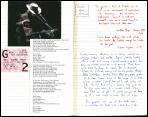
High on the walls of my classroom I have a number of posters from the Apple "Think Different" series. My high school students generally recognize the portraits of Pablo Picasso, Amelia Earhart, and Mahatama Gandhi. A few may recognize Bob Dylan from the poster reproduced at above, but very few indeed, have spent any time listening to him, seen any footage of him in concert, or have any sense of how much of an impact his music had on his era—and, indirectly, our own— much less any sense of what it is that has made him an iconic American original for close to fifty years now. I've spent part of the day putting some materials together for them to look at, and I've been thinking again about Dylan.

There's a very interesting sequence in Martin Scorsese's film No Direction Home in which footage of Dylan singing "It's Alright Ma (I'm Only Bleeding)" in concert is crosscut against an interview with Allen Ginsburg in which Ginsburg says

Around that time he asked me if I wanted to go with him to this gig in Chicago, did I want to come along. What struck me was that he was at one, or he became identical, with his breath, and Dylan had become a column of air, so to speak, at certain moments, where his total physical and mental focus was this single breath coming out of his body. He had found a way in public to be almost like a shaman, with all of his intelligence and consciousness focused on his breath.

If you study the video footage from that performance, it's not hard to see what Ginsburg is talking about. The guitar unobtrusively sets the rhythmic and melodic framework for the words arise from within him and ride on his breath, pouring forth in long concatenated phrases delivered with an uncanny self-assurance and unity of impression. It's a performance, yes, but it doesn't seem like a performance, it seems more like an event of nature: it has the unity and integrity and trajectory of sound of a rainstorm or a set of waves breaking on the shore:


Ginsburg is right, I think, to connect it all to breath. Breath has always been understood as the vehicle of spirit: the Latin verb for "breathe" is "spiro," from which we get such words as respiration and expiration and aspiration and inspiration and, of course, spirit itself. If the goal of most spiritual practices is to bring the soul into contact with the divine, the two preferred means of doing so have been meditation, which begins with concern for and attention to breath, and prayer, which begins with a concern for and attention to finding the right words.

There are times when as individuals we are able to unify our person and our breath and our words and our sense of ourselves in such a way as to arrive at a certain kind of, well, integrity. Those moments are often and perhaps of necessity private moments. Our greatest artists are often the ones who find a way to manifest that kind of integrity, as Ginsburg says of Dylan, in public. Not always, of course, no one could bear that burden, but in their moments of artistic transcendence. In so doing they draw us out of ourselves and into something deeper. The paradox is that that something deeper is something that has been in us all along, latent and yet undeniable. Listening to Dylan I hear him, yes, but my felt experience is that he is embodying something already so deep within me that it comes as a kind of recognition. Even when the lyrics as such don't necessarily make paraphrasable sense, I know exactly what he is talking about. The words are, like breath, like prayer, the vehicle of spirit, and spirit lies within us.

The implicit challenge here is that of the example that he provides us. Here is a young man who at the age of twenty was a figure of national importance whose words helped to galvanize a generation of young people to "think different" about themselves, to challenge the accepted wisdom, to question authority, to create something new out of one's voice and one's actions and one's breath. Even when he went on to repudiate the music he made when he was younger, when he chose to slip out from under the burden of the expectations that the cultural critics placed upon him, when he changed and changed and changed again, his journey was driven by his determination to be true not to what others demanded of him, but of what he demanded of himself. If we never see his likes again, it will be no one's fault but our own.


Tuesday, February 19, 2008

Closing the Circle (100x30)


The first steps sideways,
then the road rises,
the grass smooth,
but quickly steepening
toward the wall. Still fresh,
you clamber over, crawl
until you can scramble
to your feet again, and walk
with relative ease to the summit.

Breathe. Give thanks. Prepare.

Now the descent. At first a stroll,
then steadily steeper until on hands
And knees you behold... an abyss,
too far to fall. How to get home
from here? Fingers finding roots,
you flip yourself under, and hanging on
for dear life, hand over hand you go,
until your feet touch terra firma:
back where you began.


Process Reflection: This is a weird little experimental piece. Since this is the last post in the hundred-word series I’ve been doing, I began this afternoon by brainstorming a list of words and phrases that had to do with finishing, words like finale and fireworks and end of the road and closure, which led to closing the circle, which triggered the idea I began working with here, which is essentially a narrative poem imagining someone on a circular journey. In this case, the circle is not a horizontal construct but a vertical one. As I was writing I was trying to imagine the various physical obstacles one would encounter on such a journey, and then as I was doing that the whole thing began to take on this odd metaphorical weight. I spent a lot of time working the words, and then working the lines and line breaks into a configuration with a sort of circular symmetry of its own. The completed poem, and its last line, seem as good a place as any to end.

Monday, February 18, 2008

Penultimate (100x29)


I can still remember the almost tangible click in my head during my Latin I class freshman year in high school when I discovered that the word “peninsula” was derived from the word “paene,” meaning “almost,” and “insula,” meaning “island.” Almost an island…. Aha! That was for me an epiphanic moment, a revelation: that words might have not only a history but a logic connected to that history: a life of their own. I became a devotee of derivations. Now, close to fifty years later, I’m still fooling around with words: this being, in the hundred-words series, the penultimate post.


Process Reflection: I suppose that it’s somehow inevitable that as I got to thinking about this next-to-last post the word “penultimate” would shake itself off its lexicographical shelf and fall into the atrium of my brain. I started tonight’s post by writing about that word, but in so doing was overtaken by the memory of my encounter with its cognate cousin in my Latin I class, and wound up restructuring the piece around that memory in such a way as to lead up to the word of the day.

What’s been most consistently interesting to me about this nearly-completed enterprise is the way the very small canvas encourages, even necessitates, a close attention to the details, the architecture of the evolving sequence of words. I do not mean to suggest that these posts have in fact represented any transcendent or even intermediary accomplishment in terms of structural aesthetics, but they have helped to focus my attention as a writer on what exactly it is that I am doing, how I am doing it, and how else it might be attempted. Often, when I am drafting longer and less focused pieces, writing becomes for me much more automatic and intuitive and profluent; this set of writings has been, for better or worse, much more deliberate and painstaking at the word and sentence level.

I’ve also noticed by the strength of what might be called, to add two more Latin derivatives to the many already swimming about above, the autobiographical imperative: that here as elsewhere even in attempting to write analysis I wind up, as if by accident, writing my life. (Which leads us, or might lead us, into another thicket: objectivity and subjectivity. A longer post for another time.)


Sunday, February 17, 2008

Omaha (100x28)


Monday of last week we was sitting in Johnny’s on South 27th, eating our scrambled eggs and corned beef hash and waiting for the coffee to cool down enough to drink. We didn’t think much on it when the beat-up, mudcovered pickup angles into the parking space just over by the door and rattles to a stop, and out steps this lanky cowpoke in a Levi’s jacket and a ten gallon hat, looking like mebbe he come in second in a tangle with a tornado. He slaps the dust off shoulders, hitches up his pants, and heads on up the steps.


Process Reflection: Never been to Omaha. Never set foot in Nebraska. Got started on this by trying (again) to write a poem about poker, but that wasn't happening and I started thinking about particular poker games, of which my favorite is Omaha, and that got me thinking that since I don't have any information about Omaha in my head, I might be free to invent my own private Omaha, so I figured I'd start someplace, like in a diner. I googled "omaha diner" looking to come up with a credible name and found Johnny's, and then figured I had to make something happen, and so I did, and while I was doing that I started trying to create this other (wholly imagined) voice, the way this narrator is talking, and that kept me entertained through my hundred words. All of this is somehow the offshoot of the seed planted in my brain by the David Foster Wallace quote I posted yesterday. Up on that wire, and the abyss below, nada.

Oh yeah, w/r/t the guy in the truck: Dostevsky said there are only two stories: a man leaves home, and a stranger comes to town. This is the intro to the second.

Trial and Error


Doug Belshaw has a post today in which some students from Liverpool interview Ken Robinson about creativity. Robinson was witty and genial and insightful as always, but my favorite passage this:

One thing about creativity is that often you make mistakes, you get it wrong. I worked with a guy a while ago who won the Nobel Prize in Chemistry... I asked him one day when we were doing this work for the government how many of his experiments failed and he said "About ninety percent of them." And he said "But really, failing isn't quite the right word for it. If you're trying to be creative, you make all kinds of mistakes, and so what you're finding out is what works, and to find out what works you often have to discover all these things that don't work. And that's the whole process of science and art; it's very unusual to get it right the first time.


There's a parallel quote I just tracked down from Robinson's TED talks video that comes at the same point from a different angle:

Kids will take a chance. If they don’t know, they will have a go… they are not frightened of being wrong. I don’t mean to say that being wrong is being creative. But what we do know is that if you are not prepared to be wrong, you will never come up with anything original. If you are not prepared to be wrong. By the time we get to be adults, most kids have lost that capacity. They have become frightened of being wrong. And we run our companies like this by the way. We stigmatize mistakes. And now we’re running national education systems where mistakes are the worst thing you can make. And the result is we are educating people out of their creative capacities. Picasso once said this. He said, ‘All children are artists. The problem is to remain an artist as we grow up."

Saturday, February 16, 2008

Quote of the Day (100x27)


How to Play Poker

Obama never played for high stakes. Only on a very bad night could a player drop two hundred dollars in these games, typical wins and losses being closer to twenty-five bucks. [A friend] describes Obama as being a “calculating” cardplayer, avoiding long-shot draws and patiently waiting for strong starting hands. “When Barack stayed in, you pretty much figured he’s got a good hand,” former Senator Larry Walsh once told a reporter, neglecting to note that maintaining that sort of rock-solid image made it easier for Obama to bluff. (James McManus in the February 4 New Yorker.)


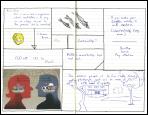
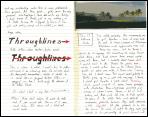
Process Reflection: Granted, these aren’t my words, but they are words that I was thinking about as I sat down to write in my journal this morning (note the old-fangled cut-and-paste job in the picture at left), and again as I sat down to do this blog entry this evening. I was actually thinking about writing a how-to poem; it was fresh in my mind because of the post today at Ken Ronkowitz's Poets Online site, and it’s an exercise that I’ve asked my students to do at various times with various models. But as I was getting ready to start, I got thinking, hey wait, there’s already a little mini-essay teed up and waiting from the McManus article in the New Yorker, and it’s about the right length. So here it is, 100 words with several layers of thoughtprovokingness (literal, metaphorical, political, and rhetorical, for starters.)

For those of you with eagle eyes and active curiosity, the other quote, in red on the left hand side of the page, is from David Foster Wallace’s characteristically funny and brilliant introduction to Best American Essays 2007:

Writing-wise, fiction is scarier, but nonfiction is harder — because nonfiction’s based in reality, and today’s felt reality is overwhelmingly, circuit-blowingly huge and complex. Whereas fiction comes out of nothing. Actually, so wait: the truth is that both genres are scary; both feel like they’re executed on tightropes, over abysses — it’s the abysses that are different. Fiction’s abyss is silence, nada. Whereas nonfiction’s abyss is Total Noise, the seething static of every particular thing and experience, and one’s total freedom of infinite choice about what to choose to attend to and represent and connect, and how, and why, etc.


Amen to that.


Friday, February 15, 2008

Friday (100x26)


5:49 on Friday, and I’m caught on the cusp of the transition between a week when there were way too many things going on and a long weekend promising at least a few empty spaces. I’d feel better if I had a better topic, but, as I keep telling my students, you have to write what it is given to you to write, then come back later and try to figure out what to do with it. At this moment, that’s me, these words, and those birds outside getting their licks in before the sun finally sinks into the Pacific.


Process Reflection: Not very ambitious, I admit: a freewrite, a process piece. The work, such as it was, involved fooling around with the wording to bring the piece in at exactly one hundred words. First I was 21 words over, then eight under, then five over again. There’s something to be said for even arbitrary formal constraints, because they make you pay a different kind of attention to which words you use and which order you use them in. It's the kind of tinkering that Raymond Carver claimed to enjoy: putting the commas back in and taking them back out again. While you do that, the world turns. Now, twenty minutes later, it’s almost dark, and quiet: the birds have gone to wherever birds go when the sun goes down. But I’m still here, pecking away, cutting and pasting, adding and subtracting, trying to get this one small thing right.

Thursday, February 14, 2008

Fire (100x25)


I was sitting in on a third grade class while visiting poet Barbara Helfgott-Hyett led the class through a reading of a Babettte Deutsch Poem called “Fireworks.” After we had read and discussed the poem, Barbara asked us to close our eyes and try to picture fireworks. What came to my mind with an unexpected forcefulness was not fireworks but a great orange wall of flame, which I connected with a long-forgotten moment. When we were asked to open our eyes and write, I wrote the first draft “Yard Work,” the first poem of my own that ever pleased me.


Process Reflection: When I first read the topic, I thought immediately of "Yard Work," written when I was in my mid-thirties. It turned out to be the first of many I wrote about my father, whom for complex reasons I had consigned to a locked room in the far corner of my brain after he died when I was eleven. The image of fire opened that door, and my father was very much a part of mental life for months afterward, showing up unnannounced almost every time I sat down to write and even visiting my dreams to talk with me. Here's the poem:

Yard Work


Spring arrives, clear and dry. Out back,
my father and I collect branches
and twigs, pile them on the brush heap.
Blown against the fence, our Christmas tree
now brown and dry, trails tinsel as
we drag it over and toss it on top
of the pile. It's time. My father takes
newspaper and shoves it beneath
the twigs and leaves at the bottom.
"Stand back now, son," he tells me.
From his pockets he pulls a pack
of matches, tears one out. He bends
and strikes, then - cupping his hands
against the breeze - lights the fire.

First a curl of smoke, then orange fingers
fan upward. Upward! Leaping, the flames
catch and claw. The first lick touches the tree,
and with an enormous crackling whoosh!
it blazes, a yellow wall against the sky.
Lashed by the heat, I stumble back into
my father's arms. I stand stunned, shielding
my face, as black vapors stream skyward,
hissing; my eyes sting and tear. In seconds,
the tree is turned to black bones; the flames
subside. Cool air sweeps my face. Behind me,
my father stands. In silence we watch
the crumbling limbs burn slowly down to ash.


Wednesday, February 13, 2008

Metal (100x24)


My brother-in-law was good with metal. His would hoist the engine out of a ’69 Plymouth, dismantle it, clean and lubricate every part, replace the gaskets and points and plugs, and then patiently reassemble it, fully confident that when he turned the ignition the car would spring to life, engine humming. If I tried that, there’d be a loud noise, an acrid smell, and lots of smoke. I’m more of a wood kind of guy. Wood is more forgiving: the tolerances are greater. You can carve and sand and smooth your way in soft, forgiving increments toward your heart’s desire.


Process Reflection: I had no idea when I sat down to write that I would wind up writing about my brother-in-law, but as I sat staring at the word "metal" on the screen I thought first about what metal is good for and then about how it is worked. From then on, the piece came easily; the problem was trying to keep it to 100 words. The first time I stopped to check I was at 116 with a ways to go, so I had to go back and start paring down.

For what it’s worth, every word is true. My father worked in wood, and as I learned from him how to use hand tools and power tools, how to cut and join and finish wood. I learned to know and appreciate the differences between pine and maple and oak and mahogany and and teak and ash, the way they resisted or responded to my ministrations, the various way the grain would come alive under stain or wax or varnish or shellac. I never quite felt comfortable with metal: cold, independently-minded metal. The only success I ever had working with metal was in art class making copper panels by rubbing the sheets over molds carved from wood. I’ve seen work done by silversmiths and goldsmiths which is beautiful to behold, but if I had the choice I’d rather own a koa bowl or a sandalwood frieze. One of the things I most admired about my brother-in-law was his ability to work with any materials. He was a gifted painter, a thoroughly competent mechanic, and a woodworker as well. He loved making things. During the time I was growing up I watched him as he built a stagecoach from scrap lumber, a sailboat, a pool table, a guitar. But what he really liked working on was cars and motorcycles, things made of metal. I've always been somewhat awed by his versatility.

Tuesday, February 12, 2008

Point of Departure (100x23)


Most nights it didn’t take long. He’d lie down, turn on his side, put his head on the pillow, stretch, and be off into that other place, those other places, amongst old friends and parakeets, disturbing juxtapositions: the basketball game suddenly gone airborne, the plane in flames, the sensation of falling, the soft whoomp as the waters embraced him, whispering, singing, songbird winking, what’s the name of that woman with the platinum hair? Mary Something, beside the campfire, sleeping bags, whose arms, whose thighs, the sound of footsteps, a car door slamming, voices outside the window, the light dawning: morning.


Process Reflection:
Couldn’t remember the topic for the day. Looked it up after doing the dishes tonight to plant it in my brain: pillow. Lay down on the sofa, did the Tuesday crossword, finished it and put it aside, started to drift off, lying there. Felt my head on the pillow; thought: pillow. Thought, okay, here's a place to begin: the point of departure. Got up and went to the computer and started typing, thinking about dreamspaces, recalling images from recent dreams. Pushed into it, keeping an eye on the word count, knowing I didn’t have much room, trying to compress. This one came fast: about seven minutes from start to finish. Came in at 102 words. Cut two. Done. Good thing too. Busy day today. Don't know how much I would have been able to do if I really had to work at it.

A Contrast in Styles


Here are two videos: the first a pretty slick promo for Barack Obama, the second an inspired parody of the first that targets John McCain. Both videos are very artful and imaginative in how they go about making, and in the case of the second, scoring, their points.


Monday, February 11, 2008

Hair (100x22)


Orville was working over his scrapbooks at the dining room table when the Parcel Post truck pulled up. Orville watched, his heart thumping, as the delivery man walked to the back of the truck, took out the large oval box, and, hoisting it to his shoulder, started up the brick walkway toward Orville’s front door. Orville put the cap on the mucilage container, hoisted himself from the chair, and was waiting just inside the door when the knock came. “Package for Orville Bottjer,” said the man. “That’s me,” said Orville, taking it from his outstretched arms. “Thanks a bunch.”


Process Reflection: Didn't have an idea of where to begin with "hair," so googled the word and found this image. At that point it pretty much wrote itself.

Sunday, February 10, 2008

Green (100x21)

It’s hard to argue with green. Green is what grows, what germinates, what sunlight calls from the darkness under the surface. Green comes naturally. Green is close to the earth, eco-friendly. Green the vine, the leaf, the grass, the garden, the forest, the prairie, the jungle, the lawn. Green the color of pears, of parsley, of peas, of peace. Green the color of conservation, of moderation, of minimalism. That small footprint: green. That potted plant. Green needs water, needs light, needs love. Green is an emerald. Green says, “Live.” Green says, “Recycle.” Green says, “Breathe.” Green says, “Enough is enough.”


Process Reflection: The whole thing about writing 100 words a day for 30 days, even without the additional constraint of assigned topics, puts you under some pressure. Some days you have time to think and prepare, some days, like today, you've got a topic and a limited amount of time in which to attempt to pull a rabbit out of a hat, if you happen to have a hat, and if the rabbit doesn't turn out to be some other variety of rodent. Today there was a lot of other stuff going on, and I was faced with the choice of pounding something out, however gestural, or falling off the wagon. What this piece has going for it is the series of moves that it has in mind to make: a meditation on at least a subset of the denotations and connotations of green. What it lacks, at this preliminary time-delimited stage of its development, is even the slightest element of surprise. It fails in its aspirations to be epiphanic. Which is fair enough. In one of my favorite essays on writing, "Let's Say You Wrote Badly This Morning," David Huddle develops a theory of what he calls "aesthetic luck":

Aesthetic luck is random and two-headed. No writer, no matter how accomplished, can be certain when sitting down to work that the results of his or her best efforts will be writing of high quality. One can school oneself in the literature of one's tradition, train oneself to a high level of technical skill, construct ideal working circumstances of time and place, regularly come to the writing desk rested, alert and in good health, achieve a state of brutal self-honesty, open one's mind to every possibility of concept and language, and nevertheless write one lousy line after another. Conversely (and perversely) one may pick up a napkin in a bar to make a few notes and suddenly find oneself writing fabulous stuff. The odds of writing well are a great deal better if the writer is well-prepared, but there's never a guarantee of good writing.

Later in the essay, he talks about revision as part of the process, and comes up with a rough estimate of the odds associated with aesthetic luck:

Aesthetic luck is the major argument in favor of working through a process of revising a piece of writing through many drafts. If you're a supremely talented artist and you hit a very lucky day, then maybe you can write a poem or story or chapter of a novel that needs no revision. If you're a regular writer with your appointed portion of aesthetic luck, you'll need to come at the piece again and again. I like to think of revision as a form of self-forgiveness: you can allow yourself mistakes and shortcomings in your writing because you know you're coming back later to improve it. Revision is the way you cope with the bad luck that made your writing less than excellent this morning. Revision is the hope you hold out for yourself to make something beautiful tomorrow though you didn't quite manage it today. Revision is democracy's literary method, the tool that allows an ordinary person to aspire to extraordinary achievement.

Revision of course is not an option for athletes. In my opinion, baseball players would be able to offer more testimony to the capriciousness of athletic luck than the players of any other game. My most outrageous notion on this matter is that the crazy luck of baseball accounts for the vast role of spitting by its players: to spit is to change one's chemistry, to cast out the immediate past, to set oneself to face the future. In their thinking; batters and pitchers must proceed in a logical manner: they consider the scouting reports and the opinions of their coaches and fellow players; they consider “the last time up,” along with the history they have shared in all their previous encounters; they make adjustments; they spit for luck.

In the overall balance of aesthetic luck, by my calculations, the bad outweighs the good by a ratio of about 17 to 1, but the good nevertheless exists.
I find Huddle's analysis both true to my experience and also enormously encouraging. Today's post is one of the 17 that I had to write to eventually, maybe, find my way to the magical number 18. It may itself take on the qualities of the 18th with subsequent revision. In the meantime, it is what it is.

Saturday, February 9, 2008

Blister (100x20)

Blister

He had planned to bring old sneakers with him, but in the morning rush had just grabbed his bag with the new sneakers. By the end of warmups he could feel the blister forming. Later, while they were doing defensive slides, he could feel the stabs of pain every time he stopped moving. After the suicides, he could barely walk. In the locker room, he pulled off his blood-soaked sock to reveal a loose flap of skin the size of a silver dollar, the cracked pink skin underneath, the red radial lines converging on the pulpy mass of bloody tissue.

Process Reflection:
The trigger was “blisters.” As I was thinking about it I remembered on many occasions seeing my sons’ feet after the first day of basketball practice, and wondering how in the world they would even be able to walk the next day. There are several larger essays lying in wait behind this exercise, one of which would have to do with sports, the disproportionately large place they occupy in the American cultural landscape, the sacrifices that athletes are called upon to make, and the ways in which those sacrifices become ritualistic rehearsals for the more substantive sacrifices we make as adults. All of which puts me in mind of a terrific poem by Anne Sexton, also a meditation from a parent’s point of view of the sacrifices a child must learn to make:

Pain for a Daughter

Blind with love, my daughter
has cried nightly for horses,
those long-necked marchers and churners
that she has mastered, any and all,
reigning them in like a circus hand--
the excitable muscles and the ripe neck;
tending this summer, a pony and a foal.
She who is too squeamish to pull
a thorn from the dog's paw,
watched her pony blossom with distemper,
the underside of the jaw swelling
like an enormous grape.
Gritting her teeth with love,
she drained the boil and scoured it
with hydrogen peroxide until pus
ran like milk on the barn floor.

Blind with loss all winter,
in dungarees, a ski jacket and a hard hat,
she visits the neighbors' stable,
our acreage not zoned for barns;
they who own the flaming horses
and the swan-whipped thoroughbred
that she tugs at and cajoles,
thinking it will burn like a furnace
under her small-hipped English seat.

Blind with pain she limps home.
The thoroughbred has stood on her foot.
He rested there like a building.
He grew into her foot until they were one.
The marks of the horseshoe printed
into her flesh, the tips of her toes
ripped off like pieces of leather,
three toenails swirled like shells
and left to float in blood in her riding boot.

Blind with fear, she sits on the toilet,
her foot balanced over the washbasin,
her father, hydrogen peroxide in hand,
performs the rites of cleansing.
She bites on a towel, sucked in breath,
sucked in and arched against the pain,
her eyes glancing off me where
I stand at the door, eyes locked
on the ceiling, eyes of a stranger,
and then she cries. . .
Oh my God, help me!
Where a child would have cried Mama!
Where a child would have believed Mama!
she bit the towel and called on God
and I saw her life stretch out. . .
I saw her torn in childbirth,
and I saw her, at that moment,
in her own death and I knew that she
knew.