Sunday, April 17, 2011

Life As We Knew It


I recently ran across a blog post that was asking why we ask students to read the stuff we do when they could be reading something they might actually like, like The Hunger Games or Life as We Knew It. The Hunger Games I knew about, but Life as We Knew It was a new one on me. So I wound up downloading a sample chapter to my Kindle, and on the strength of that chapter wound up buying the whole novel, which I then devoured in about two days.

Life as We Knew It is a YA novel which takes a fairly simple premise, almost silly premise, and then pushes it to the point where it becomes not just believable but intensely real and engrossing. It’s a novel that reads pretty much like what it purports to be, which is the journal of a high school sophomore. There isn’t much of interest going on stylistically. The language is everyday language, the sentences themselves are everyday sentences, the characters are not particularly remarkable in terms of their talents or capabilities. Even though I’m a compulsive annotator, I read the entire book without making note of a single passage that called attention to itself from a writerly perspective.

It’s a little surprising, then, that I found the book so satisfying, and that it has maintained such a strong presence in my head since I finished it. It succeeds because it builds so carefully, and renders with such patience, the experience of an ordinary girl in what turns out to be an extraordinary situation.

As the novel opens, Miranda, the main character, has just found out that her father’s second wife is pregnant. She’s excited because he’s asked her to be the godmother. She’s also looking forward to the upcoming swim meet and thinking about whether she might like to start skating again, after having taken some time off due to an injury, and she’s trying to reconnect with an old friend she’s drifted away from. And some of her friends are asking her what she thinks about the rumors that an asteroid is about to collide with the moon.

That collision, only dimly attended to in the weeks and days leading up to the event, is what sets off all that follows in the novel. The moon, knocked off its regular orbit, comes closer to the earth, setting off a sequence of effects: tsunamis, volcanic eruptions, ash in the jet stream, climate change, interruptions in the electronic grid, changes in the growing cycles of plants and the delivery systems for food, gasoline, pretty much everything. These changes occur gradually at first and become progressively more disturbing and have a progressively more disruptive effect on the lives of Miranda and the people around her. The book is largely about the escalating series of losses and threats and how Miranda and her family cope with them.

Life as We Knew It might be read as a sort of prequel to Cormac McCarthy’s The Road, a darker, more stylistically ambitious novel which takes place after civilization as we knew it has collapsed. Susan Beth Pfeffer is offering a vivid depiction of how that collapse might begin. And because it begins with more or less where we are and demonstrates how fast it might all go up in smoke, it is all the more sobering.

I’ve written before about my leanings toward catastrophism. I’d suppose I’d describe myself as a short-term optimist and long-term pessimist. I pick up the papers every day and don’t see any good reason to suspect that any of what appears there is likely to get better any time soon. (Sample inventory from today’s paper: budget crisis forcing government service cutbacks, BP oil disaster effects a year later (along with increased support (!!) for continued offshore drilling), continued coverage of nuclear disaster in Japan, record number of tornadoes in the South this year, suicide bomber in Afghanistan kills three, al-Qaida resurgent in Yemen, rebels fleeing in Libya as Qaddafi forces unleash cluster bombs in neighborhoods, chemical companies charged with injecting hundreds of millions of gallons of hazardous and carcinogenic chemicals into wells from 2005-2009. And so on.) I’m at a loss as to what to say or do in the face of headlines like that. This is the world we live in. This is the world we have created. And this is only a taste, I fear, of what is to come.

The most affecting passage in Life as We Knew It comes toward the end of the book. Miranda's family has been trapped in a house with no electricity for more than a week by a savage blizzard. They’re rationing food out of cans, one meal a day, and melting snow to get water, and the older people in the family are cutting back on eating so that Miranda’s youngest brother will be able to eat a little more. And it’s dawning on her: this is as good as it’s going to get.

I still remember when Mom sprained her ankle the first time and we played poker and really enjoyed ourselves. If you’d told me three months before then that I’d have called that a good time, I would have laughed out loud.

I eat every single day. Two months from now, maybe even a month from now, I might eat only every other day.

We’re all still alive. We’re all healthy.

These are the good times.


An asteroid hitting the moon? That’s about the last thing we need to worry about. But everything else in Life as We Knew It is pretty much dead on.


Sunday, April 3, 2011

The Silent Sky


I was in San Francisco last week and wound up taking a walk one evening on Grant Street in Chinatown. I stepped into one of the stores and there was some music playing caught me by surprise: acoustic guitar, violin, and some kind of hand-struck drum in an arrangement that sounded like a lot of Western folk music, and a very soft, floating woman’s voice doing the vocals in what I assumed was Chinese. It was one of those odd moments where it felt like I had stumbled into the right spot at the right time to hear this music. I asked the woman behind the counter what was playing, and she handed me a CD entitled Silent Sky by a band called Haya.

I bought the CD and have been listening to it since I got home. Turns out the title track, the one I heard in the store, is up on YouTube:


Turns out the lead singer, Daiquing Tana, is not actually Chinese at all, but Mongolian. I’m not sure which language she’s signing in. The CD case includes a booklet with the lyrics translated somewhat precariously into Engish:


The sunrise and the moonset
In the flourish world
From the eternal
Your frame is melting in the setting sun
I sound a sad blessedness
Silent prayer for the soul of dedication to pacify
When everything returns to silence
I have no desire.

On the blowy grassland
There is my lover
Ah you wind blowing gently
and listening to his sadness songs
Ah you moon, could you lighten his way
Ah you fire, could you make him warm


The Mongolian thing got me wondering again about the purported connection between the Mongolians and the Huns. I have yet to come across a coherent explanation of the history, but from timelines like this seem to suggest that the modern-day Mongols and the Magyars had common ancestors in Siberia as far back as 500 B.C. and that much of the military and cultural history of China, Korea, Russia, India, the Middle East, and Central Europe has been influenced by the actions of Mongol and Hun warriors like Attila, Genghis Khan, and Kubla Khan.


Sunday, February 20, 2011

Here I Am


I’ve just opened a new file in Google docs. A blank page confronts me. I’m stare at the screen. The cursor, a simple vertical black line, blinks at me, signaling a readiness, a willingness to begin. I stare at the screen. I’m thinking. It’s not that I don’t have ideas, I’ve got ideas up the wazoo, as my high-school classmates used to say, back in the day. The question is, which one? And why that one, and not one of the others?

I get up and go to the kitchen and retrieve my notebooks. (Well, four of them. The analog ones. On my computer there are notes in Word and Googledocs and Evernote and on my iPhone. And there are file cards and Post-its in little piles all over the place.) There are my two little pocket Moleskines, one for notes, one for sketches. There is my work notebook, where I take notes at meetings. And then there’s my personal journal, which I write in mostly on Saturday and Sunday mornings, right after I have done my morning exercises and right before I shower and eat. It’s my Saturday/Sunday journal because those are days when I have can usually count on having time to write that does not impinge upon other scheduled events, like making it to work on time. I do sometimes add stuff to the journal during the week, but usually it’s by pasting in something I’ve read or want to remember. This, for example:

Art is really an activity, and cannot be otherwise. There is no static art. Art is always an activity. And the fact that it ends up as a painting that somebody hangs on a wall is just a by-product of an activity. It’s not the activity itself. The real act, the real art, is the making of the art. And the real making of the art is a performance. Whether there’s people there watching you, or you’re doing it on your own, you’re moving around, you’re doing this thing and then that thing, you have an order to the way you work, there’s a body language at work in the way you stroke the canvas, there’s a sense of prioritizing of what big shapes and what little shapes, there’s always a sequence of some kind involved. Art is composition, and composition is always in time. It’s always a performance.


That passage is from a video interview on the web site of George Woollard. I've been attending workshops with George for a couple of years now. He likes to talk while he works, and I discovered early on that what he had to say about art is not only interesting in itself but often has all kinds of resonances with what I have myself been thinking (and telling my students) about writing all these many years. So after the first few sessions I began using a digital tape recorder to capture his remarks. Then I’d transfer the digital recording to my laptop, plug in my earphones, open the file, open a new Word document, and then painstakingly transcribe the audio: listen to a sentence or two, click pause, type what I heard, click go. Repeat. Repeat. Repeat. (It generally takes me about three hours to transcribe a one-hour talk.)

There are a couple of benefits that arise from this process. One of course is that I get to hear the talk again, more or less in slow motion, and the act of transcribing the words brings them more deliberately into my brain. It’s nice to have the extra processing time. Even if I never re-read the transcripts, it’s still a good way for me to absorb what he was trying to get across. In fact, having the transcript available is not unlike having the painting to hang on the wall. It’s nice to have, but it’s not the activity itself. George’s point being, it’s the activity itself that is the art, and the art in its making is a performance. (As it is in writing. As it is even as I write this, doing this thing and then that thing, involving myself in a project of sequencing: let’s see, now where are we? And what comes next?)

Another spinoff benefit: my touch typing is way better than it was when I started. A third: I can take excerpts from the talks and fold them into other work, as I have done here, moving from one idea to the next.

I’ve been reading Stanley Fish. Chapter 6 of his most recent book, How to Write a Sentence: and How to Read One, has a chapter on “The Additive Style,” which begins like this:

Sentences like Milton’s and Pater’s are not bashful about foregrounding the process of their own construction. They flaunt their artfulness and invite readers to share in the verbal pyrotechnics they display. But suppose you wanted to achieve another effect, the effect of not planning, order, and control, but of spontaneity, haphazardness, and chance. Then you might avail yourself of another style, no less artful, but marked by the appearance of artlessness. The fountain of this style is the French Essayist Michel de Montaigne... who announces (in “A Consideration upon Cicero”), “I write naturally and without a plan; the first stroke of the pen just leads to a second.”... [and] “I do not portray [finished] being; I portray passing...from day to day, minute to minute... This is a record of various and changeable occurrences, and of irresolute and, when it so befalls, contradictory ideas.” (“Of Repentance”).


What Montaigne says here echoes another of George’s core mantras: that you don’t need to know where you’re going. You need to know where you are:

So what you want to do is you want to embrace the process of composing. Composing, fabricating, creating the image. That’s what your job is. So as you try to figure out what you’re doing, this is what you do. You’re just putting one foot in front of the other. You’re walking through the composition, so all you really have to do is just decide what the next step is. You don’t have to know what the end product is. All you need to know is, okay, well, here I am.


Process Reflection: Well, this post is fairly transparently, I hope, an exercise in trying to relate and to apply a concept from the world of art to the world of writing. Another idea that George talks a lot about is the idea of linkage: that whether you are doing representational art or abstract art you begin at one point and then build outward from there, linking one move to the next. I started where I was, over there, up top, and worked my way forward. And now, here I am, over here. I’ve been making the argument with students and colleagues for years: this is what writing is about: facing a blank page and working your way into something. There are times when I (or my students) approach the blank screen or the blank canvas with a pre-set idea. But I find that what I (they) write on those occasions rarely satisfies me in the way that working in a more explorational way does. I didn’t know when I started what I was going to write about. But as I worked into it, the connections fell into place. It’s a process. It’s a performance. “Art is composition, and composition is always in time.” And so is writing.

Random Query: Did anyone else notice the colon in the title of the Fish book, and if so, does it create a disturbing ripple in your internal universe the way it does in mine?

Giving Credit Where Credit is Due: The proximate cause of me posting at all this evening was a post by Ken Ronkowitz on Weekends in Paradelle, one of a legion of really interesting blogs that Ken somehow manages to maintain, which basically embarrassed me in the nicest possible way into once again taking up the sword. Thanks, Ken.

Complaint Department: It looks like once again yet already Google docs has disabled the function that used to allow me to post directly from Google docs to my blog. So that means I have to copy, paste, and re-format everything to publish it. Color me unhappy about that. C'mon, guys. Please? Pretty please with sugar on top?


Tuesday, February 8, 2011

The Just and the Unjust


Back in November Christine Thomas over at Literary Lotus published an interview with Scott Turow in which he came up with a list of the five best legal novels. I had read three of them: Billy Budd, To Kill a Mockingbird, and Snow Falling Cedars. I had not, however, read The Just and the Unjust, by James Gould Cozzens, about which Turow had this to say:

Cozzens was regarded as a major American novelist in the middle of the 20th century, and he has fallen by the wayside in terms of public esteem. But this is just a very, very good book about a small town lawyer. It’s ultra-realistic, which means that it is from that time when realist novelists believed that their job was to portray only the so-called middle range of experience, which other people might call boring. But it’s a really beautiful book. It’s a beautiful portrait of a time and a place. If anybody really ever wants to know what it was like to be a small town lawyer in the United States in the 1930s, people whose grandfathers or great-grandfathers were lawyers in a small town and want to know what their life was like, I would say read this book.


It turns out it’s not an easy book to get hold of. It’s not on the shelves at the local bookstores, and it’s not available on Kindle. I was able to get a pretty weatherbeaten copy from the UH library, and I found Turow’s assessment dead on. Although Cozzens may not have been an innovator or stylist along the lines of his contemporaries Faulkner and Hemingway, he is a capable and disciplined storyteller who knows his way around a sentence. His narrative style tends toward a kind of desciptive precision and deliberation that brings the world of the courtroom vividly to life and is very satisfying to read. Here, for example are the opening sentence of Chapter Two:

This was the hour when time stood still. The well of the court was sunk in tepid shadow. Above the slanting half circle of shadowed seats the courtroom windows were free from the sun now, but bright with light; and Abner, leaning back in his chair, could see the northeastern sky, a hazed hot blue behind the sunny treetops. The heavy quiet in the court was not broken so much as mildly stirred by Bunting's voice. Bunting's questions, even and dry, spoken slowly, rose in the silence and shadow, caromed off wall and ceiling, and the multiple echoes died. From the witness stand, Doctor Hill, the coroner, returned his answers with professional deliberation, the ripple of sound beginning again, widening out, echoing, dying.

On the bench Judge Vredenburgh moved his head, his double-chinned but strong and firm plethoric face turning in sharp advertence, his blue eyes glinting, from Bunting to the witness and occasionally to the jury. His right hand under the desk lamp before him could not be seen, but the light winked now and then on the metal end of a pencil as he wrote. Under the bench Joe Jackman, in the glow of his lamp, wrote too, and paused and wrote and paused, his expression bemused, his thoughts apparently far away. Next to Joe sat Nick Dowdy, gray head bowed, fat chin sunk on his chest, placidly asleep. Next to Nick, Mat Rhea, the clerk of Quarter Sessions, looked at his clasped hands, slowly and patiently twiddling his thumbs. Farther down the line, Gifford Hughes, the prothonotary, sat back, his mustache sadlydrooping, his eyes dreamily fixed in space. Beyond Gifford, Hermann Mapes, the clerk of the Orphans Court, bent forward, plainly busy with some of his office work. In their elevated chairs around the circle of the rail, the tipstaffs were drowsing. Now one, now another, now two or three at once nodded slowly. Then one or another woke, lifting his head with a light practiced jerk, affecting to have been awake all the time. Down by the lower doors the state police officers yawned.


I love the way the language moves in that passage, the attention to light and sound in the first paragraph, followed by the quick, deft, shorthand sketches of the local cast of characters in the second. Cozzens depicts them with empathy and deep understanding.

The main character in the book is Abner Coates, who is assistant to the District Attorney in a murder case. The novel follows in patient detail the course of the trial over three days. During those three days, Abner finds out that the DA is going to be moving on to another job and it looks like this will give Abner the chance to himself become the DA. The question is whether or not he wants it. He had thought he did, but then, for a variety of complicated reasons, he decides to turn it down, and in this passage, where we follow his thoughts as he tries to reconcile himself to his decision, seems to me to be a classic inventory of sorts, revealing a great deal of understanding about the life of a trial lawyer in particular, but also about the dilemma of really any person trying to find the balance between complex, challenging work and quality of life issues:

Walking up to where his car was parked behind the courthouse, Abner did what he could to adjust himself to such a great change of plan. It would certainly be a load off his mind. When you were in the district attorney's office they kept you on a sort of treadmill. Quarter Sessions were sure as death and taxes. You cleaned up the term's trial list, and as soon as you were through, indeed, before you were through, it began all over again. Night and day, people (and often old familiar ones) were busy with projects considered or unconsidered, which would suddenly collide with the law and become public. In advance you could count on case after case — always fifteen or twenty — of operating a motor vehicle while under the influence of intoxicating liquor. Boys were swiping things because they had no money; and some of them were going to be caught and held for burglary, larceny, and receiving stolen goods. There would be forcible entries here and felonious assaults there. Somebody would wantonly point a firearm; and somebody else would sell malt beverages on premises without license. Fornication had duly resulted in bastardy, and the Commonwealth was charged with seeing that the disgruntled father supported his little bastard. Heretofore respectable, an old man would feel indescribable urges to expose himself to women, and this was open lewdness. Forged instruments would be uttered, fraudulent conversions attempted; and, in passion or liquor, somebody might seek to kill a man or rape a woman.

And so the indictments piled up. The district attorney's office saw the prisoners, and talked to witnesses and listened to complaints. They arraigned the guilty pleas in Miscellaneous Court; and prepared the others for the grand jury. The county officers brought in to them the non-support and desertion cases; prisoners became eligible for parole, and the parole violators were picked up. Keeping step with it all (or sometimes a little behind) the papers to be signed and the forms to be filled kept accumulating — recognizances; petitions for appointment of counsel, for approval of bills of expense, for attachment, for condemnation and destruction of contraband, for support and to vacate support, for writs of habeas corpus ad prosequendum and ad testificandum; the criminal transcripts; the warrants; the waivers of jury trial — anyone ought to be glad to get rid of all that. Not to mention the endless hours in court while you asked formal tedious questions to foregone conclusions, while you waited for juries to make up their rambling minds, for his Honor to get through in chambers, for absent witnesses to be found and produced, for court to open and court to adjourn — "My God!" thought Abner. "What a way to spend your life!"


This is a book I really enjoyed reading, the kind of solid, patiently crafted book you can sink your teeth into.

Thursday, February 3, 2011

Write or Die


A student came by yesterday for a conference and happened to tell me about a web site, writeordie.com. Which is actually what I used to draft this post. It's a pretty simple concept. You set yourself a time limit and a goal of then a certain number of words. (I chose ten minutes to come up with 200 words.) The site provides you with a text box with a timer and word count at the bottom. If you don't keep typing, the screen goes from pink to red to darker red, and then a horn starts to blare, and eventually the program starts erasing the words you have already typed. It's basically a way of forcing yourself to write, leaning more heavily on sticks than carrots.

It's been almost two months since I've posted anything on Throughlines and I knew I needed some kind of a kick in the pants to get myself started again. So this is as good a start as any, I guess. I gave myself ten minutes to come up 200 words. Right now I've got four and a half minutes left 34 words to go, so unless I run off the rails and into a rock wall I'll probably make it. Then I can go ahead and post this and say to myself, there, it's done.

At least the first draft — of exactly 200 words until I started editing it — was done. Then I just copied what I wrote there into the Blogger window, proofread and tidied up.

Process Reflection:

Well, it served the purpose, and I can see it would be a cool tool in certain situations. There's something a little franticness-inducing about typing while keeping an eye on a timer. The experience reinforced for me how much stop and go, how much thinking and re-thinking I normally do while I'm writing. Often, it's actually a kind of meditation practice. This time, it didn't feel like that.

Sunday, December 5, 2010

The Interrogative Mood


My favorite literature-related blog is Scott Esposito's Conversational Reading. He recently had a post about a new book by Padgett Powell's new book The Interrogative Mood, which is described as a novel, but is really more of a book-length list poem consisting entirely of questions. Esposito cites an interview in which Powell talks about the origins of the book:

I was in the habit of receiving emails in a particular form from a female colleague at work, instructing me how to act,’ he says – he teaches creative writing at the University of Florida. ‘They would go something like this: “Is it time for our esteemed director to chat with the provost about the autonomy of the programme? Are we remembering what was promised us last week by the dean?” I started wanting something in response. So I sat down one morning and wrote: ‘‘Are your emotions pure? Are your nerves adjustable?” Within about two pages I was done with her and I was having so much fun I wanted to carry on.
And carry on he does, for close to two hundred pages. The obvious challenge, right from page one, given the severe formal limitation which the author has submitted himself to, is to somehow avoid making the reader feel bored or bludgeoned and overwhelmed by just too damned many things coming at him for too long a time.

So how do you do that? Well, it helps to be manic and it helps to be funny (this is the funniest book I've read in years) and it helps to be innovative and uninhibited and it helps to have a supercharged brain that that can get from point a to point b to point z and back again in lots of different ways.

Here's the opening salvo:

ARE YOUR EMOTIONS PURE? Are your nerves adjustable? How do you stand in relation to the potato? Should it still be Constantinople? Does a nameless horse make you more nervous or less nervous than a named horse? In your view, do children smell good? If before you now, would you eat animal crackers? Could you lie down and take a rest on a sidewalk? Did you love your mother and father, and do Psalms do it for you? If you are relegated to last place in every category, are you bothered enough to struggle up? Does your doorbell ever ring? Is there sand in your craw? Could Mendeleyev place you correctly in a square on a chart of periodic identities, or would you resonate all over the board? How many push-ups can you do?

Are you inclined to favor the Windward Islands or the Leeward Islands? Does a man wearing hair tonic and chewing gum suggest criminality, or are you drawn to his happy-go-lucky charm? Are you familiar with the religious positions taken regarding the various hooves of animals? Under what circumstance, or set of circumstances, might you noodle for a catfish? Will you spend more money for better terry cloth? Is sugar your thing? If a gentle specimen of livestock passed you by en route to its slaughter, would you palm its rump? Are you disturbed by overtechnical shoes? Are you much taken by jewelry? Do you recall the passion you had as an undergraduate for philosophy? Do you have a headache?

Why won’t the aliens step forth to help us? Did you know that Native American mothers suckled their children to age five, merely bending at the waist to feed them afield? Have you ever witnessed the playing of shuffleboard at a nudist colony? If tennis courts could be of but one surface, which surface should that be? In your economics, are you, generally, laissez-faire or socialist? If you could design the flag for a nation, what color or colors would predominate?

This is essentially all by way of warming up. As Powell gets going, he keeps inventing new ways to bend sequences to new purposes and to begin connecting them so that they (at times) resonate with one another and (at times) leap off in other unanticipated directions. Sometimes there are little riffs with philosophical overtones:

Is there enough time left? Does it matter that I do not specify for what? Was there ever enough time? Was there once too much? Does the notion of “enough time” actually make any sense? Does it suggest we had things to do and could not do them for reasons other than that we were incompetents? Did we have things to do? Things better done than not? Thus, important things? Are there important things?
(The book I found myself thinking about as I was reading The Interrogative Mood is John Ashbery's A Wave. In both books, you basically are launched into a hyperstimulating verbal environment with sequences of sentences and thoughts coming at you in waves: the verbal equivalent of jazz, with many of the attendant pleasures thereof.)

Sometimes it feels as if you are under interrogation by a pyschologist attempting to assess your competencies and your character, as if in rehearsal for The Last Judgment:

Were you a thumb sucker? Would you rather argue with people or not? Can you think of a musical instrument useful in murder other than piano wire? Have you studied the soft toes of geckos? Do you comprehend with complete certainty how bonds work? Would you sail an ocean on a small boat? Do people who purport to know what a fractal is have a leg up on those who confess they don’t? If you came upon a party celebrating something or someone with a yellow sheet cake and white icing, would you partake happily? Do you remember the candies called jawbreakers and Fireballs? Do you have a cutting-edge TV? What dead person would you bring back to life? Do you favor protecting the little wilderness remaining, or do you concede that there is so little left it might as well be ceded to the tide? Would a small red balloon cheer you up? A dog?
And sometimes it's just, well, like this:

If I said to you, “I want to return to 1940 and have a big coupe with big running boards and drive it drunkenly and carefully along dirt roads never causing harm except for frightening chickens out of the road, and I want you standing out there on the running board saying Slow down, or Let me in, and laughing, but I don’t stop, because of course you don’t mean it, you think as I do that a big 1940s coupe and careful drunken driving and one party outside the car and one inside and both laughing and chickens spraying unhurt into the ditches is what life was then, is what life was before it became ruined by us and all our crap,” and if I said to you, “I have an actual goddamned time machine, I am not kidding, we can get in the coupe inside thirty seconds if we take off our clothes and push the red button underneath that computer over there, come on, strip, get ready”—would you get ready to go with me, and go? Would you ask a lot of questions? Or would you just say, “Shut up and push the button”?

So if you find yourself, as I did the other night, with your finger hovering over the keyboard as you debate with yourself whether or not a book of this kind might be worth ponying up some cash for? Shut up and push the button.

Sunday, November 7, 2010

The Golden Vanity


I'm teaching again this fall, one class of sophomores, and since I've been asking them to maintain commonplace books I've been keeping one of my own. Earlier this week I decided to try a second torn-paper collage (the first was the subject of my previous post on Throughlines, which it seems hard to believe was more than a month ago), and it came out, without a whole lot of planning or forethought, like this:


I don't know what you see when you look at this, a ducky or a horsey perhaps. But when I got done with it and took a step back, I know exactly what popped into my mind: it's a boat. And something in my reptile brain was telling me which one: the Golden Vanity. And therein hangs a tale.

Forty-five years ago, during freshman orientation week at Fairfield University, the luck of the draw for dorm rooms matched me up with a guy named Bill Sheehan. I had never met him before, and I did not see him much afterward, but the few evenings we spent together in that dorm room had a significant impact on my life. Because he had brought his guitar, and he could play, and he could sing, and he was familiar with a whole bunch of music I had barely heard of and certainly never heard.

It's hard to believe, listening to what gets played on radio stations today, that once upon a time there was room on the airwaves for the likes of Joan Baez and Judy Collins and Peter, Paul, and Mary. The folk music revival and the British Invasion (The Beatles, The Stones, The Who, among literally hundreds of others) happened more or less simultaneously with and helped to fuel political engagement - civil rights and Vietnam war protests among them - among high school and college students to a degree that is pretty much unimaginable today. A colleague had a conversation with his students during homeroom the other day and they apparently incredulous that such a thing as the draft ever existed.

Anyway, one of the songs that Bill Sheehan sang for me in our dorm room was a song called The Golden Vanity. It is number 286 of the set 305 songs included in the exhaustively researched English and Scottish Popular Ballads which were collected by Francis Child and published in a series of six volumes from 1882 to 1898. I bought the whole set in the Dover Paperback edition and I have it still.

As with all other ballads passed down by word of mouth over many generations, there are a lot of variations of the song. The one that Bill sang for me was a somewhat simplified and colloquialized version not unlike that recorded by dozens of folk musicians of the era. The lyrics as I learned them went something like this:

The Golden Vanity

There once was a ship and she sailed upon the sea
And the name of the ship was the Golden Vanity
And we feared she would be taken by the Spanish enemy
As she sailed upon the lowland, lowland, lowland
Sailed upon the lowland sea.

Then up spoke our cabinboy and boldly out spoke he
And he said to our captain "What will you give to me
If I swim along the side of the Spanish enemy
And I sink her in the lowland sea?"

"Oh I will give you silver and I will give you gold
And my own fair daughter your bonny bride shall be
If you'll swim along the side of the Spanish enemy
And you'll sink her in the lowland, lowland, lowland
Sink her in the lowland sea.

Then the boy he made him ready and overboard sprang he
And he swam to the side of the Spanish enemy
With his brace and auger in her side he bored holes three
And sank he her in the lowland, lowland, lowland,
Sank her in the lowland sea.

Then quickly he swam back to the cheering of the crew
But the captain would not heed him, for his promise he did rue
And he scorned his poor entreaties when loudly he did sue
And he left him in the lowland, lowland, lowland
Left him in the lowland sea.

Then the boy turned around and swam to the other side
And up to his messmates full bitterly he cried
"O messmates, draw me up, for I'm drifting with the tide
And I'm sinking in the lowland, lowland, lowland
Sinking in the lowland sea."


It's a grim little tale, no? Any way you read it, it's a downer. Perhaps the kid is a hero who gets screwed by the captain, who, now that he has what he wants, doesn't see why he should bothered to live up to his promise. Easier to let the little sucker drown. Or perhaps the kid himself is a greedy little manipulator ("What will you give to me?") who gets his just deserts, although that reading is contradicted by the cheering of the crew, who clearly see him as a hero. (In other versions of the song, however, the crew is too busy playing cards and drinking to take much notice of his plight.) But even if he did undertake the mission for selfish purposes, he has struck a blow for the home team. He deserves a better fate than a watery grave. It is, like many of the other "popular ballads," a strange song, with its little nugget of cynical wisdom, to be passing down from generation to generation.

However, as John Gardner use to say, "the passions may be terrible, but the syllables are a relief." The song, as Bill sang it, and as he sang many others, was hauntingly beautiful. I bought my first guitar two weeks after freshman orientation, and continued to play (not well, alas) for 35 years, before my shoulder basically gave up the ghost on me. But the song, and the story, and the memory, have stuck in my head, and were recalled up out of the deep by the chance fall of torn paper as it was glued down.

Friday, October 1, 2010

This


This is what I do. This is where I live right now. This is the dawn, the dusk, the ying and yang, the yes and do, the high and low. This is the moment. This is the thought. This is the secret. This is the dream. This is the land, the ocean, the sky. The near and far, the sound and the silence, the what and the how. The why. This is the breath, the muscle and bone, the blood. The inside. The outside. The surface. The depths. The wings. The roots. The seed. The flower. The mother, the son. The beginning of something, and all that will be left at the end.


Wednesday, September 29, 2010

Simple Surprises


Process Reflection: I'm starting to get the hang of the printmaking process. And one of the things I'm learning is that sometimes simple is better. At the end of last week's Tuesday night printmaking class, I had about forty-five minutes left to work after having spent most of the evening working on a big experimental print that didn't really work out. So rather than go back to the drawing board with that one, or just pack up and go home discouraged, I figured I'd play around a little bit.

I took a piece of scrap plexiglass from the drawer and rather quickly drew out some curved shapes with an x-acto knife through the contact paper that protects the surface. Then I painted the whole thing with a mixture of acrylic medium and carborundum grit. While it was drying I tore up some scraps of painted paper into small triangular shapes and painted the backs with Rhoplex, a pressure-sensitive glue which binds the papers to the print when you roll the plate through the press.

Once the medium and the grit had dried on the plexiglass, I peeled off the remaining paper backing, which left smooth plexiglass in some parts and tooth-like rough shapes in other parts. I inked up the plate and then wiped it down, leaving ink on the rough areas and no ink in the white areas. Then I put the plate on the press bed, laid the paper triangles down on the plate glue side up, put the white paper for the print on top of that, lowered the blankets that protect the roller when the press is being used, and rolled it through. I really didn't know how it was going to look, but when I lifted the print I was pleased with its musical, rhythmic quality. It's bright and lively and easy to look at. So last night I wound up doing two more along the same lines, the first with the same plate and the second with another, slightly larger piece of scrap plexiglass:


The last print has more contrast and is more dramatic, but those big black areas feel a little overpowering to me. I'm going to try another next week with a more neutral ink, maybe a brown or green, and maybe scratch back into the dark areas a little.

One thing I've got to try to figure out: the Rhoplex is a very sticky, rubbery glue and it's a bear to work with. It's very hard to get glue on the back of the paper without also getting it on the front, especially with small pieces of paper, which tend to move around when you are brushing them which gets glue on the edges that smears onto the front. Then when you go to print, the paper sticks not only to the white paper, but also to the plate, and you wind up tearing it when you lift the print. Rats.

Sunday, September 19, 2010

A Way to Work


I've been attending a series of Saturday morning plein-air painting sessions with George, and one of the things that he has been encouraging us to do is to draw and paint with our non-dominant hand:

"People talk about being the master of the medium and all of that, but in fact when you look at artists' work a lot of times mastery isn't just dexterity, mastery is about control over the process, it's about control over what is conceptual in the work, what is abstract in the work, what is important to the storyline. [Painting with your left hand] gives it a kind deliberateness and intentionality which I think is a critical thing..."

The point of working this way is to take yourself out of your comfort zone, out of the kind of comfortable automaticity that leads you to work more quickly because your hand seems to know what it's doing, and into a way of working which is, because it is unfamiliar and somewhat awkward, introduces a kind of vulnerability and freshness into the process.


As George points out, the problem with landscapes at a certain level of proficiency is that they all start to look pretty much the same. That's a mountain, that's a tree, that's a lake, that's the sky. You take it in at one glance, and it's an unusual landscape indeed that has the power to draw you into it and keep you there. A less self-assured, more ambiguous landscape, if it is composed well, has at least the potential to exert that kind of power.

As we've been working on this, I've been thinking about a writing exercise I sometimes ask my students to do, which has some of the same purposes and some of the same effects. I ask them to write about whatever they would like to write about, with one minor restriction: they can't use the letter "e". Writers, and not just student writers, have developed a kind of shorthand proficiency with the basic elements of written communication, and often what gets written has a kind of offhand, glib quality to it. Choosing to work without the letter "e" throws you a little off balance and forces you to pay a different kind of attention to the words themselves, how they are spelled, how they are shaped, how they are sequenced. You can't work automatically any more. You have to invent a new way of working on the fly. You may lose something (you may lose a lot) in terms of precision and fluency. But you may gain something in terms of texture. And you will definitely gain something in terms of originality and freshness and compositional interest. And it's certainly not impossible to do:

This last Saturday, up at Wa'ahila Park on looking out on Manoa Valley, all of us drawing with our non-dominant hands, I got to thinking about a task I could assign which would allow for this kind of play in both art and writing. My kids maintain journals, and I thought I'd ask for us all to draw a cross to cut our journals into quadrants, thusly:


So tomorrow — or on a day not far away — I'm going to try this out in class. With luck, kids and adults will all play around with it a bit and find it satisfying, if not scintillating. So that's a plan. Aloha, for now.


Tuesday, September 14, 2010

Novel No Longer?


In the March 15 issue of the New Yorker, James Wood wrote a review in which he raised the question of whether the novel can be said to be an evolving form, and if so, whether the more traditional writerly techniques associated with the form are now, in essence, old hat.

Perhaps it is as absurd to talk about progress in literature as it is to talk about progress in electricity—both are natural resources awaiting different forms of activation. The novel is peculiar in this respect, because while anyone painting today exactly like Courbet, or composing music exactly like Brahms, would be accounted a fraud or a forger, much contemporary fiction borrows the codes and conventions—the basic narrative grammar—of Flaubert or Balzac without essential alteration.

By grammar, I mean the rather lazy stock-in-trade of mainstream realist fiction: the cinematic sweep, followed by the selection of small, telling details (“It was a large room, filled almost entirely by rows of antique computers; there was an odd smell of aftershave and bacon”); the careful mixing of dynamic and habitual detail (“At one of the computers, a man was unhurriedly eating a spring roll; traffic noise pierced the thick, sealed windows; an ambulance yelped by”); the preference for the concrete over the abstract (“She was twenty-nine, but still went home every evening to her mom’s ground-floor apartment in Queens, which doubled by day as a yoga studio”); vivid brevity of character-sketching (“Bob wore a bright-yellow T-shirt that read ‘Got Beer?,’ and had a small mole on his upper lip”); plenty of homely “filler” (“She ordered a beer and a sandwich, sat down at the table, and opened her computer”); more or less orderly access to consciousness and memory (“He lay on the bed and thought with shame of everything that had happened that day”); lucid but allowably lyrical sentences (“From the window, he watched the streetlights flicker on, in amber hesitations”). And this does not even touch on the small change of fictional narrative: how strange it is, when you think about it, that thousands of novels are published every year, in which characters all have different names (whereas, in real life, doesn’t one always have at least three friends named John, and another three named Elizabeth?), or in which characters quizzically “raise an eyebrow,” and angrily “knit their brows,” or just express themselves in quotation marks and single adverbs (“ ‘You know that’s not fair,’ he said, whiningly”). At this level of convention, there is a shorter distance than one would imagine between, say, “Harriet the Spy” and “Disgrace.”
I am willing to concede the accuracy of his inventory, willing even to extend it by making note of on the rhetorical power of devices as the lengthy inventory in the form of a list, such as the one with which the second paragraph above begins. And I understand that a critic like Wood, who has read God knows how many novels a year for how many years, may well reach a point when everything comes across begins to sound like something he's read before.

But I do not share his impatience or disillusionment with "mainstream realist fiction," and I find that I have little patience for the sort of avant-garde "experimental" writing which jettisons such hackneyed devices as plot, characterization, and the careful accumulation of details, in hopes of becoming The Next New Thing.  On the contrary, it is precisely the fact that the tools are so familiar and the rules of the game so well-defined that allows me to make credible distinctions between "Harriet the Spy" and "Disgrace," or, say,  between Jonathan Franzen and Leo Tolstoy, to whom, incredibly, Franzen has recently been compared in several adulatory recent reviews.

By way of illustration, here is a passage from a book my friend Paula loaned to me recently, The Dream of Scipio by Iain Pears. This is a book I have been working my way through slowly and with full gratitude and appreciation for the authors masterly attention to exactly the kinds of narrative mechanics that Wood purports to find tiresome. In fact, I marked this passage as I was reading (and then re-reading) it precisely  because the writing itself gave me so much pleasure:

It was raining lightly and he hurried, crossing the road and putting his foot in a deep puddle that had opened up in the pavement the previous winter and had never been repaired. He stopped and looked down at his soaking foot and sodden shoe, his only decent pair of winter shoes, which he had taken out that morning and checked carefully to make sure their soles were still good. With luck they would last. This would not help them, and he cursed the war, the Germans, Marcel, the city, and the weather equally, for bringing their final disintegration that much closer. Then, more slowly and carefully, looking down at the ground, he walked the last couple hundred meters to his home, standing in the entrance, shaking himself and brushing as much water as possible out of his hair and off his clothes.

He went up the stairs, into his chilly apartment, and even before he switched on the lights he fetched a towel. He stood by the window drying his hair, staring down at the steps of the church of Saint Agricole opposite. It was nearly eight; the doors were open and the last people at evening mass were coming out, each one pausing at the door, looking up at the rain as though they could see where it was all coming from, then hunching down and hurrying away.

Only one person there was not in a rush, standing close by the entrance, faintly illuminated by the light coming out of the open doorway. Julien stiffened. The patience of the way the woman let the rain run down her body rather than trying to find cover. He could see little, but he would have recognized here in any light or any weather.

He ran down the stairs, forgetting his soaking shoe, not taking a coat or umbrella, and ran as quickly as he could across the street, bounding up the steps two at a time.

“Julia!” he called out.

She turned and smiled, and held out her arms to him. When he finally let go he was soaked to the skin once more. (257-8)

I love this passage. I love the specificity of detail in the first two sentences, and how much work Pears is able to get done with such deft, quick strokes: the puddle, the shoe, what Julien's concern for the condition of his shoe manages to suggest about the larger circumstance of his life. The way that the rain becomes not just a weather event but an efficient means of driving Julien's actions (going up the stairs, toweling off, looking out the window), characterizing Julia's state of mind (she's the only one NOT seeking shelter) and finally dramatizing, through Julien's obliviousness to what a moment ago was his greatest concern, what he feels for her. If this whole passage were to be thought of as a sort of writerly performance on the parallel bars, that last line is just a lovely, artful dismount.

Wood says,

I love literature, but not because I love stories per se. I find nearly all the moves the traditional novel makes unbelievably predictable, tired, contrived, and essentially purposeless. I can never remember characters’ names, plot developments, lines of dialogue, details of setting. It’s not clear to me what such narratives are supposedly revealing about the human condition. I’m drawn to literature instead as a form of thinking, consciousness, wisdom-seeking. I like work that’s focused not only page by page but line by line on what the writer really cares about rather than hoping that what the writer cares about will somehow mysteriously creep through the cracks of narrative, which is the way I experience most stories and novels.

I say, I love literature, but not because I love stories per se. I love stories which are told artfully and which reflect, precisely in their artfulness, the writer's deep concern for what he really cares about. I would hope that that care would extend to his characters, to his reader, and to the careful deployment of what storytelling resources the writer has at his disposal, as well as to the larger questions (Clausen: What kind of world we is this? How we should live in it?) which, as Wood rightly suggests, the novel as a form is uniquely designed to explore.

Thursday, September 9, 2010

September Song


There hasn't been a whole lot of music on the radio the last few years that I much care to listen to, so I've been happy with the rise of Pandora, which gives me the chance to put in the name of a song or an artist to create a channel which will play songs selected by some computerized algorithm that matches my song to others having some of the same tonal or instrumental or generic characteristics, or, as their web site has it, "everything from melody, harmony and rhythm, to instrumentation, orchestration, arrangement, lyrics, and of course the rich world of singing and vocal harmony."

I've tried different channels, and some of them wind up giving back a pretty narrow band of songs just like what you thought you might get. But last week I tried basing a channel on Richard Thompson, and the thing about Thompson is that he's pretty much a category-buster all by himself: a folk singer most people have never heard of, an innovative and edgy lyricist, a rock legend who has never had, as far as I know, a song in the top twenty (or even the top fifty), and one of the most versatile and accomplished masters of the guitar ever to walk the planet. And so he seems to knock the algorithm-making machine sideways a bit, and it keeps spitting out a very weird and eclectic and surprising mix of songs by all manner of musicians across a whole bunch of decades (Thompson has been cranking out his eclectic music for 40 years), everything from Led Zep to Neil Young and Boston and Dire Straits on the one hand, to people I've never paid much or attention, like Bruce Cockburn, or even ever heard of, like Stephen Bennett or Colin Hay or Big Head Todd and The Monsters.

Anyway, the other night I was in the gym and suddenly found myself listening to Tom Rush singing "The Urge for Going," a song I used to love and had not heard in maybe 20 years. It's a great song for September, and his gravelly voice against the clean acoustic guitar lines really resonates with Joni Mitchell's lyrics. I particularly love the end of the song, where acceptance and appreciation swirl in competition with mourning and regret:


I'll ply the fire with kindling,
I'll pull the blankets to my chin
I'll lock the vagrant winter out
I'll bolt my wandering in
I'd like to call back summertime
And have her stay for just another month or so
But she's got the urge for going
I guess she'll have to go

And she's gets the urge for going
when the meadow grass is turning brown
All her empire's are falling down
and winter's closing in

I lived in New England for twenty-five years, and know only too well whereof he sings. Even though we don't have seasons in Hawaii (well, we do, but the differences between them are much more subtle), the song still reverberates with me, perhaps even more so as I approach birthday number 64, and September as begins to feel maybe a little optimistic. But that sun still feels good.

Tuesday, September 7, 2010

Me and Louise


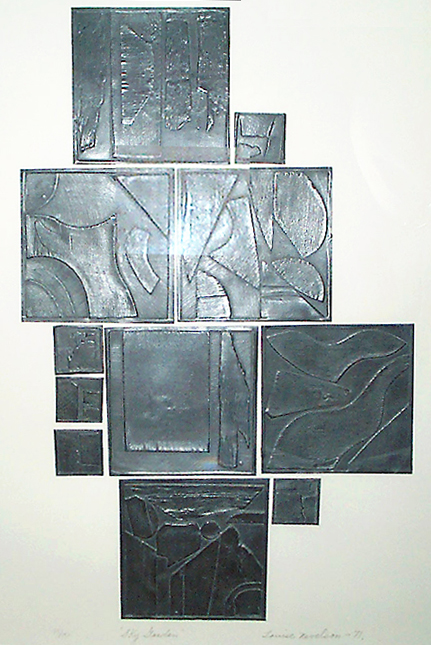
During the summer I took a printmaking course at the Linekona Art Center downtown. I have for some time been an admirer of the sculptures of Louise Nevelson, many of which were essentially assemblages made up of small wooden pieces in complex architectural configurations. "Sky Cathedral" is a good example:


There's something magisterial about this piece, and many of her others, a forcefulness, a kind of authority, all of this random stuff being gathered together and composed, asserted as a unified whole. It's beautiful and impressive and even a little scary.

As I've looked around on the internet and elsewhere, I've run across a lot of other things I like, like for example this configuration of sculpted steel squares:


Anyway, during the printmaking course we were encouraged to try, among other things, using cardboard to print from, I thought I'd try make a print that borrowed on her architectural style. So I made a cut out a series of cardboard pieces and glued various shapes on top of one another and laid them out and did a couple of prints like this one:


So that was okay, but the paper-and-ink medium didn't really offer the tactile, monumental quality that I was looking for. So the other day, I took out the bag of cardboard cutouts I had made and glued them down onto a piece of plywood and then used acrylic paint and medium to make it look like it was in fact made out of weathered wood. The (12"x24") panel came out looking a lot more like what I was after, especially after I painted over it with a gloss medium that put a soft sheen over the textured surface.


So there it is, my little homage to Louise.

Tuesday, August 17, 2010

Writing from the Inside Out


This is the pre-orientation week at my school. Part of the preparations for the year is a series of Back-to-School Workshops for teachers, and I volunteered to do a reprise of a workshop I did during July at the Summer Lab School which I had decided to call “Writing from the Inside Out,” based on a series of notions that I have gravitated toward during my 40 years as a full-time teacher and sometime writer. Taken together those notions form a kind of architectural framework for a pedagogical philosophy that I would describe as being radically simplistic. I think that in school students are often taught, in subtle and often unintentional ways, that writing is a certain sort of (schooly) thing that is done is a certain sort of (schooly) way for a certain sort of (schooly) purpose. This indoctrination seems to start in the middle elementary grades and gets progressively more severe as students progress through school, to the point where many high school students (and adults) feel not just that feel that writing is something that is not for them, or worse, that they hate it. "Writing from the Inside Out" is my shorthand for a process which starts with what is going on inside the minds of the students as opposed to the more prevalent process of starting with what the teacher's agenda might happen to be.

There’s a book I like a lot by Danny Gregory called The Creative License: Giving Yourself Permission to Be the Artist You Truly Are. It includes a short quotation from Howard Ikemoto that goes like this: “When my daughter was about seven years old she asked me one day what I did at work. I told her I worked at the college — that my job was to teach people how to draw. She stared at me, incredulous, and said “You mean they forget?”

What I was driving at today, basically, was this: Writing is — or can be — a playful activity, a self-expressive activity, an exploratory activity, with satisfactions and rewards that come from no other source. It is potentially a powerful and relevant and, to use a word perhaps too often bandied about, transformative self-teaching tool at every grade level and in every discipline. But somewhere along the line we teach kids to forget that. We make it into a compliance activity and we remove from it most of the things that make it most satisfying and enjoyable. My argument is that we have to try to reclaim and turn students loose in at least some of the territory in which writing is about discovery and craft and the revelations that can emerge from purposeful play, and to recover some of the initial joy and energy and engagement that writing held for them before they arrived at school.

So I shared a couple of radically simple writing exercises, the first of which was a three minute poetry exercise I described in a post three and a half years ago. As the other teachers wrote at their seats, I did one at the board. As often happens when you write freely with no preconceptions, I surprised myself with what showed up:

Loss. Departures. The sun
setting, long shadows singing
their song of lament. Why this?
Why now? What recourse,
what will we have left
when the new day dawns?


I’m not going to go into all of the background, the ballast, that pushed these words out onto the board in front of me. Suffice it to say that I recognize in these words a fresh opportunity, and what I would see as fertile ground. There are things to play with here: the emotion, the images, the questions, the sequences of syllables. There's a poem waiting to emerge, or perhaps an essay, or perhaps a story, or perhaps something I can only sense but do not yet have a name for.

It's a beginning. There's interesting work yet to be done. I love being in that spot. I’ve been missing that. Having the chance to do the workshop gave me the spur to start writing again.

Summer is over. Next week I’ll be back in the classroom again after two years doing admin only. I’m really excited about it.


Monday, July 12, 2010

eBook or not eBook


I've considered, from time to time, whether or not to go ahead and buy a Kindle or a Nook. There are some obvious plusses: books are cheaper if you buy them online, you don't have to carry a bunch of books around with you when you travel, and if you want to read something Right Now, you can have it in seconds. You might be saving a tree or two. And recently the prices have been falling, so that's an attraction.

But there's another voice in my head saying, basically, let's wait. I hadn't worked out the reasons behind that counsel, but the other day I found that D'Arcy Norman had been there and done that. Why do without an eReader? Let us count the ways:

They’re awkward. The digital tools that would make digital books worth the hassle, most notably copy and paste, are disabled via DRM.

And ebooks don’t offer analogs for the best parts of the experience of owning and reading dead-trees books. I can’t write in an ebook. I can’t dog-ear corners. I can’t flip back and forth. I can’t compare passages in different sections (or books) easily. I can’t slip pieces of paper in between pages. I can’t hand an ebook to my wife to read, or to a colleague. I can’t loan my copy to someone. I can’t give it away when I’m done. I can’t leave it in an airport for someone to find and read on their own trip.

Ebooks don’t feel right. They don’t smell right. They’re still not ready for prime time. I’m not sure they will be.


He's onto something there. The whole experience of having a book in my hand is a personal, textural, textual experience. I do all the stuff D'Arcy is talking about: marginal notes, crossreferences, dog-ears, flipping back and forth, passing them along. (I've got four books passed along to me on my desk right now, a little inventory of pleasures waiting to be tasted.)

I use the Kindle app on my iPhone and like that, to a degree. But the only time I really use it is as a fallback, when I'm stuck somewhere with nothing to read. I'm like having the option. I don't mind visiting. But I don't want to live there.

Followup, July 20: Here's a post by Leslie Gates doing an analysis of the pros and cons of each.

Friday, July 9, 2010

New Art


A month or so ago I went to a joint exhibition at the Linekona Art Center and saw for the first time some monoprints by Linda Spadaro. I especially liked some of the effects she created using chine collĂ©. I did not at that time have access to a printing press, but I had been doing a lot of pretty detailed doodling in my notebooks, and I thought I’d try to see what effects I could generate by combining the color glue-ons with black-and-white pattern drawing. I did a couple more or less like the one you see here, using Pigma pens of various sizes on 140 lb cold-pressed watercolor paper.


Shortly after the show, I found out about a Tuesday night printmaking course at the Linekona. I went to the first class, had to miss the second because I was attending a conference in San Francisco. Since coming back I’ve been to two more and I have to say I’m liking it a ton. This is the first print I made. It’s printed from two plexiglass plates on the surface of which there are various inscribed and superimposed aberrations. Materials include paper, cloth, masking tape, aluminum foil, watercolor crayon, and etching ink.


There are some things I like about this print. I liked the basic color pattern, the geometry of it, and some of the textures. But there are also a lot of things wrong with this print that even a tyro like me can see. The ink is not laid on evenly. Actually, you lay it on and then wipe it back dwon until there’s very little left. But one of the things I’ve learned is that any porous surface, like the cloth to the left, absorbs ink, and then when the pressure from the roller hits it the ink gets pushed out onto the paper in dark gobs, and unbalances or even messes up the print entirely. But hey, it was a start. I’m doing a series of prints from the same plate, trying new things with each print. And I’ve got a couple of other plates I’m working with as well. Eventually I’ll get a print I like.

Thursday, June 10, 2010

Three Squared


Here are three panels I've worked on this week.


I began this first one by gluing down four pieces of fabric onto an 18" plywood panel. (There is also, for no really good reason other than that I decided to try it, a bodhi leaf secreted beneath the swatch on the lower left side.) Then I coated the fabric with a blue-grey acrylic mixture, to which I added torn paper elements which were placed at least partially to obscure the seams between the different pices of fabric. One it was all dry, I used a wide, mostly dry brush to drag pigment along the ridges of the fabric in the upper left hand corner, creating the brocaded effect.


This is a pretty straightforward torn-paper-on-plywood-panel collage. (Twelve inches.) I tried to keep this one simple, limiting the color range and linking the shapes and colors in a way that emphasizes balance and clarity and coherence. Right now it feels like the most fully realized piece I've done.


This is a reworking of an older 12-inch panel that felt unfinished. I added the handwritten text (readers with eagle eyes may recognize the text as part of the Saramago excerpt I posted last week, the one about the relationship between the brain-in-the fingers and  the brain-in-the-head.) This was by way of an experiment. I had some semi-transparent mulberry paper I bought last week and I wanted to check if it would a) take the handwriting in ink without tearing or bleeding and b) if it would become essentially transparent when glued down with acrylic medium on top of other materials. The answer in both cases turned out to be be yes, so that's going to become an element in future works for sure.

Each of these panels seems to me to have a sort of character, a wordless but thought-inducing presence. I'm interested in how much of one's emotional reaction to a work of art is a function of color. Last night I bought an aloha shirt. There were actually three shirts on the rack with the same design, but in different color combinations. Two of them I wouldn't wear on a bet. The third one was just gorgeous: the colors worked with the forms in a way that is emotionally complex and satisfying, sort of like the way this panel works the white-yellow-orange-red-brown-black continuum.


Monday, June 7, 2010

Ali'iolani


Got a ride a week or two ago from a friend who dropped me off at Waialae and 6th near Sacred Hearts Academy and St. Patrick's School. Called my wife to come pick me up, and had about fifteen minutes to sit on the stone wall waiting, so I did a little pen-and-ink sketch looking up into Palolo Valley past Ali'iolani Elementary. The other night I had my watercolors out so I thought I'd try dropping some color in.


Thursday, June 3, 2010

The End is Near


The campus is empty today. Academy exams are over. Teachers are squirreled away in their offices finishing their grades. Outside, where there are normally people in movement all day every day, the birds have more or less taken over. The summer sun bakes down on empty fields. Over in the gym, someone is playing a ragtime recording, and the sound is carrying over to my office. Every once in a while a graduating senior will pop in to say goodbye. At the junior school, many teachers are packing up their rooms in preparation for the great migration, as all of our K-1 teachers move up the hill to the new K-1 facility.

Tomorrow we have our end-of-the-year meetings, followed by lunch at the President's house for those who are perhaps reluctant to let go of the year, or who want the chance to say good-bye before heading off to do whatever it is that they will be doing this summer.

I've always felt strange about the end of the year. The start of school is a pure pleasure, a fresh start, a time of anticipation and eagerness, a chance to renew ties and catch up. The end of the year is pleasurable as well, bringing closure and perhaps some sense of satisfaction, but it is also tinged with regret, both for being what it is (as opposed to what it might have been) and for the saying of goodbyes.

I've never been good at saying goodbye. I tend to shuffle and mumble and feel like whatever words I can come up with are inadequate to the occasion. If I can find a plausible excuse for ducking out, I'm gone. I was talking with Tim earlier today, and he was saying he likes to hold the idea in his mind that he will cross paths with everyone at some point later. I like to believe that too, even when it seems unlikely. There's a song by Eric Anderson that has a chorus that has stuck in my mind for the more than forty years since I first heard him sing it:

If it comes that our ways don't touch together
'Cause our roads you know they just don't meet again
I'd be pleased to know that you still think about me
I'd be pleased to count myself amongst your friends.
But now I only stop myself and wonder
If you ever think of all that's gone behind
Yes I wonder just how things are going for you
I wonder does it ever cross your mind.
That lyric, with its guarded optimism and its reflective wonderment,  pretty well captures my feelings at the end of the year.

Of course, the all-time mega-über-maximum-full-tilt goodbye lyric is the Donne poem I was asked by my English teacher to commit to memory when I was a sophomore in high school myself. If there's a more artful and fully realized poem in the English language, I don't know what it would be.

A Valediction: Forbidding Mourning         

As virtuous men pass mildly away,
   And whisper to their souls to go,
Whilst some of their sad friends do say,
   "The breath goes now," and some say, "No,"

So let us melt, and make no noise,
   No tear-floods, nor sigh-tempests move;
'Twere profanation of our joys
   To tell the laity our love.

Moving of the earth brings harms and fears,
   Men reckon what it did and meant;
But trepidation of the spheres,
   Though greater far, is innocent.

Dull sublunary lovers' love
   (Whose soul is sense) cannot admit
Absence, because it doth remove
   Those things which elemented it.

But we, by a love so much refined
   That our selves know not what it is,
Inter-assured of the mind,
   Care less, eyes, lips, and hands to miss.

Our two souls therefore, which are one,
   Though I must go, endure not yet
A breach, but an expansion.
   Like gold to airy thinness beat.

If they be two, they are two so
   As stiff twin compasses are two:
Thy soul, the fixed foot, makes no show
   To move, but doth, if the other do;

And though it in the center sit,
   Yet when the other far doth roam,
It leans, and hearkens after it,
   And grows erect, as that comes home.

Such wilt thou be to me, who must,
   Like the other foot, obliquely run;
Thy firmness makes my circle just,
   And makes me end where I begun.


Wednesday, June 2, 2010

The Cave


I've been reading Jose Saramago's novel The Cave, and I've got to say, it's an artful and charming piece of work. Saramago won the Nobel prize in 1998, and while I had obviously heard of him I had not read anything he had written until this one. The Cave is set in a unnamed country in a vaguely delineated, vaguely dystopian future time. The main character is a potter named Cipriano Algor, who lives with his daughter in the country and delivers his wares every few weeks to to a somewhat sinister business and residential combine in the city referred to only as the Center. The first disruptive event in Cipriano's rather placid life — Cipriano is a placid man, a ruminative man, the kind of man to befriend a lost dog, and when he has done so, to name him "Found"and check on him in the middle of the night — comes when he is given notice that the Center will no longer be accepting his wares, because customers have stopped buying handcrafted pottery, in favor of plastic containers which are cheaper and less likely to chip or break. This initial disturbance is followed by a number of others, as Cipriano begins his journey from the life he once knew toward a re-invention forced upon him by circumstances.

What I most like about the book is the loose, bemused, allusive voice of the narrator, who has a tendency to string thoughts together with only the bare mininum in terms of punctuation or writerly punctiliousness about the niceties of sentence structure. Many of the passages interweave the narrative proper with what at first seem to be the more or less random thoughts of the narrator as he tells the story. But these digression. In this passage, for example, Cipriano goes to visit the grave of his dead wife, but we are treated along the way to a) an inventory of the locations in which Cipriano no longer experiences her presence (thereby suggesting the depth of his solitude), b) a little homily on the shortness of life, spoken by the narrator as if he were addressing his own character, c) a commentary on Cipriano's actions and what they imply about the nature of time, this time directed to us as readers, which segues into d) another meditation on the nature of writing itself:

Cipriano Algor approached his wife's grave, she has been under there for three years now, three years during which she has appeared nowhere, not in the house, not in the pottery, not in bed, not beneath the shade of the mulberry tree, nor at the clay pit beneath the scorching sun, she has not sat down again at the table or at the potter's wheel, nor has she cleared out the ashes fallen from the grate, nor seen the earthenware pots and plates set out to dry, she does not peel the potatoes, knead the clay, or say, That's the way things are, Cipriano, life only gives you two days, and given the number of people who only get to live for a day and a half, and others even less, we can't really complain. Cipriano Algor stayed no longer than three minutes, he was intelligent enough to know that the important thing was not to stand there, with prayers or without, looking at the grave, the important thing was to have come, the important thing is the road you walked, the journey you made, if you are aware of prolonging your contemplation of the grave it is be cause you are watching yourself or, worse still, it is because you hope others are watching you. Compared with the instantaneous speed of thought, which heads off in a straight line even when it seems to us to have lost its way, because what we fail to realize is that, as it races off in one direction, it is in fact advancing in all directions at once, anyway, as we were saying, compared with that, the poor word is constantly having to ask permission from one foot to lift the other foot, and even then it is always stumbling, hesitating and dithering over an adjective or a verb that turns up unannounced by its subject, and that must be why Cipriano did not have time to tell his wife everything that was on his mind, apart from that business about it being unjust, Justa, but it may well be that the murmurings we can hear coming from him now, as he walks toward the gate leading out of the cemetery, are precisely what he had meant to say. (32-3)  
Throughout the book the sentences unfold in surprising and often delightful ways like this. It's not a book that seems to explicitly to be trying to be funny, but I often find myself laughing out loud, just because the story keeps taking minor, delight-ful turns. A little bit later in the book, the narrator delivers himself of a little mini-essay on a subject I've actually been thinking a lot about lately, as I have gotten more deeply involved in making art. One of the interesting things about art in particular, and innovation in general, is that so much of it occurs in the making itself, not in the planning. The brain can hatch a plan, but often the brain is better advised to step aside, let the fingers take over, and see what turns up. Saramago takes this somewhat familiar idea and literalizes it, postulating that in fact the fingers have brains of their very own:


Indeed, very few people are aware that in each of our fingers, located somewhere between the first phalange, the mesophalange, and the metaphalange, there is a tiny brain. The fact is that the other organ which we call the brain, the one with which we came into the world, the one which we transport around in our head and which transports us so that we can transport it, has only ever had very general, vague, diffuse and, above all, unimaginative ideas about what the hands and fingers should do. For example, if the brain-in-our-head suddenly gets an idea for a painting, a sculpture, a piece of music or literature, or a clay figurine, it simply sends a signal to that effect and then waits to see what will happen. Having sent an order to the hands and fingers, it believes, or pretends to believe, that the task will then be completed, once the extremities of the arms have done their work. The brain has never been curious enough to ask itself why the end result of this manipulative process, which is complex even in its simplest forms, bears so little resemblance to what the brain had imagined before it issued its instructions to the hands. It should be noted that the fingers are not born with brains, these develop gradually with the passage of time and with the help of what the eyes see. The help of the eyes is important, as important as what is seen through them. That is why the fingers have always excelled at uncovering what is concealed. Anything in the brain-in-our-head that appears to have an instinctive, magical, or supernatural quality— whatever that may mean—is taught to it by the small brains in our fingers. In order for the brain-in-the-head to know what a stone is, the fingers first have to touch it, to feel its rough surface, its weight and density, to cut themselves on it. Only long afterward does the brain realize that from a fragment of that rock one could make something which the brain will call a knife or something it will call an idol. The brain-in-the-head has always lagged behind the hands, and even now, when it seems to have overtaken them, the fingers still have to summarize for it the results of their tactile investigations, the shiver that runs across the epidermis when it touches clay, the lacerating sharpness of the graver, the acid biting into the plate, the faint vibration of a piece of paper laid flat, the orography of textures, the crosshatching of fibers, the alphabet of the world in relief. (66-7)

I don't know about you, but I think this is just apt and dead-on accurate and basically just way too cool, most especially that wonderful, surprising, disarming, elegant final parallel construction, culminating as it does in the metaphor of the alphabet of the world. This is writing which enacts verbally exactly what it is describing conceptually about the nature of invention and surprise.

Monday, May 31, 2010

May Workshop


Yesterday I finished a three-day workshop (Saturday and Sunday of last weekend, Saturday of this weekend) and wound up with four new mixed-media collages in various stages of completion. The three square ones are about two feet across, which represents a step up in scale for me.


This first one is a study in browns and blue and gold. I started with a plywood panel I had gessoed and braced. The first thing I did was sketch in some basic lines and shaded areas using charcoal. That black and white area in the upper left is the visible remnant of that first move. Then I laid down the various torn-paper fragments, most of which I had prepared previously by impressing or painting loose geometrical figures on each one. I tried for a loose kind of linkage, which resulted in the largish triangular shape that dominates the left hand side of the image. There were a lot of hard lines on the lower right hand side, and I tried to soften them by rolling some thin white paints over that area, which created another sort of eco-zone when the over there. I tried to stay loose and not get too fussy. Now when I look at it it feels a little like an imaginative exercise in plate tectonics.


The second one is the least finished of the three big panels. I had it in mind that it was going to be multilayered from the start, and was mostly going to  be about experimenting with surface effects. This is where it is now. I don't know where it's going to end up. It's a little angry and unsettled right now; but maybe that's okay. I began it by using gel medium to glue down aluminum foil over the whole surface of the panel, and then tried various ways of applying color, including paint, paper, oil pastels, and regular pastels. The honeycomb pattern of white over red was George's idea: to use some lacy paper I had brought along as a kind of stencil: laying it down, painting over it, and then peeling it back. The idea for the thin red lines also came from George. It was toward the end of the day and he was challenging me to make a move that would bring it toward completion. He suggested I look back through my materials to find something that could make a difference. By way of demonstrating, he began picking up and discarding stuff that I had on the table. He picked up a flexible plastic ruler I had there, bent it back and forth, and then pressed the curved edge against the red area, more or less where the line is now, saying, "You could use this as a stamp." Kristen had some red paint mixed on her palette behind me, so I tried that and it really helped pull the piece together.


This is the workshop piece that I was most happy with. I've had trouble working with yellow so I decided to just start out by laying out a lot of yellow on the panel, and I placed three large torn-paper elements on top. Then during the week, knowing I was going to be working with warm colors, I gathered up all the brown and orange and red and yellow paper and cloth I could find, and stamped a lot of the pieces with geometrical forms. Yesterday I just started laying them down and trying to link them together, making this more or less massive landscapy from I wound up with. The last thing I did, taking advice from the group, was to cover up some of the remaining pure yellow areas and softening some of the rest of them with darker paint. I like the overall effect, especially the way the light seems to pushing in from behind.


This last one is a smaller panel I did at home with some of the leftover pieces of paper that were on my desk from preparing stuff for the previous panel. It did it fast, and I had a very clear sense of how I wanted the pieces to link up, moving from left to right. The two yellow pieces went on next to last, and the brown-and-black torn paper, as a sort of exclamation point. Nothing fancy, nothing very daring, but I like it. More than most of what I've done, it feels complete to me.

Friday, May 21, 2010

Poetry


Pizza. Or perhaps
pizzicato. A place,
(piazza), a pie, a bit
of percussive play.
Purse your lips,
and push the air out:
poof. Like that.
What does that feel
like? Not like love,
not like languor.
More like impatience,
like petulance, like
disdain. Pfff. Yeah,
right. As if. Give
me a break.

Then what? We're still
here. Waiting. Like
a play, right? This is
the first speech.
A soliloquy. Perhaps.
An overture. A prelude.
To what we are waiting
for. The purpose. The
point. The purported
punch line. But

suppose there is no
payoff. Suppose it
simply is what it is.
Like life. Like waking
up every day and thinking,
maybe today it will all
become clear. When I
asked my mom, way back
when, for a palomino,
she said, "When my ship
comes in." She said,
"When I win the Irish
Sweepstakes." She said,
"Maybe someday."

I thought a lot about
that ship. I wondered
where on the ocean
it might be, how soon
it might come sailing
into port. How little
I knew of metaphor.
How much I've learned:
Pffft. Yeah right.
As if.

Process Reflection:

It's been a long time now since I just sat down to play with words. I seem to have become burdened with the self-imposed expectation that I ought to have something to say. That's as sure a road to writer's block as I know. Today I stopped in for a few minutes to visit with Tim's Writer's Club, and since it was there last meeting of the year they had pizza. Maybe because that seed had been planted in my mind, I felt like writing tonight.

I needed a place to begin. So I began with that: pizza. The word, the sound, the feel of the syllables. I just started playing with it, pushing it. After the first four lines I had a sense of the emerging structure and the possibilities posed by the syllables. (As you can hear, once you go down that road it's hard to turn off it.) Then I just tried to follow the thoughts that the syllables pushed up at me. Funny that my mom showed up. Not for the first time, of course.

Funny too: I did get that palomino, some years later. Two actually. I rode them for two years. Between the two of them they about killed my dream of horses. Be careful what you wish for.

Thursday, May 13, 2010

Variations on a Theme


Process Reflection:

I was working here within two self-imposed constraints: first that I would use exactly the same materials in each of the four collages; second that I would work on the concept of linkage, connecting one part to the next in a way that would make the development of each piece more organic and internally consistent. Two relevant quotations from my mentor:

Anyway, there’s an idea that I’m trying to develop here, which is that the forms work best when you tie them together. We call it linkage. Where it’s like you’re growing a form. So you always have to connect it, you don’t just pop it out there. The forms are always like branches on a tree, they’re always tied together. And it’s one thing you can do to help your compositions, is to link one form to the next, because it gives a sense of solidity to it, a feeling of connection. The biggest problem people have with composition is unity, is keeping the composition unified. If you just start plopping things out there, here and there, thinking that you’re balancing the composition, you may be balancing it in some way, you may be offsetting one thing with another thing in a way, but you’re also building into it opposition, and you can bring this kind of competition into the composition where the forms are fighting each other, and if you start juggling things all over the place, if you’re putting one thing over here and another thing over here, you’re going to have the real possibility that you’re going to get yourself into a bind. You’re composition is going to be caught and you’re not going to know where to go because you’ve got one thing over here and another thing over here and another thing over there and another thing over here and you’re not going to be able to connect them all, you see, it’s the connection that’s important.


I’m just trying to come up with some rules. Now these are my rules. They’re not your rules, they’re my rules. You can make your own rules. But the idea of having rules is that they give you a framework, they give you a structure to hang the composition on, to build with, so that in a way what you’re doing is you’re developing a system. And that system can be returned to, you can have some confidence in it because it works. It worked once, you can do it again.