
Wednesday, February 6, 2008

One Brick (100x17)


One Brick at a Time


I. Axioms


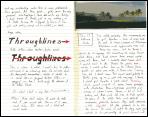
Brick. Thick. Block. Chunk. Blink. Black. Blank. Stuck. Flunk. Quick. Drank.
Trick. Prank. Brink. Wreck. Clock. Stick. Stink. Flank. Fleck. Flunk. Click.
Stuck. Stack. Crack. Crock. Clank. Chink. Drink. Drunk. Plink. Pluck. Smack.
Prick. Plank. Prank. Plunk. Crank. Trunk. Thank. Quack. Cluck. Clunk. Stark.
Stock. Wrack. Flick. Flack. Flock. Track. Truck. Whack. Think. Spank. Snack.
Spunk. Shank. Shack. Slick. Slack. Frank. Shock. Shuck. Slink. Skunk. Snuck.


II. Derivations


Brick, Black: Thick Block. Chunk.

Think. Blink. Blank. Stuck.

Quick trick: Prank.

Trunk. Whack. Clunk. Clank. Plank. Stack. Stock.

Frank snuck drink. Stank. Truck, slick. Brink. Blink. Wreck.


Process Reflection: This started as a belated attempt to follow up on my idea from Monday’s post about playing with something along the lines of “Silent Poem” by Robert Francis. I was correcting papers tonight and a student had written an essay about a breakthrough moment in his writing when he realized his topic was too large. When he narrowed his focus, he was able to write easily. Which got me thinking about the well-known passage in Zen and the Art of Motorcycle Maintenance where Pirsig recounts an early teaching experience where he advises a student with writer’s block to forget about writing about her town or even a street or a building, and about one brick in the building. I wanted to find the passage, and wound up googling “pirsig one brick.” That took me on a lot of interesting detours (I eventually found the passage), many of which involved the phrase “one brick at a time,” and so when I sat down shortly thereafter to write, the seed had been planted in my mind. I just started with “brick” and began free-associating words, with the ideas of coming up with a wall of words a la Francis, and pretty soon had agreed with myself on the implicit rules: one-syllable five-letter words that ended in either “ck” or “nk.” So that was entertaining. While I was working on that another part of my brain started looking for combinations, and so I began playing the derivation game down below, and then working both ends in the effort to build up to 100 words total. After an hour’s worth of fiddling about, I came in just over at 103, and decided that was enough for today.

(Image Credit:
http://www.cs.virginia.edu/~gfx/courses/2004/Intro.Fall.04/
assignments/imageprocessing/images/bricks.bmp)

Tuesday, February 5, 2008

Mini-rant (100x16)

There are more cars on Oahu than there are people. Why? The island is only 60 miles across. The bulk of the population lives in the Honolulu area, perhaps ten miles wide and five miles high. You rarely need to go more than 30 miles an hour, and you rarely need to go more than ten miles in any one direction. The weather is temperate 365 days a year. If ever there was a city that was built for bikes and electric cars, this is it. But there is no infrastructure in place, and no plans to build one. Why?

Process Reflection/Elaboration: This is the 100-word version of a longer rant that would reflect on Hawaii’s unique opportunity to become a world leader in energy sustainability. Solar energy, wave energy, wind energy, thermal energy: we’ve got the potential to develop them all. Instead, most of our electrical energy, more than 90%, is generated by burning petroleum which has to be shipped in. There are almost no bike paths or bike lanes, even though Honolulu is a small enough city that pretty much everyone could ride bikes and get to work faster than they do now in cars. And they’d be keeping the air clean and staying in shape. Instead, we keep importing cars and throwing up new construction like there’s no tomorrow. When the world runs out of oil, which is going to be sooner rather than later, we’re going to feel it harder than most. Assuming we’re not underwater by that time. Grrr.

Monday, February 4, 2008

Marching (100x15)


One hundred words a day. That should be easy, right? Well, yeah, sometimes. Some days the words just line themselves up and come marching out from under your fingers like so many loyal soldiers marching merrily off to win honor for the king. Some days they are more like recalcitrant children, hiding out, grudging their participation, wary of being drawn into something they don’t think is going to be all that much fun. And some days, like today, they just show up uninvited and lounge about, burping and scratching themselves as they try to decide what they will do tomorrow.

Process Reflection: The topic for today was "victory," and I've got to admit I only engaged it glancingly. Those marching soldiers owe what minimal existential status they can claim to the presence of that word in my consciousness, as do, to a slightly lesser degree, the other characters who showed up to do, however reluctantly, their metaphorical duty within the framework of the task at hand.

Another way of looking at it: my students have a standing assignment to hand in to me once a cycle (we schedule classes over a six-day cycle) a piece of writing, a “Cycle Paper,” which represents an hour’s worth of work. Topic is up to them. Form is up to them. It can be a single self-contained piece, several short pieces, or a continuation of a longer piece that they might choose to work on over several weeks or months. The first few weeks the students generally have no problem. Then, about a month into the semester, inevitably start getting pieces of writing whose subject is something along the lines of “My Cycle Paper About How I Couldn’t Think of Anything to Write for My Cycle Paper.”

Which is, of course, a creative response which is well within the rules of the game, but gets old fast. Which is why I tell them they only get one of those a semester. I’m into day 15 of the thirty-day hundred-word-a-day cycle, and I’m cashing in my voucher.


By way of compensation for those of you who might have visited this site in the hopes of finding something more worth reading, I’ll share, by way of compensation for your time, this artful little poem by Robert Francis. I’ve been thinking about trying something like this for one of these pieces, in that I’ve always admired what he manages to get done in a short space (50 words including the title). But this is a poem that I can tell took him a hell of a lot longer than an hour to put together.


Silent Poem

backroad leafmold stonewall chipmunk
underbrush grapevine woodchuck shadblow

woodsmoke cowbarn honeysuckle woodpile
sawhorse bucksaw outhouse wellsweep

backdoor flagstone bulkhead buttermilk
candlestick ragrug firedog brownbread

hilltop outcrop cowbell buttercup
whetstone thunderstorm pitchfork steeplebush

gristmill millstone cornmeal waterwheel
watercress buckwheat firefly jewelweed

gravestone groundpine windbreak bedrock
weathercock snowfall starlight cockcrow

(Picture Credits: http://www.diggerhistory.info/pages-conflicts-periods/ww2/pages-2aif-cmf/7-div-aif.htm, http://www.gunflint.com/packages/pkg_photos/woodpile.jpg)

Sunday, February 3, 2008

Setting the Standard (100x14)


“Standard” is a word with an identity crisis, a built-in neurosis. Oxymoronical, schizoid, it has its head in the clouds and its feet in the muck. To be standard is to fail to meet the standard. To aspire to quality (to wish to exceed whatever standards are in place) is to acknowledge that reality is essentially shoddy. Standard operating procedure, beloved of bureaucracies, is the enemy of originality, of innovation, of excel-lence. Where standardization is the rule, the individual voice is silenced. Pop culture, peer pressure, what everyone learns in eight grade: don’t be different. It isn’t worth the price.


Process Reflection: The topic/word/prompt for the day: standard. I thought about attempting some sort of narrative, but then found myself thinking about the two different senses of the word: the nominal (“a level of quality or attainment”) and the adjectival (“used or accepted as normal or average”). So I started pushing into that, one thought at a time, trying out different ways of articulating the different senses of the word. Toward the end I found myself thinking back to my first few years as a middle school teacher, when you could almost sense the hostility in the air when anyone in the classroom (other than the teacher, of course, who was assumed to be hopelessly uncool anyway) said anything remotely out of the ordinary or admitted to any enthusiasm for anything academic: nerd alert. That was the surprise in the exercise for me. I didn’t expect to end up there, in that space.

Saturday, February 2, 2008

Etude (100x13)


The sky layered with clouds, the nearest dense and grey
along the horizon, the farthest pale and white, illuminated
by the sun not quite shining through but defining all we see:
thin horizontal bands of grey and gold and white and even,
over the left, just above the water, pure unobstructed blue.

The water dark and calm, waves gathering themselves,
making their approach in dark obedient rows
as over to the right the filtered sunlights play upon
the surface of the deep. And out there, just on the edge
of vision, a single sail: souls in transit between two worlds.


Process Reflection: Pretty much what you see is what you get. I took the picture a month or so ago one evening at Waikiki Beach. I thought I'd try to re-present the picture in words, and decided to try to mirror the structure of the picture with its two broad horizontal planes in the structure of the writing. I like the picture more than the poem, there are a lot more things to look at, and a lot more ways of looking, than I could cram into 100 words. So maybe the cliché is true: maybe it's more like a thousand.

Friday, February 1, 2008

The Story of Stuff


Chris Watson posted this link today to The Story of Stuff, which features a pretty thought-provoking and provocative analysis of our consumerist lifestyle, its origins, and its aftereffects. It's an entertaining, hi-tech stump speech worth watching, whether you agree or disagree with its premises. It includes many links to organizations working on one aspect or another of the multidimensional, interlocked matrix of problems.

Limbo (100x12)


Limbo

The baggage check lines snake back and forth between the metal stanchions with their black nylon belts. I make my way to the back of the line with my bags and then stand and shuffle, stand and shuffle, dragging my luggage along with me at each three-foot advance. Every ninety seconds a recorded announcement is broadcast over the PA in three languages warning against leaving your luggage unattended or accepting luggage from any stranger. Twenty minutes later, I check my bags, and go off to the security checkpoint to stand in line and wait to take off my shoes.

Process Reflection: The topic was "airports." I decided to just focus down at the moment of arrival and see how far 100 words would take me. Not that far, obviously, which is part of the point, I guess. Going through the whole process in any detail would take pages and pages, and who would want to read it?

I hate traveling. I hate the dead time, the standing around, the waiting around at the gates, the time it takes to get everyone seated, the time taxiing, the time in the air, the lack of space, the bad food, the need to climb over or be climbed over your fellow travelers, the waiting around for the bags.

Which isn't to say there aren't minor compensations. I like the moment of takeoff, the jet hurtling down the runway then, miraculously, rising into the air. I like the descent and touchdown. I also like wandering around strange airports on layovers, eating bad food, checking out the bookstores, studying the people. And once I get where I'm going, obviously I like being there.

But given a choice, most times, I'd just as soon stay home.

Thursday, January 31, 2008

Punctuality (100x11)


I do not want to write about punctuality. Truth to tell, I am not all that crazy about assigned topics in the first place, their primary pedagogical purpose being, so far as I can tell, to allow teachers, and in the best case scenario, the students as well, to compare apples to apples, squash to squash, lightning bolt to lightning bolt. “Look at what Amanda did with punctuality! Isn’t that cool?” All of which is well and good: this is how we learn to write, by broadening our sense of the possibilities. But not for me, not today. Maybe tomorrow.

Process Reflection: I seem to be getting a lot of my writing work done when I’m in that zone between being half awake and half asleep. At 4:30 this morning I woke up and as I was trying to get back to sleep I got to thinking about the topic for today’s assignment. Until yesterday, I didn’t even know that the students in Barbara’s class, where I got the idea for this little 30 day exercise, were using topics. But yesterday I finally figured out how to find the class blog and there it was, the topic for the day, and I thought, okay, maybe I’ll try that. So I actually did some thinking about punctuality as a topic, and this morning as I lay in bed trying unsuccessfully to get back to sleep, I even had a story taking shape in my head about the time when I was a newly-married student teacher in Nanakuli and invited my cooperating teacher and her husband over for dinner at 6:30. We had dinner on the table at the appointed time; they showed up at 7:20. That was my first introduction to the concept of “Hawaiian time,” which is anywhere from an hour to two weeks past whatever it says on the clock. But there was this other voice in my head that was saying, Nah, I don’t want to go there.

I finally figured out that I wasn’t going to get back to sleep before it was time to get up anyway, so I hauled myself out of bed and opened my journal and the first sentence that came out of my pen was “I do not want to write about punctuality,” so I said to myself, there, okay, let’s see where that leads. (I was not unaware that in beginning that way I was in fact writing about punctuality, albeit in an obliquely oppositional way. Which leads us to one of those tricky existential questions: can you fulfill an assignment by making the decision not to fulfill the assignment? Hmm. I wonder…) Anyway, at that point my writerly focus shifted, briefly, to punctuation. (Etymologically related to punctuality, via the Latin punctum, which means “point.” Does that count?) In the second sentence, I got interested in the cadences of the sentence, the interruptive, additive qualities of the emerging voice (not, of course, unlike my own, when I am holding forth, as I can’t help but do (there, I’m doing it again)), which is what led to all those commas.

So then I was up over the 50 word mark, more than halfway home, and so I shifted over to the computer and typed up what I had and added what I thought I wanted to add and did a word count and oops, I was at 122, so I had to go back and work on a more compact dismount. Got it down to 98 words and had two more to go, and then couldn’t resist adding “Maybe tomorrow,” as my little punctuality joke. So now it’s just about exactly an hour since I stumbled out of bed and I’ve got my assignment done. Time to get started on my day. Have to leave for school promptly at 7:00.

Wednesday, January 30, 2008

Alphanumerics (100x10)


Alphanumerics

One: Finger. Moon. Obelisk. The self in isolation.
Two: Victory. Peace. The self in the mirror. Horns. Love.
Three: A pitchfork. A stool. The Letter W. A crowd.
Four: Picket fence. Sturdy chair or table. Hair standing on end.
Five: A Handful. Greetings. Kindergarten turkey. Stop!
Six: Two hands now. Old enough to know better. Cousin of G.
Seven: Adze. Reason. In group, out group. Imbalance. Luck.
Eight: Open and shut. Snowman. Two by four. Enough. Infinity.
Nine: Perfect square. Tic-tac-toe. Oddness. The end of the line.
Ten: On and off. Skinny and fat. Personal Best. Starting Over.


Process Reflection: Just a game. I started with the idea of the sequence of numbers from one to ten, perhaps because this is the tenth post in the current series. I started by looking at my fingers and trying to think analogically, and then broke out sideways from there, thinking about the shape of the number, the contexts in which it appears, its associations. Most of which I could only gesture at, given the phrase-based format I fell into and decided to stay with. By then end of my first runthrough I had about 50 words, and the need to get to a hundred kept me inside the sandbox for a while, adding, tinkering. There are a lot of better examples of this sort of thing out there, like “Bestiary for the Fingers of My Right Hand” from our current poet laureate Charles Simic which can be found here if you’re interested.

The 100-word constraint is interesting. In some cases, like yesterday, it's quite hard to pare down what I want to say to meet the limit. In other cases, like this one, the need to push up to 100 words opens up new territory and winds up changing the original look and feel of the writing.

Tuesday, January 29, 2008

Confusion (100x9)


Confusion: five card stud, high-low, roll your own. You get two down cards, and turn one up. Bet. Another down card, roll one, bet.. Repeat twice, until you have one down card and four up. Key concept: your hole card and all others like it in your hand, are wild. Another twist: now you can replace one card, up or down, for a buck. Bet, then declare: one chip in you hand, you’re going high; none, low; two, scoop. But if you try to scoop, you must win both ways, or you win nothing. Final bet. Let’s see the cards.

Process Reflection: This is the compact, freeze dried, 100-word explanation of my favorite poker game, which we call "Confusion" for reasons which become increasingly clear every time you play it. Poker purists sometimes object to wild card games, but this is a game that combines strategy and luck. It's a game which involves a lot of strategic moves as you are creating your hand (by rolling your up cards and choosing which card to discard) and leads to dramatic and surprising showdowns. In the hands pictured, for example, the apparent heart flush (5-6-8-K) looks like a loser to the apparent full house. But if the down card in the heart flush is a king, it's really a 5-6-7-8-9 straight flush, which would usually be a pretty good hand, except that the hand at the top of the screen (Jd, Jc, Qc, Kc) could in fact be a royal flush if the down card is a jack. And worse, the apparent full house (K-K-7-7) may very well be five of a kind, if the down card is a seven or a king. The heart flush is a guaranteed winner for half the pot, since it's the best low hand, but if he gets greedy and tries to scoop, he'll lose everything if either of the other two people have made their hands.

Full disclosure: those of you who are paying close attention to the picture have probably figured out that this isn't a game of confusion at all. It's a game of six card Anaconda, with two cards left to roll. But the picture serves to illustrate the possibilities.

Monday, January 28, 2008

Found Poem (100x8)


Lost in Love

He knew she was there
by the joy and fear
that overwhelmed his heart.
She stood at the other end of the rink,
talking to a lady.

There was nothing very special
in her dress, nor in her pose;
but she was as easy to recognize
in that crowd as a rose among nettles.
Everything was lit up by her.
“Can I really step down there
on the ice and go over to her?”
he thought.

The place where she stood
seemed to him unapproachably holy,
and there was a moment
when he almost went away —
he was so filled with awe.


Process Reflection: I thought I might take a shot at a found poem, and I decided to look in the most obvious place: what I'm reading now. One of my students is reading Anna Karenina, and since it's a book I had never gotten around to reading before, I figured I'd read it along with her. This is a passage from early in the book when Levin, a landowner from the country, has come to Moscow to ask a young woman he has known since her childhood if she will marry him. He's beset with doubts about whether he is worthy of her, and whether she will in fact accept him or laugh in his face.

I've been charmed, so far, by Tolstoy's tone: he renders his characters with what comes across as a kind of compassionate amusement. He sees them as somewhat awkward and ridiculous, but perhaps no more so than any of the rest of us. I'm reading Tom Perotta's Little Children at the same time (having heartily enjoyed his most recent effort, The Abstinence Teacher). Perotta has also been described as a "gentle satirist, and his characters are also awkward and ridiculous at times," but one comes away from his definitely funny but pointedly devastating characterizations with something closer to dismay than amusement. You get the sense that he's interested in his characters, but not so much that he loves them. But with Tolstoy, so far at least, you get the sense that he does love them, despite their foibles, and that he is encouraging you to love them too.

In an attempt to stay within the 100-word framework, I wound up deleting a few words from the original, but still came in a few words over. I'm not going to get too anal-retentive about it. Whatever.

Sunday, January 27, 2008

Iced Out (100x7)


I don’t know if this is the time to bring this up, or when that time would be, but it’s been two years now with not one word from you. I’ve tried to do what you asked, to let you go and get on with my life. But I still don’t know what I did wrong, why it had to be this way, why you chose to ice me out in the first place and why you have kept it up this long. I guess this is how it has to be, but God help me, I still love you.


Process Reflection: One hundred one-syllable words for an archetypal human situation.

I was watching “Friday Night Lights” the other night and there’s a scene where one of the characters who has been hurting for some time over a breakup confronts his ex-girlfriend and says “Just look me in the eye and tell me you don’t feel the same way I feel about you and move on.” So she looks him in the eye and says. “I don’t felt the same way about you that you feel about me. You need to move on,” and then turns on her heel and leaves him standing there.

Then the other day I was talking with a friend who is still hurting after a breakup that he stills sees as inexplicable, and that got me thinking about the various times in my life, from grade seven on up, when I was in situations close enough to this one to be able to relate.

When I used to teach elementary school one of the things I once heard one of my mentors say was that if kids know they are going to write every day, they start to pay a different kind of attention to what is going on in their lives. And I know that’s true: now that I’m a week into this 100-word exercise, I’m starting to line up ideas ahead of time. I was thinking as I went to sleep last night about what I might wind up writing about today, and I had thought about maybe working with a one-syllable limitation.


When I woke up near midnight, I started pushing one syllable words down the road of my mind and found myself muttering “I don’t know if this is the time…” Not wanting to forget that beginning, I got out of bed, went to the kitchen, opened my notebook, and next thing you know I was channeling these words out of that tv drama and that real-life conversation.

Saturday, January 26, 2008

Stop Making Sense (100x6)


If the hour is not at hand, be always low
in the saddle, expect a second or third small test,
a few words here, a few words over the stable
where you stood for all those hours with the brsh
in your hand, waiting for your mother to show up
and push that mare out of the way, grab you
by the hand and deliver you, one last sad time,
from the vise of youthful fear and sheer animal malice,
this before the tables turned and her long downward arc
left her in that darkened room behind the next door.

Process Reflection: The initial structural concept was straightforward enough: one sentence, ten lines, ten words per line. I also had it in mind to try something in the manner of John Ashbery, who has made a career out of writing allusive, elusive, poems which are verbally and syntactically rich but which resist paraphrase or literal interpretation. Here’s a representative passage, in this case from a poem called “Mottled Tuesday”:

Hey, you’re doing it, like I didn’t tell you
to, my sinking laundry boat, point of departure,
my white pomegranate, my swizzle stick.
We’re leaving again of our own volition
for bogus patterned plains streaked by canals,
maybe. Amorous ghosts will pursue us
for a time, but sometimes they get, you know, confused and
forget to stop when we do, as they continue to populate this
fertile land with their own bizarre self-imaginings.
Here’s hoping the referral goes tidily, O brother.

I’ve always been intrigued by Ashbery; his poems insist that you re-invent yourself as a reader, starting by putting aside your most central readerly assumption, that a piece of writing ought to have a paraphrasable content.

There’s an assignment I sometimes give my students which, for lack of a better title, I call “Stop Making Sense.” The assignment is to attempt to fill a page, or a certain number of lines, with nonsense. It sounds easy, and someone like Ashbery can make it perhaps look easy, but easy it isn’t. Our brains aren’t wired that way. What happens is most often what happened to me in this exercise: while your left brain plays its little structural game, the right brain tosses up whatever it is that it feels you have not been paying attention to. Something wants to surface, something comes to call.

In this case, the person coming to call is my mom. The scene which emerges from and ultimately triumphs over the non-scene, the non-sense, actually happened to me when I was about twelve years old. It’s a scene I had not consciously thought about in close to fifty years. We had bought a horse whom I had, in gesture whose irony I did not appreciate until some years later, Joy. (I’ve told that story before.) It was my job each morning and evening to feed and attend to Joy, but she was fractious and inventively mean-spirited beast and on the occasion in question, when I entered her stall one evening around dinnertime to bring her a bucket of bran mash, she let me in; but then, when I went to leave the stall, she kept pushing her enormous body against the wall of the stall in such a way as to pen me in. I spent a good half hour trapped in the stall, wondering how I would ever get out, when suddenly my mother, who stood all of 5’1” on a good day, appeared in the barn demanding to know what was going on. When I told her Joy wouldn’t let me out, she walked over, smacked her on the rump, pushed her aside (and she moved!), grabbed my hand, and led me out of the barn and into the house for my own dinner. I don’t who was more surprised by her temerity, me or Joy.

I would not claim much for the poem that has resulted from the exercise. It is in essence just a draft, a seed, a beginning of something. It's something that might become a poem, or a part of another, more ambitioius narrative, long overdue, about my mother. But it does now exist, and it exists only because of my own willingness to subject myself to the discipline of the exercise. Which is one of the many interrelated messages I am trying to send to my students. If you don’t know where to begin, that’s okay. Write something that doesn’t make sense. And good luck with that.

Friday, January 25, 2008

I Think Not (100x5)


I Think Not

Not so fast.
Not on your life.
Not another one.
Not a soul in sight.
Not if I can help it.
Not a cloud in the sky.
Not a very hard decision.
Not unless you make me.
Not before you apologize.
Not so hard to understand.
Not a chance in the world.
Not making much progress.
Not after what just happened.
Not bloody likely, then, is it?
Not much left to the imagination.
Not without good reason, I’m not.
Not for nothing have we come this far.
Not because you have to, but because you want to.


Process Reflection: What you see is pretty much what you get. Just fooling around with an idea here. A couple of funny moments as I was putting this together. I was interested in the emotional freight that some of the phrases seem to carry with them, and the variety of tonalities. Not going to win any prizes. Not to worry.

Thursday, January 24, 2008

Axiomatic (100x4)


Axiomatic

Tell me what you see. Tell me what you think
about what you see. What do you observe?
What can you infer from what you observe?
What is still open to question? Are you stuck?
That’s great! Now you’re in a position to learn
something! “I don’t understand.” That’s the sound
of a door closing. Open the door: Phrase your lack
of understanding as a question. If you can ask
the right question, you’re more than halfway
to an answer. One answer might be fill in the x
Another answer might be y, or z, or m squared.
Still stuck? Shift your point of view. How would
a psychologist answer the question? A lawyer?
Your mother? Your best friend? Triangulate.
Get the stereo view. Broad is the road to deep.


Process Reflection: Started out with the intention to go with 100 words, and had to bend the rules a little to make it work, wound up at 130. Anyway, there are certain moves I ask students to make over and over, certain questions I tend to keep asking, day after day, in class, and I thought it might be interesting to try to come up with a compact version of the drill I do every day. If my classroom is the iceberg, maybe this is the tip.

Wednesday, January 23, 2008

Sixty-One (100x3)


Thirteen Ways of Thinking about 61

Babe Ruth’s single season home-run record.
Five degrees lower than Honolulu ever gets.
Three squares shy of a chessboard.
16 looking at itself in a mirror, much later.
Two digits which add up to a magic number.
The highway Bob Dylan revisited.
Nine cards more than a poker deck.
Seven octaves and some grace notes.
Number 18 in the sequence of prime numbers.
My quarter grade in Dan Barren’s geometry class.
My father’s age when the third heart attack took him down.
Three largish English classes; four smallish ones.
The birthday I celebrate today.

Process Reflection: This started out from the intersection of two events in my life: discovering the 100-Word assignment on the web two days ago, and turning 61 today. It’s a birthday I’ve been warily watching approach because, as the poem indicates, my father only made it barely this long, and I don’t really know how I feel about getting to be older than my father. My original idea was to have it be a ten-line poem entitle “Ten Ways…” but I was some words short and began playing around to fill in some words and wound up with thirteen lines, which seemed appropriate as a nod to Wallace Stevens, whose poem “Thirteen Ways of Looking at a Blackbird” is one of my favorites and a core text in my sophomore English class. What sort of surprised me about the poem was how just the effort of trying to assemble this list wound up producing a sort of capsule autobiographical sketch. That wasn’t my original intention, but again, given the occasion, seems apropos. After I got all the lines and hit 100 words right on the nose, I spent another five or ten minutes arranging and rearranging the sequence of lines. Originally, the one about my dad was first. (Maybe it still should be. Dunno. The poem still feels wet to me.) But writing this turned out to be more fun than I thought it was going to be when I started it.

Tuesday, January 22, 2008

After School On Ordinary Days (100x2)


After School on Ordinary Days

Once I’m in the door, I put down my bookbag,
change into jeans and a t-shirt, and walk up to the kiosk
on the corner to buy a copy of the Honolulu Advertiser,
not so much for the news, but because every day,
five weeks late, they publish on the second page
of the Island Life section, the New York Times
Crossword Puzzle. I settle into my chair, skim the news,
then fold back the page, take out my Pilot Razor-Point,
and set to work, filling in the ones I know, figuring out
the ones I don’t, until the last letter falls into place,
and I’m ready to start what’s left of my day.

Process Reflection: I was talking with my sophomore students today, on the first day of class, about reading as a writer and writing as a reader. We began by with reading as writers by looking at a poem by Maria Gillan called “After School on Ordinary Days,” trying to read the poem with some attention to writerly choices. One set observations had to do with the way that the poet elaborates on the china closet and what’s in it, and how that move toward specificity conveys useful information to us as readers. Another had to do with the way that the poet resolves the poem by appending a kind of summary tag, a caption, commenting on the transformative power of memory. Which led us briefly into a discussion on the sources of poetic inspiration, of which we identified at least four: observation, memory, imagination, and emotion. We spent a little time unpacking Wordsworth’s definition of poetry as the “spontaneous overflow of powerful emotion… recollected in tranquility.” The homework assignment, writing as readers, was to write a poem (or perhaps a short prose narrative) introducing ourselves to one another by sharing something along the lines of “After School on Ordinary Days," and borrowing whatever writerly moves from the original that seem useful. This one's mine, and, coming in at 113 words, counts as number two in the 100-Word-a-Day sweepstakes.

Monday, January 21, 2008

100 Words a Day


Barbara Ganley's post today references an student post with a simple idea for a frame: write 100 words a day. Over the holidays and during exam week I've been all over the place in my mind, but not writing much. Tomorrow we start the new semester, and I'm looking forward to re-establishing some rhythm in my writing life, and this sounds like a user-friendly goal. So I'm ready to play. So here are my hundred words for today. It was 98 when I pasted it in, but to get in the spirit, I just added two more. Extra points if you can tell which ones:

Orion

This then something. This then
a testament. This then a strand,
this a filament, this a pause. A net.
A waiting: the snowcrust crackling,
white clouded breath, all eyes and ears.

No song, this. No mere diversion.
No hours lost undredeemed. Thus far,
what you see, I see. I sense you there,
waiting as well. What you seek: light.
Breathe. Listen. This then. Something.

Now another. Never the last, each
only an instance. This, then this, then
This. Stand, listen, take another step.
The bow is drawn, the string is taut,
Now I see you. Now the arrow flies.


Process Reflection: Three nights ago I was having trouble sleeping and finally at around 2:00 a.m. I decided to get up and write a little in my journal to settle my head. I went to the kitchen and wrote for a while, then went back to bed and lay in the dark with words still stirring in my subconscious, which tossed up to me the first five words of this poem. I flicked the light on, and lay in bed with my notebook and began working into it. The first few lines came more or less came out of nowhere, out of the impulse simply to be writing. There were some lines in there that came out of connections only I could make, connections that a reader would not understand, so I gave the poem the working title "Code Poem." Then at the end first stanza I had this memory flash of being 12 years old on the farm, with the shotgun my father had recently given to me as a birthday present in my arms, trudging through the underbrush in the snow in the hopes of perhaps starting up a rabbit or a grouse. So at that point it dawned on me I had a poem going that was about writing, and about hunting, and about the way words present themselves: the rhythm of thought. By that time I felt like I had a good start and so I left it about half finished, turned off the light, and went to sleep.

Tonight after I woke up from a late afternoon nap and began thinking about what I wanted to do with this last evening before the new semester begins, I decided to see what I could do with the raw material. I re-shaped a few of the original lines, switched the title to "Orion" and the shotgun for a bow, decided on the stanza shape, and just pushed along toward the ending, which I had not planned, but which arose out of the several small decisions I had made along the way.

This is not the first time that a poem has come to me in that in-between space between waking and sleeping, when the conscious mind has relaxed its hold enough to allow words to arrive from another place.

Saturday, January 12, 2008

In My Language


Chris Sessums posted this video, which I am now planning to share very early on with my second semester sophomore English students, who will be arriving in my classroom for the first time next week. In the class, which has an explicit critical thinking emphasis, we generally spend a lot of time exploring modes of thought, learning how to ask good questions, and considering the importance and power of being able to shift your point of view. This video is a mini-workshop in all of these things. I'm eager to what the students make of it.


Wednesday, January 9, 2008

Form and Matter


Here's a treat for the eyes and ears, courtesy of my son: