Sunday, July 28, 2013

Collage and Composition


Having written yesterday about the Tao Te Ching and the inadequacy of linear thinking in general and words in particular in helping us to process and understand reality, I was thinking this morning again about how collage works as a medium, how the juxtaposition of apparently unrelated elements can create in-between spaces that are suggestive and generative.

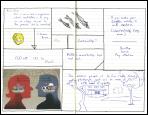
By way of illustration, here's a collage I put together last night:


The elements of this collage are mostly recycled from old books. The exceptions are the stamp, the target, and the two pieces of red paper which happened to be on my desk as I was working on this. I had no idea in mind as I was putting it together. I would not say that I have an idea in mind now that it's finished, either, although there are certainly several kinds of logic at work: a logic of materials, a logic of method, a logic of composition, a logic of color. That much said, there's also a randomness about collage that I like. Max Ernst said, "Collage is the noble conquest of the irrational, the coupling of two realities, irreconcilable in appearance, upon a plane which apparently does not suit them." I've spent hundreds of hours over the last few years both making collages and observing and archiving digitally the collages of others. I've also thought a lot about the connections between the compositional processes of collage and the compositional processes of certain kinds of writing. 

I have sometimes asked my students to do an exercise where they are asked to attempt to write a page of prose that makes no sense at all. (It's an exercise I return to frequently myself because the results are almost always interesting in unpredictable ways.) The thing is, it's a lot harder to do than you might think. Our brains are wired in a particular way, and even when we consciously attempt to undercut the literal sense of what we are writing, as for example John Ashbery often does to brilliant effect, our brains do not toss up entirely random alternatives; there always seems to be some sort of shadow logic at work. The ultimate point of an exercise like this, of course, is not to write nonsense, but rather to write in a way that offers the promise of pleasant surprises and at least the possibility of insight. It is, or ought to be, a playful, exploratory process. It is not helpful to have too clear of an idea in mind at the start. Robert Rauschenberg: "I'm opposed to the whole idea of conception-execution—of getting and idea for a picture and then carrying it out. I've always felt as though, whatever I've used and whatever I've done, the method was always closer to a collaboration with materials than to any kind of manipulation and control.

Another example. This morning, as all of this was taking shape in my mind, I sat down to write in my commonplace book as I generally do on weekend mornings, and so with the intention of having something to share here, I began writing with the intention of Not Making Sense:

If only because lasting locks one (you)
Down and what if keeps you (us) up—
rock, paper, scissors too simple a circle,
what about teapot or parrot or ocean?—
so yes an unfolding or perhaps a flight,
hands out front, tentacular antennae,
the possible check by jowl with oblivion
or worse (how foolish to expect other
wisdom), we (all) must needs from time
at least to time try to fly (unfolding)
against the grain, paste purple over green,
see what might be seen (harpoon, flower,
cube, plane) arrive again (surprised?)
where we have been but not the same.

I had come up with the first four words (if only because lasting) while I was doing my morning stretching and was trying to come up with a sequence of words that would be appropriately incoherent. The word "locks" suggested itself mostly because I was thinking of using some element of sound correspondence, in this case the L sound, to bind the words moving forward. As I continued to write, I was pleasantly aware of the dynamic tension between my own self-assigned task to avoid making sense, and the compositional imperative to make the whole hold together. Somewhere around line three several things became apparent: first, that there was in fact an unanticipated logic emerging that it might be fun to play with; second, that it had begun to feel like a sort of sonnet, which then gave me several constraints to work against: the length of the line, and the length (14 lines) of the poem; third, that there was another game that wanted to be played having to do with parenthetical interpolations of a certain sort. Alert readers may have also noticed that some of the elements of last night's collage also leaked, not entirely accidentally, into the poem, which, as it turns out, makes more compactly and perhaps more obliquely much the same case that I have been making in this post: sometimes you just need to put one thing next to another, and then another thing after that, and see what happens.


Saturday, July 27, 2013

(4) The Way


On December 31 of last year I began what I had intended to be a series of posts on the books on My Ideal Bookshelf, an idea which I borrowed from the book of that name which I was given as a Christmas present. I completed three posts in that series, shifted gears for a couple of more posts, and then dropped out of the writing life for a while. Now that I'm back, I'd like to pick up the thread with this post, number four in the series.


My mother was born a Methodist. In order to be allowed to marry my father, she was required to convert to Catholicism, and to promise to raise her children in the Catholic faith. This despite the fact that my father was in fact a non-practicing Catholic, who spent Sunday mornings at home while the family went to mass. By the time I had reached what the church referred to as the age of reason (age seven), I had been made to commit to memory the Our Father, the Hail Mary, the Apostles Creed, the Salve Regina ("Hail Holy Queen, Mother of Mercy, our Life, our Sweetness, and our Hope..."), and I had to recite them out loud to my mother each evening. I knew these prayers by heart before I had any real notion of what the words might mean. From third to fifth grade I attended a Catholic School administered by the Sisters of Mercy, and received further detailed instruction in the finer points of Catholic doctrine. I knew the ten commandments, I knew the difference between mortal sin and venial sin, and my imagination had been furnished with the topology of the afterlife - heaven, hell, purgatory, and limbo - and the angelic denizens thereof: on the good side the cherubim, the seraphim, the thrones, the dominations, and on the Other Side Satan and his minions. After a brief respite in a public junior high school, I spent four years in Catholic High Schools (two with the Benedictines and two with the Jesuits) and enrolled in 1965 at Fairfield University, a Jesuit college.

By the time I started college I had what I considered to be more than adequate reason to be skeptical of the teachings which had been impressed upon my brain. I remember taking a course in high school on Jewish theology, taught by a rabbi, and being impressed by the fact that there was in fact at least one alternative Vision of Truth. I also remember reading several books about Buddhism while in high school, and writing what I think now was perhaps an overly academic paper about the origins of the Mahayana and Hinayana traditions.

So it was maybe not so surprising that during my sophomore year at Fairfield, having declared myself as a philosophy major, I signed up for a course in Oriental Philosophy. The course was taught by a first-year teacher named Lik Kuen Tong. Dr. Tong turned out to be one of the most influential teachers I had at Fairfield, a brilliant mind and brilliant lecturer. Last I heard he was still teaching at Fairfield. Anyway, the course began with a survey of the core texts of oriental philosophy, which necessarily included Lao Tsu's Tao Te Ching. I do not think I can adequately convey how completely that book, in the terminology of the era, blew my mind.

Open to page one, and what do you see? The first four lines:

The Tao that can be told is not the eternal Tao.
The name that can be named is not the eternal name.
The nameless is the beginning of heaven and earth.
The named is the mother of the ten thousand things.

Hold on! That's it? That's the way things are? The whole idea of naming, of wrapping reality up in words, is erroneous from the start? It was like, well, pick your metaphor. A lightning bolt. Scales falling from my eyes. A whole new ball game. I had a new way of coming to grips with the existential questions: What kind of world is this? How should we live in it? In place of the view of the world I had inherited, and which I had assumed was more or less universal, there was suddenly an alternative, one that immediately resonated with me and felt closer to my intuitive sense of the ways things must actually be.

Taoism has a very simple (which is not the same as simplistic) view of the nature of the world. The Tao, or the way, is a process, a flow, a stream of karmically freighted events. One attempt either to live one's life in harmony with that flow, or to try to change its direction, an enterprise which is fraught with all sorts of dangers. One of the core concepts of Taoism is wu-wei, which can mean emptiness on the one hand or non-action on the other. Much of the Tao Te Ching is devoted to giving counsel about how it is just as important, in some situations at least, NOT to act as it is to act:

Do you think you can take over the universe and improve it?
I do not believe it can be done.
...The universe is sacred.
You cannot improve it.
If you try to change it, you will ruin it.
If you try to hold it, you will lose it... (29)

or

The softest thing in the universe
Overcomes the hardest thing in the universe.
That without substance can enter where there is no room.
Hence I know the value of non-action.
Teaching without words and work without doing
Are understood by very few. (43)

or

In the pursuit of learning, every day something is acquired.
In the pursuit of the Tao, every day something is dropped.
Less and less is done
Until non-action is achieved.
When nothing is done, nothing is left undone.
The world is ruled by letting things take their course.
It cannot be ruled by interfering. (48)

What I've started to sketch out here is the tip of a very large iceberg indeed. The Tao Te Ching is a book I still go back to from time to time when I feel the need to reflect and center myself. The teachings of Lao Tsu had an enormous and liberating effect on my own thinking as a young man, and have helped to shape, in ways that are in some cases obvious and in others quiet subtle, both my personal philosophy and my pedagogical philosophy as I have gotten older.

(Numbers in parentheses above are references to the numbered poems in the Tao Te Ching. The translation is by Jane English and Gia-Fu Feng.)


Friday, July 26, 2013

Transatlantic


I've been having a harder time of late, for some reason, finding things that I really want to read. In the last six months, while I've been waiting for George R.R. Martin to get around to finishing book six, I've started way more books than I've finished. So I was happy to find, about a month ago, that Colum McCann had a new novel out. From reading Let the Great World Spin I knew him to be a writer of formidable gifts, and so when I saw Transatlantic at the local B&N I snapped it up.

Transatlantic comes at you in two parts. Book One weaves together three stories based on actual public events: the first transatlantic plane flight from Newfoundland to Ireland by Jack Alcock and Arthur Brown in 1919; Frederick Douglass's extended visit to Ireland in 1845 and '46; and the 1998 peace negotiations brokered between the Irish and the British by American Senator George Mitchell in 1998. McCann imagines his way into the minds and lives of each of the public figures in ways that are informative, entertaining, and entirely convincing.

Given that the events seem to connected only by virtue of the fact that they really took place, in Ireland, the reader is led to wonder, where are we going with this? McCann raises that question in order to be able answer it in Book Two, which focuses on the decidedly non-public but very clearly connected lives of four generations of one family of Irish women, who appear as very minor and apparently unconnected figures in Book One, but whose stories, as they emerge in Book One, have every bit as much drama and weight and resonance as the lives of the more famous people who have gone down in the historical record. In this sense, the book is a work of excavation, of correction, of restitution, paying homage to the lives of ordinary people who turn out to be not so ordinary after all. It's a book that honors the dedication and bravery and capabilities of women who play out the drama of their lives with little hope or expectation of notice or acknowledgement by those in charge of keeping the historical record.

Along the way there is also pleasure to be taken in some remarkable writing. Here, for example, is a passage describing the arrival in New York City of Irish housemaid Lily Duggan, who has been inspired by the visit of Frederick Douglass (in ways he had not intended and might not have wished for) to leave Ireland and seek the freedom in America that she senses she will never have at home. She's seventeen years old and has just spent eight weeks on the ocean:

New York appeared like a cough of blood. The sun was going down behind the warehouses and tall buildings. She saw men on the wharfside in the ruin of themselves. A man barked questions. Name. Age. Birthplace. Speak up, he said. Speak up, goddammit. She was sprayed with lice powder and allowed entry. Lily jostled her way along the waterfront among the stevedores, police officers, beggars. A stench rose up from the oily harbor. The brokenness. The rawness. The filth. She had met only a few Americans in her life—all of them in Webb's house in Dublin—but in New York the men were adherent to shadows. The sloping Negroes were bent and huddled. What freedom, that? Some still wore the branding marks. Scars. Crutches. Slings. She passed by. The women along the docks—white women, black women, mulattos—were rude with lip paint. Their dresses rode above their ankles. It was not at all what Lily wanted the city to be. No fancy carriages pulled by drays. No men in bow ties. No thumping speeches along the waterfront. Just the filthy Irish calling out to her in all manner of disdain. And the silent Germans. The skulking Italians. She wandered amongst them in a haze. Children in rags of unbleached cotton. Dogs on the corner. A mob of pigeons descended from the sky. She moved away from the cries of teamsters and the cadenced call of peddlers. Pulled her shawl around her shoulders. Her heart shuddered in her thin dress. She walked the streets, terrified of thieves. Her shoes were filthy with human waste. She clutched her bonnet tight. Rain fell. Her feet blistered. The streets were a fever. Brick upon brick. Voice upon voice. She passed dimly in lit lofts where women sat sewing. Men in top hats stood in doorways of dry-goods stores. Boys on their knees set cobblestones. A fat man wound a music box. A young girl made paper cutouts. She hurried on. A rat brazened past her on the pavement. She slept in a hotel on Fourth Avenue where the bedbugs concealed themselves beneath a flap of wallpaper. She woke, her first morning in America, to the scream of a horse being beaten with a truncheon outside her window. (163)

It would be a day's work to enumerate the various ways in which this language works to bring Lily and the world she has found herself in alive in our minds. But just for starters, I note the punchy, abbreviated syntax, the density and variety and authority of the imagery, and the way McCann conveys the movement of Lily's thoughts at the same time that we follow the movement of her body.

Like I said, I've been having trouble finishing books. I didn't have any trouble finishing this one.


Thursday, July 25, 2013

Little Enough


Ah, Thursday. The sun shining
on the leaves of the trees outside
my door, the hum of the AC,
the splashes and shrieks of
tweener girls in the pool across
the way.  A perfect day
for writing a poem, for floating
an idea out into the void, for
figuring out first this, then what
comes next. Stand up or stay
seated? Putter or grind? Stay
or go. Never mind; no matter.
Enough to be here. Today's mantra:
I have arrived. I am home.

Process Reflection: What you see. I had a few minutes waiting for Matt to come by, and was sitting at my computer, and the thought occurred to me that if I could write something that would make three days in a row for Throughlines. Just trying to keep the ball rolling. This morning my wife sent me a press release for Thich Nhat Hanh's upcoming world tour which contained a little explanation and endorsement of mindfulness:


Mindfulness is the energy of being aware and awake to the present moment. It is the continuous practice of touching life deeply in every moment of daily life. To be mindful is to be truly present with those around you and with what you are doing. We bring our body and mind into harmony while we wash the dishes, drive the car, take our morning cup of tea, or prepare for a retreat. 
“I have arrived. I am home” 

... It is the practice of dwelling happily in the present moment. We are no longer grasping at the future, regretting the past or being swept away by our feelings of despair or anger. We have arrived at our true home, our true self, no longer seeking to be something else.
So that's the occasion and the inspiration. No big thing. Only words.

Wednesday, July 24, 2013

Beginning


There was a poem in the April 29 New Yorker by Lia Purpura that I liked, clipped, pasted in my commonplace book, and subsequently committed to memory:

Beginning

In the beginning
in the list of begats
one begat
got forgot:
work begets work
(one poem
bears the next).
In other words,
once there was air,
a bird could be got.
Not taken.
Not kept.
But conjured up.


It was an easy poem to memorize because it's so tightly and logically organized. First there's the context, when (in the beginning) and where (in the list of begats), then the core assertion: they left out something important (one begat got forgot): "work begets work." As, for example, in the act of writing, one word leads to the next, or, as Purpura offers, "one poems bears the next."

My guess is that in the composition process, the assertion "work begets work," is what came first. It's the kind of phrase one might hear and then begin turning over in one's mind. Taken by itself, it's a truism. An apt and perhaps useful or insightful truism, but a truism nonetheless, and certainly not one that would initially suggest itself as being the basis for a poem, except for the way the syllables move. Work begets work. All that crackling. And then there at the center, the word "begets," with its procreative denotation, its biblical associations, and its (at this point latent) metaphorical power. Given the phrase "work begets work," I can easily imagine how a writer with a playful spirit, and alertness to sounds, and some knowledge of the bible might reverse-engineer the rest of the poem's first sentence.

What interests me more is what happens in the second act. "In other words..." is an interesting move, the move that says, essentially, let me clarify my assertion. Let me come at it from another direction. Let's try an example. "In other words..." what?

"Once there was air, a bird could be got." The key word in that sentence, the loaded word, the word in need of yet further clarification, is the word "got." It's an everyday word with a long history and a lot of possible meanings. (Its definition in my copy of the American Heritage Dictionary takes up sixteen column inches of very small print.)  The syntax demands that we read it in its old-fashioned sense as a past participle; current usage would be "gotten," but the two word sequence"be got" is clearly intended to echo (and extend) the one-word "begets" and "begets" we've already seen and heard.

So what does "got" mean here? Purpura anticipates the question, and answers it. Not "taken," which would be one plausible interpretation. Not "held," which would be another. But "conjured up," which comes as a surprise, right? Suddenly, unexpectedly, we're talking about conjuration, about magic. Given the existence of air, it is within the province of the imagination to conjure up birds.

So in one sense this is a poem about how poems get written, about how writing itself works. Given something, given anything—a phrase, a sequence of sounds, the existence of air—the imagination is capable of conjuring up whatever it might be that would follow. The poem is also an endorsement of the writerly work ethic, and a demonstration of how that effort sometimes pays off. The work itself is what generates the product, and the point of "conjured up," as I take it, is that at the end of the process there is at least the possibility of a discovery, the kind of surprise that poems can (and this poem does) deliver.

Another thing: I love the way the texture of the poem shifts with "conjured up." "Conjured" comes as a relief after all those buhs and guhs and tuhs. But different as it is, it's integrative as well: the "ur" sound occurs earlier in the poem in two places: "work begets work" and in "bird," both of which are relevant: the work leads to something being conjured, and what's conjured is the bird. So there's a kind of sonic binding going on, a kind of ur-sprache, an incantation.

Purpura is having a lot of fun with sounds, it's hard not to notice that. For example, the final "P" sound brings the poem to a satisfyingly clean conclusion. Having noticed that, having been prompted by the arrangement of sounds in the poem to pay attention to sounds, it's hard not to notice that that "P"sound occurs only once before, as in initial sound in the word "poem." The Poem begins the process of conjuring which in this case ends with the word uP. Sonic binding again. A beginning and an end. The poem enacts exactly what it is talking about. It begins in the mundane and ends in magic.

In another sense, this is also a poem about evolution, even cosmogenesis. Given the space-time continuum, shall we not expect energy and matter? Given planets, shall we not anticipate planetary creatures, real or imagined? Given ocean, shall we not expect fish? Given air, shall we not expect birds? Or in their absence, be inclined to imagine them?

This poem gets a lot of work done in a very short space. It's compact and clean and makes a point about the "work" of writing with elegance and grace. I'm considering asking my students to take a look at it this fall, see what they think.


Tuesday, July 23, 2013

Long Time Coming


Okay, so I get it, it's been six months. No excuses. I've been elsewhere, and more or less avoiding doing any writing at all. But I'm thinking it's time to climb back into the saddle. Why now? Well, my tenure as an administrator is coming to an end. As of the start of the school year, about a month from now, I'll be back in the classroom for one semester, at the end of which I will be retiring. One of the reasons I began this blog in the first place was to have a space to be reflective about my teaching practice. But then I wasn't teaching, and what I was doing did not often lend itself to public reflection and sharing. And then I got hijacked first by Tumblr, and then by Pinterest (links in the sidebar, I'm too lazy to work them in here) and a lot of the time I would have been spending writing was going there. And the things I did feel inclined to write about all wound up being Big Ambitious Projects that I never wound up following up on. So here's the new paradigm. Shorter. More informal. More regular. Try to work my way back into shape. No shortage of things to write about, once I get going. I'll be back tomorrow. Promise.

Friday, February 15, 2013

Autoportrait III


(Part three of a series.)


My favorite writing utensil is a black pilot Razor-point pen. I don't like ballpoints. My handwriting is very tightly compressed and difficult for others to read, although I don't feel any need or desire to change it to suit others. I have changed a tire perhaps seven or eight times. The worst time experience was when I was outside an indoor soccer facility on a rainy winter night and drove the car through a puddle that was obscuring a pothole and it tore the tire in half. I had to change it in the cold and rain while my son played his soccer match indoors. Although I use it sparingly, my favorite punctuation mark is the semicolon. I do not have a favorite color or favorite day of the week. I have owned two Volkswagens, one Datsun, one Chevelle, one Chevette, and five Toyotas, in that order. Before that, I owned a Honda motorbike and later, a Honda motorcycle. Almost everything I wear is made of cotton. I like my bed hard and my pillows firm. I have no reason to believe that anything in the world is likely to get better in the future. I do not like the smell of perfume. I went for years without reading the paper. Now I skim the local paper daily but rarely find anything worth reading in it. I like going to art galleries. I read mostly lying down. I have taught myself to touch type, and have greatly improved my performance to do so by transcribing audiotapes I've made of comments one of my artist friends makes while he is doing demos. I no longer enjoy going to the beach. I have never been in a fistfight or punched anyone, although as a teenager I was punched several times by morons. Both of my parents believed in paying for quality. My mother used to say, with only a tinge of irony, "The best is none too good." The two times of day I enjoy the most are when I am setting off for work and when I am walking home. I get impatient with people who complain of being bored. I agree with the woman in The Glass Menagerie who argues that boredom betrays a lack of inner resources. I often surprise myself by weeping in movies and then feel ridiculous for doing so. It is my general practice to withhold my opinion unless I am asked for it, unless I am with people I know and trust. I have never been seriously hungry. I have never been in the armed services. I have never fired a machine gun. I have fired rifles, shotguns, and pistols. I've shot and killed woodchucks, crows, squirrels, rabbits, pheasant, and ruffed grouse. I rarely get headaches. My knowledge of world geography is sketchy at best. If I had to draw a map of Asia, I'd get most of the major countries but I have no real sense of how they interlock. I dislike Musak and Hallmark cards and all other forms of merchandized secondhand sentiment. When I was a child, I used to believe that there were animals outside the windows of my house waiting for me to come out so they could pounce on me. I used to follow my mother around the house because I thought I would be safer in her presence. I prefer abstract art to realistic art. I have fainted on several occasions, including once when I was serving as an altar boy at a confirmation ceremony and holding the bishop's crozier, which fell to the ground with a crash that startled everyone in the congregation when I passed out. When people ask me if I miss New England, I tell them I miss the last week of September and the first week of October, and that's about it. I do not like cauliflower, Brussels sprouts, broccoli, artichokes, asparagus, eggplant, peas, corn, or lima beans. I generally fall asleep quickly and sleep solidly. Given a choice, I'd wear jeans, sandals, and a t-shirt all the time. I do not smoke. I do not drink coffee. It bothers me when people walk by art on the walls and do not even register that it is there, much less look at it. When I visit houses I am always drawn to look at what is on their bookshelves. I skateboarded long before skateboarding became a craze. I know how to whistle and sometimes like to do so, but it annoys me when others whistle so when I catch myself whistling in company I try to stop. I have had surgery for cancer; it saved my life. I cannot recall ever wanting to take revenge on anyone. While I am sometimes disappointed by the behavior of others, I do not generally get angry at them. I do get angry at myself. I don't believe in ghosts, but I do not necessarily disbelieve in them either. One of the scariest people I ever met claimed to have worked as a ghostbuster and he had detailed, very convincing stories of how he had worked with a team to make contact with spirits stuck in between the real world and the spirit world and to perform healing rituals to help them to the other side where they could be at peace. I nearly killed myself and my son when I drove in front of a truck while fumbling in the glove compartment for a pen. The car was totaled and by some miracle we were essentially unhurt. I am an unapologetic liberal democrat, and it distresses me that liberals over the last thirty years have let themselves be pushed around by conservative demagogues spouting utter nonsense. I know several poems by heart: Frost, Dickinson, W.S. Merwin, and William Carlos Williams. I have played chess for more than fifty years and am a decent player but probably not as good as I should be at this point. I've never been serious enough to really study the openings or analyze even the games I have played, much less the games of others. This particular autoportrait exercise produces a kind of writing which make me seem duller and less fully rounded than I feel myself to be. I like my life. I like to read and write. I love talking about ideas with students and colleagues. I've never wished to be anyone else or envied anyone else's life. I work hard, and I try to be useful in this world. I have few regrets and no complaints. It's good to be here, for as long as it lasts.

Tuesday, February 12, 2013

Autoportrait II


(This is part two of an exercise begun in the previous post.)

The things I enjoy doing the most require are not in any way reflective of who I am or how I am different from anyone else. I like simple, repetitive tasks that have a physical component; for example, washing the dishes after dinner, then drying them, putting them away, and wiping the counters. I love a warm shower. I enjoy the short morning walk from my home to my office, although I have to keep my wits about me. Today as I was walking across the street in the crosswalk, the first car coming toward me stopped and the one behind it wasn't watching and had to slam on the brakes and screech to a halt, very nearly rear-ending the car in front. I generally am reading five or six books at a time. I've just begun Autoportrait by Edouard Levé, which is the ur-text from which what I am writing now derives. I am the sort of person to whom the word ur-text occurs naturally; it wasn't something I had to wrack my brains for. At one point in my life I took care of seven horses. My mother took up smoking on the advice of her doctor, who told her that it would do her good to sit down and smoke a cigarette several times a day. She lived into her nineties. I do not like to drink alcohol. In my family, some of us had straight teeth that were soft and got cavities easily, and some of us had crooked teeth with hard enamel. I got the hard teeth. My father bought each of his sons a rifle when we were twelve, and taught us how to use it. I've read and written poetry for my entire adult life. Some people would find that ridiculous or off-putting. I don't care much about what people think. I have been described as anti-social, as too serious, as intimidating. I do not see myself that way, but I don't go out of my way to alleviate those impressions. I generally don't enjoy meeting new people unless it's in the context of work to be done. Nor do I like saying goodbye, even to people I know well and am fond of. I don't like the girls at the mall who try to start up a conversation as you walk by so that they can sell you face cream or swirly dresses. When I was in China this summer, I was put off by the department store salespeople who attach themselves to you the minute you walk in the door and walk around the store with you grabbing items from the racks and holding them up in front of your face. I eat the same breakfast pretty much every day on alternate days: one day cereal and banana, the next day a toasted bagel. I used to do crossword puzzles religiously, as did my mother. I sometimes wonder at what point exactly my life closed down to these narrow obsessive rituals. I rarely laugh out loud except when I'm reading something funny. I enjoy napping. I like the feel of my body in motion. My vision of an ideal afterlife would be an endless pickup basketball game.  I read somewhere a long time ago that there is an antiworld that is moving toward us from the future at the same speed that we are moving toward it from the past, and the collision of the two worlds will be the end of time. I don't watch television. There is another autoportrait exactly like this one, except that all of the sentences are saying things that I cannot or will not say here. I have a family, for example, but I do not believe it would be okay for me or acceptable to them if I were to drag them into this, except for my parents, who are no longer alive and who would perhaps forgive me in any case. The form of this exercise contributes to a certain tonality and flatness of affect. My father died when I was eleven and I was angry at him for having worked himself to death. I like being able to be of assistance to others, but I don't like asking for help. I don't believe in God. I'm not sure I ever did. I'm happier with a Hershey Bar than a fancy chocolate truffle. I love the smell and taste of vanilla. I dream vividly when I sleep but rarely can remember my dreams when I awaken. Sometimes when I am arising from sleep a phrase or a sentence sticks with me and I write it down before I get up. I've come up with the start of some interesting poems that way. I once saw Eldridge Cleaver give a speech to undergrads at Vassar College in which he told them to remember that "political power springs from the lips of the pussy." I am generally more comfortable in the company of women than of men, unless there's a card game or work to be done. I have trouble finding sneakers that fit me. I've never met anyone famous. I've never been interested in being famous myself. I don't care about money, except to the extent that I want to be able to support myself and have a little to spend. I like building fires, but have no use for a fireplace where I live now. The most influential teacher in my life advised me, after I had been teaching for fifteen years, to leave education and broaden myself by trying something else. I never did. If I had to choose, I'd rather be too hot than too cold. Swimming is the most tiring of exercises for me. I tried surfing once but fell off my board and had to swim through the whitewash to get to it, and was so exhausted by the time I got to it that I wasn't interested in paddling out for another try. A peanut butter and jelly sandwich is still one of my favorite meals. Robert Rauschenberg was onto something when he said "Whatever I've used and whatever I've done, the method was always closer to a collaboration with materials than to any kind of conscious manipulation or control." To some extent that's what's going on here. I used to wonder how you would know when you had become an adult.

Process Reflection: Autoportrait I was interesting enough as a writing exercise that I wanted to return to it and extend it. The basic rules as I understand them are 1) that every sentence is a statement and 2) that each statement is true. Perhaps there's also an expectation of some degree of spontaneity, which implies that you don't go back and mess with it too much. (I did some light editing in this one, and moved two or three sentences; I feel a little conflicted about that, but what the hell.) Writing something of this nature puts you in a different kind of box and basically forces you to write differently than you normally would, which provides at least the opportunity for surprise. I had no idea what was coming next as I was writing, and I kind of like being in that space.  It's like a building a collage or a doing pointillist painting: you lay down one unit after the other, and the odd juxtapositions create energies of various kinds in the spaces between them in ways that are not quite predictable. I found myself thinking a lot this time about what I was NOT writing, and added in a line about that.

I'm used to following the rhythms of my thought as I write and more or less consciously building sequences and structures that create emphasis and give the opportunity for humor or self-questioning. In my regular writing I rely heavily on paragraph breaks and signposting with words like "similarly" or "furthermore" or "on the other hand." Now even writing something as functional and utilitarian as this process reflection feels luxurious; I can get a line of thought going and run with it as far as I like: a sentence, a paragraph, a full-blown essay. Having done the autopilot exercise as a kind of five-finger-exercise, I can return to my normal writing feeling refreshed and freed up. I sometimes used to do a thing in class with students where I would speak in monotone, monorhythmic syllables that – sound – like – this – and – take – a – way – all – norm – al – in – to – na – tion – and – the – ef – fect – is – im –med – i – ate – ly – ap – par – ent. It was always a relief, for them and for me, to go back to normal speech patterns, which are inflected in completely unconscious but highly sophisticated ways. The point being that every element of verbal discourse is subject to strategic manipulation, and in fact when you write and speak "naturally" there is always somebody at the controls, it's just not your conscious mind. One way to alert the conscious mind to the fact that there's somebody else in charge is to place yourself under the kinds of constraints represented by this exercise or, say, by what Padgett Powell does in his novel "The Interrogative Mood," which consists entirely of questions. When you say to yourself, okay, now, I'm back, the question facing you is: so what are you going to do with it?

All of which is to say, this is pretty interesting. I may not be done yet.

Saturday, February 9, 2013

Autoportrait I


So  okay. I have not yet finished what I started. I didn't even get up a good head of steam. I did three posts in early January that were going to be part of a series and then I walked away for a while. The next book in line is the Tao Te Ching, and that's a simple book with a complicated story and I haven't had the gumption to get going with it; it feels too big too me.

What I've figured out is that given the number of distractor factors I've got going on right now (Tumblr, Pinterest, my artwork, chess, reading, and oh yeah, my job), the only way I'm going to get into a regular writing rhythm again is to attempt smaller bites, try my hand at things that look more like fun and less like work. That doesn't mean I'm not going to keep going with the bookshelf thing, I will. But in between I'm going to play a little bit.

One of the things I like about Tumblr is that the posts generally include links not only to the person who most recently put up the post but also to the people who posted originally. So when time permits you can do a bit of surfing to find other blogs. That's how I ran across a blog I really like maintained by Stephen Sparks called Invisible Stories. It's got some interesting layers. On Wednesday his post began like this:

[After reading Édouard Levé’s Autoportrait in January ‘12, I attempted—as an exercise in personality upkeep—to compose a series of declarative statements of my own. I succeeded for a few months before fragmenting into sentences surrounded by comforting white space. With the same intentions, but hopefully better resolve, I attempt another stab (in the dark) here.]

He then posted a short essayish sort of compilation of declarative sentences that I found interesting to read both for what they had to say and for the territory they suggested might be there to be explored. Cool idea, I said to myself. That might be fun, I said to myself. So here goes:

I'm now five years older than my father was when he passed away. I've lived in Honolulu for almost fifteen years now. I like living in a state with no majority population. I like the air, the potable tapwater, the sunshine, temperatures in the eighties all year round. But it irks me that in a small city with a perfect climate there is no infrastructure for bicycles. We're choking on traffic. And in an environment where we have access to wind and sun and wave energy every single day, we generate more than 90% of our electricity by burning petroleum. There was a time in my life when I was a political activist, but politics discourages me now. People will go to extraordinary lengths to deny the most obvious truths if they do not fit with their predispositions. Al Gore wrote a book about that. I suspect that he had hopes that the book would be a game changer. The game has not changed. Before I wound up with arthritis in my hips, I used to play, and coach, basketball. Before I wound up with nerve damage in my shoulder, I used to play guitar. Before I became an administrator, I used to teach. I've been a voracious reader all my life. I read less now. I find it harder to get lit up by books these days. My life seems to be devolving into a series of departures. All of which are, let us say, rehearsals. I begin every day with a routine of stretching that borrows bits and pieces from yoga and tai chi. It takes about ten to fifteen minutes. Then I shower, make breakfast and go off to work. I like going to work as the sun is rising, but in the winter months it's often still dark when I reach my office. My office is always cold. It's in a big building with central air which seems always to be set at the same temperature whether the days are long and sunny or short and rainy. During the winter it's cold. I've worn a blue fleece jacket in my office every day for five years. I take it off when I go outside. I don't like travelling much. I like being at home. I like having time to myself. For the last several months I've been spending time in the evenings making collages out of old books and photographs. (Before that it was drawings. Before that it was prints. Before that it was idiosyncratic oddball abstract paintings.) I sit and piece bits of paper and cardboard together and glue them down with acrylic medium. It's somehow very satisfying, this business of pasting bits of old things down to make something new. Often while I work I find myself thinking of my father, who spent time most evenings in his study, pasting pictures and newspaper columns into scrapbooks with hunting and fishing themes. Dad liked to think of himself as an outdoorsman. He was a meticulous man, and his scrapbooks were elegantly maintained. He's been dead for 55 years. The scrapbooks are gone. I don't know where.