




My default process when writing is closely akin to my process when beginning a drawing or collage. I put a blank piece of paper on the desktop and begin with a mark of some kind: a word or phrase, if I’m writing; a shape, if I’m drawing; a scrap of paper if I’m starting a collage. Donald Barthelme puts it in a way that makes sense to me:
The writer is one who, embarking upon a task, does not know what to do… Writing is a process of dealing with not-knowing, a forcing of what and how.
The pen is an instrument of discovery rather than just a recording implement. If you write a letter of resignation or something with an agenda, you’re simply using a pen to record what you have thought out. In a poem, the pen is more like a flashlight, a Geiger counter, or one of those metal detectors that people walk around beaches with. You’re trying to discover something that you don’t know exists, maybe something of value.
The core concept, the fundamental practice, is thus purely explorational. I don’t know what I’m doing when I begin. And often, when I have finished, I would be hard-pressed to describe what I have done. The artwork, if it is successful, will speak for itself, and will invite the viewer to participate in the creation of whatever “meaning” the work might be understood to have. The “meaning” derived by one viewer will in all likelihood vary considerably from the meaning derived by another.
If this seems to be a somewhat arbitrary and potentially confusing way of proceeding, so be it. I find that submitting myself to this process to be both entertaining and, in the long run, very satisfying. (This all should sound vaguely familiar to anyone who has read my previous post about “the open text” in general and the poetry of Cole Swensen in particular.)
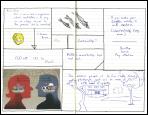
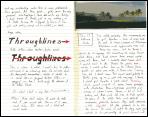
Anyway, all that I have written so far is by way of introduction to a few pieces I have recently completed which combine collage-making of a sort and drawing of a sort. In each case the artwork began as pure collage (pasting paper on paper), and upon completion of the collage work the pen-and-ink elements were added. I had not until recently thought to combine the two, but what resulted when I did so interests me:


Essay
A place to begin. An undertaking. An attempt at con-
struction, picking up pieces, turning them this way
and that. Squinting, weighing, wondering
whether this one goes here or
there.
How do we de-
cide? Slowly something takes shape, a song
insists on being sung. One voice, another, eventually, a choir.
A cathedral. Vocational
therapy. We're in this together, we
gather, we lean on
each other. We wander. We stand tall,
we call out, we await the arrival
of the eyes
that, falling upon us, bring us,
ever so briefly, to life.
Process Reflection:
Most people, hearing the word "essay," don't necessarily think about its derivation, the sense of the word that means "a trial" or "an attempt." But every work of art, and of writing, is in that most elemental sense an essay. The collage at the top of the page, entitled "Essay" is one of literally hundreds that I have worked on in recent years. The poem, a very "wet" recent draft with the same title, is an attempt both to generate some words about the collage and to mirror in its structure some of the observable elements of its architecture: the way in which disparate fragments and pieces come together, or, insisting on their unique individuality, resist coming together. One critical difference between the two "essays" is that the pieces of the collage, once glued down, are immovable, whereas the poem, now in its fifth or sixth incarnation, is subject to as many re-visions as I have the time and the patience to attempt.
 |
| The Poet (RBS Collage) |
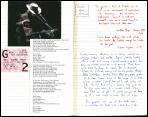
Twenty Questions
Is it raining out?
Is it raining in?
Are you a public fountain?
Are you an antique musical instrument?
Are you a famous resort, perhaps?
What is your occupation?
Are you by chance a body of water?
Do you often travel alone?
What is your native language, then?
Do you recall the word for carnation?
Are you sorry?
Will you be sorry?
Is this your handkerchief?
What is your destination?
Are you Aquarius?
Are you the watermelon flower?
Will you please take off your glasses?
Is this a holiday for you?
Is that a scar, or a birthmark?
Is there no word for calyx in your tongue?
Twenty Questions
Did you hear the thunder this morning? What was up with that?
Shouldn't there be an easier way to get those sneakers clean?
Have you seen my sweater? What are we going to do about
Elizabeth? Can you tell me what you have in mind? Don’t you
Think we’d be better off if we just stayed home? What is that crow
So upset about? Is there a reason why you need to be doing that
Right now? How many times have I asked you to stop?
If I get done in time, would you like to come with me
To the basketball game? Why are the newspapers still covering
That story? Would you care for some peppers? Is my scarf
Too much? Wouldn’t it be nice to be able to fly a plane?
What do you think you’re doing? Isn’t there a statute of limitations
On that? When is the rain supposed to end? Can I ask you a question?
 |
| RBS: Homeland |

 |
| Motherwell: Australia II |
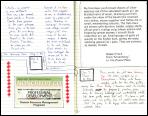
I could see no reason why tram tickets, buttons, and old junk from attics and rubbish heaps should not serve well as materials for paintings; they suited the purpose just as well as factory-made paints… it's possible to cry out using bits of old rubbish, and that's what I did...

 |
| Fig. 6 |


 |
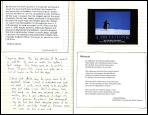
| The Standards of Excellence |
 |
| The Quest for Identity |

