Showing posts with label art. Show all posts

Sunday, November 16, 2025

Explorations


My default process when writing is closely akin to my process when beginning a drawing or collage. I put a blank piece of paper on the desktop and begin with a mark of some kind: a word or phrase, if I’m writing; a shape, if I’m drawing; a scrap of paper if I’m starting a collage. Donald Barthelme puts it in a way that makes sense to me:

The writer is one who, embarking upon a task, does not know what to do… Writing is a process of dealing with not-knowing, a forcing of what and how.

                                             
After that I proceed by making another, and another, and another, pushing into the space and watching what emerges as I work. As Billy Collins puts it:

The pen is an instrument of discovery rather than just a recording implement. If you write a letter of resignation or something with an agenda, you’re simply using a pen to record what you have thought out. In a poem, the pen is more like a flashlight, a Geiger counter, or one of those metal detectors that people walk around beaches with. You’re trying to discover something that you don’t know exists, maybe something of value.


The core concept, the fundamental practice, is thus purely explorational. I don’t know what I’m doing when I begin. And often, when I have finished, I would be hard-pressed to describe what I have done. The artwork, if it is successful, will speak for itself, and will invite the viewer to participate in the creation of whatever “meaning” the work might be understood to have. The “meaning” derived by one viewer will in all likelihood vary considerably from the meaning derived by another.

If this seems to be a somewhat arbitrary and potentially confusing way of proceeding, so be it. I find that submitting myself to this process to be both entertaining and, in the long run, very satisfying. (This all should sound vaguely familiar to anyone who has read my previous post about “the open text” in general and the poetry of Cole Swensen in particular.)

Anyway, all that I have written so far is by way of introduction to a few pieces I have recently completed which combine collage-making of a sort and drawing of a sort. In each case the artwork began as pure collage (pasting paper on paper), and upon completion of the collage work the pen-and-ink elements were added. I had not until recently thought to combine the two, but what resulted when I did so interests me:


Tuesday, April 8, 2025

What I've Learned


What I've Learned


Alas, not much. But not nothing, either. A place to start,

to begin with. Point A, as when the pen meets the paper


for the first time, and keeps moving until it stops and lifts,

or doubles back on itself to make a shape of some kind.


Or continues on into the white space, meandering,

trying to discover what it's meant to become this time.


Boundaries are helpful. You can go in one direction

only so long without getting lost. Better to return


home on occasion and consider whether to expand,

consolidate, change course entirely, or begin again.


The choices you make at any particular time are

mostly a matter of intuition. Often one move


will dictate the next, and the one after that, in a way

that will, with luck, deliver what you never saw coming:


A flower. A comet. A house. A star. A beating heart.


Process Reflection:

This is a poem written after I completed the pen-and-ink drawing in my previous post. The poem is a reflection on the process of drawing in general and of drawing that picture in particular; it is also, inevitably, a parallel reflection on the writing process as I understand it and practice it. Formally, I was attempting several things at once. I originally had it in mind that it would be a sonnet, or at least sonnet-ish, and that each line would contain 14 syllables. When I got to the end of fourteen lines, I found that the logic of the poem as it had unfolded in the writing suggested that I needed one more line, which was a) a surprise to me (I hadn't planned to do that) but also b) a surprise in the poem that mirrored or echoed the surprise that I felt once I had completed the drawing and began to see things in it that I had not completely intended. Although I think looking at the picture may help snap the intention of the poem into focus, I hope that the poem works as a standalone written document as well.

Tuesday, March 18, 2025

Back to the Drawing Board


This is the most recent in a long line of pen-and-ink drawings I have done over the last fifteen or twenty years. I have a particular way of working that has evolved over time. Most of the drawings are done on Bristol paper, which has a very smooth surface that accepts a clean line, and doesn't tear up the tips of the Pigma Micron pens (usually .05 or .08) that I like because the ink dries quickly and is waterproof.

I find the process of drawing to be enjoyable, a way of centering myself. I most often listen to music, humming or singing along to myself while I am drawing. I begin by penciling in the rectangle that I'm going to work within. I used to do the drawing first and add the surrounding rectangle, afterwards, but discovered that it is prohibitively expensive to pay for mats and frames in custom sizes, so in recent years I pick a standard-sized mat, measure out the opening in the mat, and then draw very lightly in pencil the lines that will form the outer edges of the finished drawings.

I never have a plan laid out in advance when I draw, I just put the tip of the pen down on the paper and draw some kind of shape and fill it in, then do another next to that, and another next to that. I leave white space between each shape, and as I work the white space, the negative space, starts to assert itself as a compositional focus that often outweighs the shapes I have actually drawn. At some point I will draw straight lines, like the diagonals in the picture above, to subdivide the paper into sections. In terms of composition, my goal is to wind up with a some stylistic consistency within each section and stylistic variety from section to section. (In an earlier post I wrote a poem about how this process works.)

Obviously this drawing is not a literal representation of anything to be found it the world. It's more or less a pure abstraction, although inevitably some abstracted elements will wind up suggesting something to whoever looks at the drawing. While it's not unusual for people to tell me when they "see" something in the drawing, it is very unusual for that something to be anything I had consciously included. An example in this case is the small rectangular shape in the middle right of the picture which reads as perhaps a house or a face sitting atop something that might be read as a star. I find it interesting when those elements make their presence known as I draw, but I can't say that I have planned them. I accept them as pleasant surprises, or as evidence of my subconscious tossing up something I was not expecting and will not immediately—or perhaps ever—understand. Even the large flowery shape at the upper left emerged mostly because I was working to fill in the negative spaces left by the sixteen smaller shapes surrounding it. I was also consciously trying to introduce some semitones in the form of dots and thin lines to contrast with the more heavily contrasted black and white sections in the rest of the drawing. It became a plant form only by default.

I've had a lifelong interest in art, and have a large collection of books related to drawing and painting and collage. One of the things that satisfies me about the work that I have been doing is that there is nothing like it out there anywhere. There's some Zentangle stuff that I took an interest in for a while, but most of what I saw out there seemed to me to be over-structured and stylistically repetitive. This art is my art. Each time I sit down to draw it's an adventure of sorts, a process of exploration and observation. I enjoy making the drawing, and I enjoy studying the resulting artwork once it is made.

These kinds of drawings do not lend themselves to explanation. There's not much that I or anyone else could offer by way of paraphrase or summary. I could describe in words what goes on in my head when looking at any one section, or at the drawing as a whole, but that would be a pretty pointless exercise. They exist in a non-verbal plane.

Which is not to say that there are no parallels between what I am doing when I draw and what I am doing when I write poetry, or prose, for that matter. My writing practice is not unlike my drawing practice. Probably the most simple and elegant articulation of that process, whether working as an artist or as a writer, has been attributed to Jasper Johns: Do something. Then do something to that. Then do something to that.

I'm sure that there are some people, and you, Gentle Reader, may very well be one of them, who would question why any sane person, given the ongoing political and environmental chaos going on in the world and getting worse every day, would choose to spend his time producing hermetical drawings or often well-nigh incomprehensible poems. My response is pretty simple. There is little or nothing I can do at the personal level to deal with any of that stuff. I'm an old man. I do not see any reason to choose to spend the limited amount of time I have left on this planet tilting at windmills. My art, and my poetry, is something that gives me pleasure while I do it, and some small measure of satisfaction when it is done. Granted, the value that accrues from it does not have a positive impact on the world as it is. But it helps me to navigate and endure that world, for as long as I remain a part of it.

I'll bookend this post with the followup drawing I completed yesterday:


Tuesday, February 21, 2023

Bookmarks II


Just bookmarks again this week. I've been doing more drawing than writing of late. I like working small scale like this; it lowers the stakes and I can finish a piece in one sitting, whereas larger pieces can take weeks. But if you happen to have arrived here looking for something pretty interesting to read, this short essay touches on many of the themes this blog has existed to explore. I ran across it this week in One Long River of Song by Brian Doyle, a collection of essays which is in its entirety pretty awesome. As is his novel, Mink River.

Tuesday, February 14, 2023

Bookmarks


Tuesday, January 17, 2023

Artifactual


 Artifactual


What's the point? What if
there is no point? What if
the pointlessness is the point?
At what point does whether
or not there is a point become
a pointless question to even ask?


Do you feel like you owe it
to yourself to be able to offer
some kind of explanation?
What is there you can say?
It is, as they say, what it is:
right there in black and white:


Why this and not that? Why not
something else entirely?
Fact is, I can't say. I'm not sure
myself. I am just trying to make
space for something to exist
where before there was nothing.


Process Reflection:

I have for some years enjoyed playing around with mark-making in various contexts. One of the simplest forms of mark-making is simply doodling, and at departmental and administrative meetings I found that doodling gave me something to occupy the part of my brain that was going quietly crazy while my left brain was trying to keep up with the flow of the conversation. It's a simple process: apply the point of the pen to the paper, and see what wants to show up. The stakes are low, and if what you have drawn doesn't pass muster, who cares? It still feels good while you are doing it. At least it does to me.

At some point I began, in the comfort and privacy of my study, trying more ambitious projects for which I felt the term "doodling" was reductive and dismissive. I preferred to think of them as black-and-white drawings. In some cases those drawings included some recognizable real-world elements. In many cases they did not. (Samples here and here.) I was primarily interested in exploring the ways in which these two simple elements, black and white, interact with one another, particularly in the negative spaces they create for one another. And the time I spent drawing began to feel a lot like a meditation exercise for me as well; I feel calmed and focused while drawing, and I'm often pleased with the results even when I can understand why someone else might not see them as being "art" in any sense of the word they might be familiar with.

The other night I happened to be in the mood to draw, but as it happened I had two sheets of blank paper in front of me rather than one, and while I drew I was also thinking about what to write for the weekly meeting of the poetry group that I host on zoom. So while I was drawing I began turning over in my mind the whole question of the value and worth of what I was doing, both as an artist as a writer, and as the words presented themselves I write them down, and as the movement of the lines proceeded I did that as well, more or less contrapuntally. The finished drawing is above. In writing the words, I was aware of trying to mimic, in a playful manner, in the sequences of the sounds the repetitive movements and patterns in the drawing. 

The next morning I took the lines I had written and did several revisions, of which the poem you see above is the product, but quite probably not the end product. I have yet to get feedback on the poem from my group. But it seems to me at this intermediate point that the poem is driving at something that I feel is at the core of both drawing and writing: they are disciplines based on a certain sort of magic, which is to make something out of nothing. And I do believe that what results from any particular exercise need not necessarily meet anyone else's criteria of excellence. It's quite enough for me that it makes me feel good when I'm done with it.


Thursday, February 7, 2019

Quarter to Twelve


Quarter to Twelve

A strident sun overseeing what might
be desert, what might be sea. Rocks
just here; on the horizon, perhaps, hills.
Something breaking up in the middle
(where it all began, where it always
begins): buckthorn bursting into bloom,
grackles harassing wrens, or maybe
some kind of business with an axe.
Over on the right, a building? A book-
case? A mirror? All of the above?
The whole surrounded by a wall:
contents under pressure. The light
doing its definitive work. The day
nearly over, or just about to begin. 


Process Reflection:

It's been a while since I did a pen-and-ink abstract. Wound up doing this one yesterday. It's small, maybe 4" x 6". As usual I had no idea what it was going to turn out to be as I was doing it. I started in the middle drawing more or less random shapes, and worked my way around, ending with the circular figure in the upper left. I was aware, as I worked, of wanting to break up whatever patterns were emerging as I worked, which is why I went to some horizontals in the lower right and then to some verticals and right angles in the upper right. By the time I got to the upper left all I had left to do was circles, so since it was looking landscapey by that time I decided to do a sun thing.

But I kind of liked the way it came out. And today when I was trying without success to get some traction on a poem, I put that work aside and thought I'd just try to work out from the drawing and see what words showed up. I was conscious of wanting to have the poem have some of the same shiftiness that was present in the picture, as well as some of the same continuity. The title just popped into my mind somewhere in the middle of the third or fourth draft.

Looking at the picture as it will appear here, I notice that it appears a little lumpier than it would if I had taken it with my regular camera than with my iPhone. But you can kind of get the idea of what it looks like.


Thursday, January 17, 2019

The Great Wave


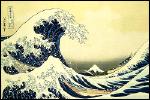
One of the gifts I got from my family for Christmas was a jigsaw puzzle version of Katsushika Hokusai's iconic woodprint the Great Wave of Kanagawa. Of all the works of art that I have seen in my lifetime, it is the one which resonates the most with me, so I was happy to have the chance to spend some time with it each day over the last few weeks, especially since the cold and rain have been keeping me mostly indoors anyway. Took a while to complete the 1000-piece puzzle, and I was convinced at many points along the way that there were pieces missing, but no, I finished it up this morning:


The Great Wave is an image of artistic virtuosity that works both as a dramatic image and as a philosophical allegory of sorts. It's made up of essentially four elements: the sky, which takes up fully half of the picture; the three boats in the foreground, with the oarsmen—more than twenty of them—huddled against the force of the waves; the great wave itself, looming large and about to break over the boats; and—off in the distance, framed by the sky, the boats, and the water— snow-covered Mt. Fuji.

The drama of the image is explicit. It's a bad day on the water; the waves are threatening; the men—presumably fishermen out trying to wrest a living from the water—are in mortal danger. The looming blue wave itself—and its somewhat smaller echo below— is rendered in stylized detail, its myriad little white fingers reaching  out like talons as the wave begins its precipitate descent toward the sailors bowed helplessly against its power. The wave is terrifying, but it is also very beautiful: Hokusai has gone to extreme lengths to render the wave's colorations, including long curling arcs of royal blue to help define the shape of the otherwise nearly jet-black water. Even the sea-spume is rendered, thousands of little white droplets of water and mist pervading the air over the boats, frozen just before the moment of impact.

For me, this picture has always seemed an allegory the human condition. Life is always to some degree a matter of turmoil: work to be done, food to be procured, challenges to be met, dangers to be confronted. The daily vicissitudes of life can be pleasurable, but they can also be painful, and at times overwhelming. The wave is for me the emblem of imminent danger, the reminder that at any given moment failure is possible, and even total destruction not out of the question.

And yet, that's not, as they say, the whole picture. In the midst of turmoil, we are also surrounded, and grounded, by something else, something which is not usually at the forefront of our consciousness but which nevertheless exists and endures. In this picture that presence is represented by Mount Fuji, dwarfed by the wave, occupying only about one twentieth of the overall image. But we can recognize that as a trick of perspective. In reality, of course, Mt. Fuji is larger than the wave by many orders of magnitude. If the perspective were reversed and we were looking at the wave from the summit of Mt. Fuji, the waves would be barely noticeable, and humans in their boats not visible at all.

I see the presence of Mt. Fuji in the picture—Hokusai could just as easily have left it out—as being symbolic of that which is permanent, changeless, and enduring in the world, both in the physical sense (the waves will break and dissipate, the mountain will likely be there forever) and in the spiritual sense (in the midst of turmoil of human life, and even perhaps beyond the life of the body itself, there is nonetheless a locus of centeredness, of stillness, of peace.)

Mt. Fuji can thus be seen as representing a kind of spiritual ideal. Pretty much all of the many forms of Buddhism make reference to the concept of the Buddha nature: the potential we have within us to achieve absolute happiness. If we assume this to be the case, the obvious operational question to ask would be "How do we manifest our Buddha nature? How do we bring it forth?" Each form of Buddhism has its own answer to that question, its own practice. Some Buddhists meditate, some chant, some take vows of poverty, some garden, some write, some retreat from the world, some go into the world to do good works.

Hokusai himself had something to say about the nature of practice. It's one of my favorite passages of any kind in literature. (It's been on the sidebar of this blog since its inception.) I've seen various translations of it, but this is the one that I think is most relevant here.

From the age of six I was in the habit of drawing all kinds of things. Although I had produced numerous designs by my fiftieth year, none of my works done before my seventieth is really worth counting. At the age of seventy-three I have come to understand the true form of animals, insects and fish and the nature of plants and trees. Consequently, by the age of eighty-six I will have made more and more progress, and at ninety I will have got closer to the essence of art. At the age of one hundred I will have reached a magnificent level and at one hundred and ten each dot and each line will be alive. I would like to ask those who outlive me to observe that I have not spoken without reason.

The passage dates from 1833, as Hokusai indicates, he was 73 years old. He lived another 13 years, so he clearly never reached the final pinnacle of artistic excellence as he himself envisioned it. Nor—and this is perhaps not obvious, but crucially important to understanding his point—did he expect to. That's what I love about his last sentence: "I would like to ask those who outlive me to observe that I have not spoken without reason." He knew he wasn't going to live that long. And he knows we know it as well. How long one lives is not what matters. Hokusai became a master of one of the most difficult of artistic mediums* and left an archive of artworks which will continue to inspire appreciation and contemplation for as long as humans walk on this earth. That's perhaps as close to transcendence as any of us might hope to come.

* Special bonus: Here's a fascinating process-analysis video showing the work of a contemporary master of the woodcut.


Monday, April 30, 2018

The Poet


The Poet (RBS Collage)


The Poet

Out on the water
I can think, or
rather give up
thinking altogether—

the afternoon hills
bathed in sunlight,
the glistening water
on fire, the scull

itself gliding oh so
lightly as if through air,
bearing me to a place
I seek but cannot see. 


Friday, April 6, 2018

Drawing as Exploration


Put the point of the pen down
somewhere in the upper left
corner of the paper, and move
your hand, leaving a mark, an angle,
a curve, a line that moves away
and then comes back to connect
with itself. So now there's a shape,
and that shape sets the direction
for the next, which must of necessity
be similar or different, larger or
smaller, closer or farther away.
Now there are two, now three,
now twenty. Along the way questions
arise. How long, for example, before
whatever patterns begun by accident
should by design be broken? How much
of the surface should be inked, how
much left white? How close to the edge?
What about the negative spaces?
Inking is another story, silent, automatic,
eye and hand in motion, mostly
without thought. Music can help
to mark the time, set the rhythm
and the feel. It will take longer
than you think. Often the pen tip
starts to fray, or the ink dries up.
Switch pens. A pen with a big tip
makes the work go faster, but
if your hand strays it's harder
to correct the mistake. Hold
your breath, pay attention, learn
to trust your hand. When
the drawing is done, touch up
the tiny white spots with a fine-
tipped pen, and you're done.
Step back and see what you've got.


-->


Tuesday, October 14, 2014

64 x 60 (Nothing Is…)


I started drawing tonight on a piece of paper five and a half inches square. It's basically a backwards drawing: inking in the black spaces creates the white lines. Right now, it looks like a collection of black shapes on a white background, but once it's done, it'll be a latticework of white lines against a black background. Nothing is but what is not.


Friday, September 26, 2014

The Fruited Plain


The Fruited Plain


This is an assemblage that I put together today from wood scraps. I made and painted the shadow box yesterday, so today it was a matter of selecting the pieces to be included and figuring out how they would go together. The starting point was the brownish square piece at the top right. I knew I wanted to use that, and I knew I wanted some strong colors, so I cut the yellow piece to match the width of the brown piece and then trimmed the long piece with the cracking paint on it to a size that would make the whole thing a square.  There had originally been raised strip of wood in the center of the brown square, and I tried gluing that in, but I didn't like the effect and decided to inlay the blue-grey strip into the groove that was already there. The last addition to the surface was the horizontal white bar, which was actually a leftover piece from a cut I had done earlier, so I glued and clamped it on and it fit right in.

When the central square was done, it occurred to me that I could frame that square with some strips I had of 1/4" plywood that had already been painted a golden yellow color that went well with the other tones in the piece, so I cut the strips to fit, glued them, and clamped the whole thing up to dry. A couple of hours later I went back, took the clamps off, and then glued the whole thing into the shadow box and clamped that up.

While it was drying, I was thinking about a title. The overall amber tone got me thinking about amber waves of grain, but that felt a little too literal and potentially misleading, and so I took one and a half steps sideways and wound up with The Fruited Plain, an oblique tribute to American abundance, the harvest season, and the gesture of making something attractive out of what other people have thrown away.


Friday, September 12, 2014

Disclaimer


It occurred to me as I was falling asleep last night (which is when many of my more generative ideas arise) that the post I had written might be giving the impression that I think of myself as some sort of new-age adept, an evangelist of attentiveness and deep meditation. Nothing could be further from the truth. It's precisely because I find those kinds of states so infrequent and ephemeral that I honor the attempt to seek them out. They certainly don't happen spontaneously, at least for me. There were a couple of posts on Tumblr today that showed a cartoon panel of a woman with her hand on the side of her face and her eyes downcast, as if she were thinking, but there were different captions on each of the  posts. The one that stuck in my head, and that I in fact wrote down in my newly created Spark File—a new section of my not-so-newly created commonplace book—was this:

You will find exactly what you are looking for, and it will not be enough.

That little epigram pretty much sums up, IMHO,  the dilemma of human experience. Even when we get what we want, we are not satisfied. (There's a parallel formulation that has the disadvantage of having become a cliché: Be careful what you wish for; you might get it. Cliché it may be, but that doesn't mean it's not accurate.) For most of us, most of the time, function is indeed smothered in surmise, and nothing is but what is not.

I spent my teenage and college years in the sixties, and there were lots of people like Baba Ram Dass (nee Richard Alpert) going around encouraging us to learn how to "Be Here Now." Put that way, it seemed easy enough. But it wasn't, and it isn't. Because it's not in our nature. At least it's not in mine, nor in anyone's else's that I have ever met. The closest I have been able to come to that state of present-mindedness is when I am doing artwork, when the part of my brain that is thinking about what happened yesterday and what is going to be happening tomorrow and what I should have said to Alpha or what I'm going to say to Beta gets shut down, when the whole verbal apparatus of my brain gets shut down and all I am attending to is what is under my hands and in my line of vision.

That may be one reason why I generally find abstract or art more satisfying than representational art: it exists unanchored and is essentially inexplicable, which is a kind of relief. (It can be entertaining to read the tortured and irrelevant prose the self-appointed explicators come up with when they DO try to find words to describe what they think they see. But I've read a ton of it, and my observation is that there isn't anyone who does it well, with the possible exception of Robert Motherwell, who presumably knew whereof he spoke. Mostly it's a matter of trying to find people who do it less badly than the ones who are flat out full of shit, and the woods are full of them.)

An example might help. Here's something I completed yesterday. It consists of black paper torn and mounted on black cardboard. When thought I was done I looked down on the floor and saw a scrap of purplish paper lying there and more or less on impulse I picked it up, tore the edges to make it feel more like family, and put it on last.


So there it is. I like it. While I was working on it, I wasn't doing a lot of discursive thinking. I was just working. Or, to put a different spin on the same idea, just having fun. I have no idea what it is, or what it means. Maybe you do. (Feel free to interpret. I'd be curious. And you couldn't do any worse than what shows up in the average museum catalog.) It is, like most of my art, and most of the artworks I respond to, self-enclosed: a world of its own. Any resemblance to the world we actually inhabit on a daily basis—or believe ourselves to inhabit, which is an essay for another day—is either coincidental, or so deeply buried in the central core of my brain that I have no ready access to it. It is merely an artifact of experience, a fossil from which a method and motivation could be inferred only if accompanied by a grain of salt.


Friday, August 29, 2014

64 x 29 (Priced Out of the Picture)


Visited a store downtown today, saw a competent little framed collage hanging on the wall. I asked the price. Saleswoman took it down and checked: $395. At $200, I would have thought about it. At $125, I would have bought it. Most of the artwork I see is overpriced by 100 to 200 percent, IMHO. Lower prices would put more art into more hands.


Sunday, August 24, 2014

64 x 25 (Striplings)


I had set out acrylics for the kids to paint some ceramic medallions they had made the last time they were here. Just before we went to clean up, I grabbed a roller and ran it over the leftover puddles of color in the mixing pan, then rolled out a couple parallel segments on heavy white paper. Boom! Sometimes things just fall into place:

Striplings